







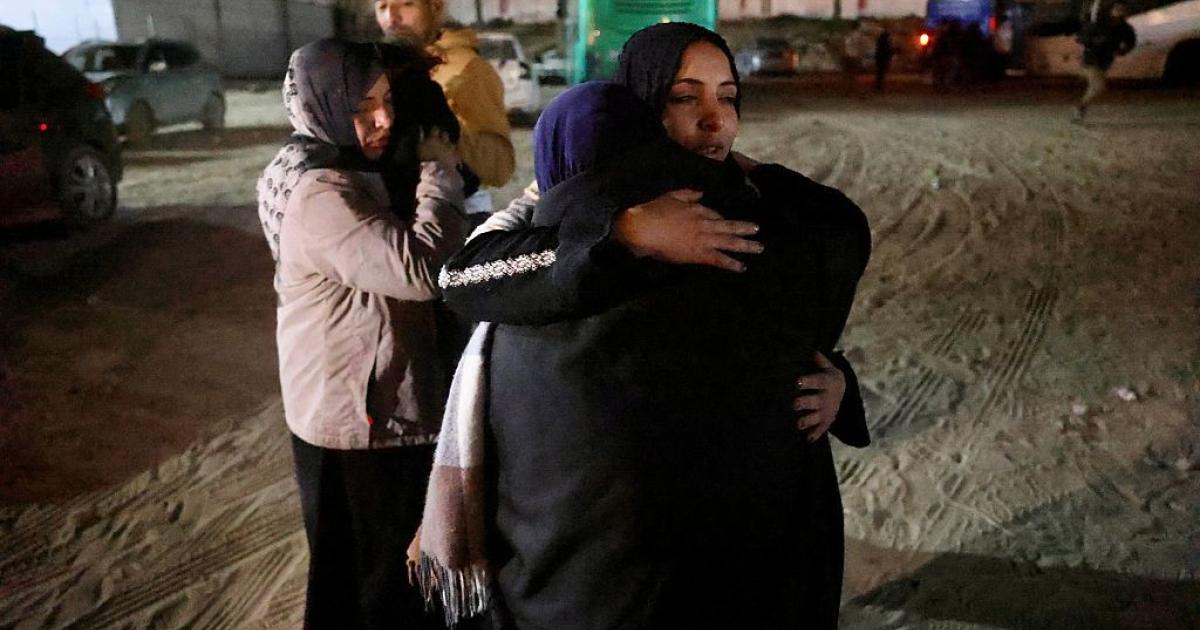
The moment of the release of the disabled prisoner Yahya Abu Seif from the Gaza Strip was not just a return to freedom, but an unveiling of the cruelty and helplessness he experienced behind bars. Abu Seif, who lost most of his family members in the war, found himself a sick prisoner confined to a wheelchair, which did not spare him from the Israeli machine of abuse.
In the notorious 'Sde Teiman' prison, Abu Seif spent a full year, which he described as the longest and worst in his life, struggling with his ailing body in the absence of the most basic care. The prison administration denied him the use of his wheelchair for movement, turning his daily life into a series of arduous stations that required superhuman patience.
Abu Seif's story embodies the suffering of thousands of Palestinian prisoners who face a daily struggle with illness in conditions lacking the minimum healthcare. For these individuals, prison is not just walls, but a state of forced helplessness imposed on them amidst continuous isolation and interrogation policies.
In a related context, the tragedy of prisoner Fadi Abu Al-Subh stands out. He was arrested in 2019 while on his way for treatment, and the occupation authorities refuse to release him despite the expiration of his sentence. The prison administration uses emergency laws and new war regulations to extend his detention indefinitely, intensifying the pain of his family who await his release.
Abu Al-Subh's mother states that her son suffers from multiple fractures and metal plates in his legs, yet he is denied treatment or transfer to a hospital. The family considers what Fadi is subjected to as a slow death sentence, given his continuous transfer between Ashkelon, Nafha, and Ramon prisons under extremely harsh conditions.
Data from human rights sources indicate that the number of prisoners in occupation prisons exceeded 9,600 prisoners and detainees by early April 2025. Among these are hundreds of children and women, in addition to over 1,200 prisoners suffering from chronic and serious illnesses that directly threaten their lives.
The prisoner movement has recorded the martyrdom of over 89 prisoners as a result of deliberate medical negligence policies or physical torture inside interrogation centers. Among the martyrs are 52 detainees from the Gaza Strip who died under mysterious circumstances, reflecting the extent of grave violations committed away from international oversight.
Abdullah Al-Zaghari, head of the Palestinian Prisoner's Club, affirmed that the number of prisoners suffering from serious diseases such as cancer and kidney failure is continuously increasing. He explained that the suffering does not stop at illness, but extends to systematic malnutrition and the deprivation of prisoners from clean water and essential medicines.
Prison administrations follow retaliatory policies that include cutting off water for long periods and preventing bathing, in addition to systematic physical assaults that escalated after October 7th. These practices have led to a severe deterioration in the psychological and physical condition of prisoners, especially those held in army camps.
For his part, Islam Abdo, an official in the Ministry of Prisoners, described the file of sick prisoners as one of the most dangerous aspects of violations inside Israeli prisons currently. He pointed out that the deliberate delay in conducting medical examinations and transfers to hospitals aims to physically exhaust prisoners and slowly eliminate them.
Ahmed Abu Ras, a specialist in prisoner affairs, believes that the occupation uses clinics inside prisons as a mere formality for international organizations. In reality, prisoners do not receive any real treatment, but their surgeries are postponed for years, often leading to the exacerbation of the disease to an incurable degree.
Human rights calls for urgent international intervention to save the lives of sick prisoners and provide them with protection in accordance with the Fourth Geneva Convention are increasing. Observers believe that international silence towards these crimes encourages the occupation to continue its policy of enforced disappearance and depriving prisoners of Red Cross visits.
Issam Abu Daqqa, a member of the Prisoners' Committee, stressed that the issue of sick prisoners must remain at the top of the humanitarian and political priorities for Palestinians. The right to treatment and dignity is a fundamental right that cannot be compromised, and the continued detention of critical cases constitutes a full-fledged war crime.
In conclusion, human rights organizations affirm that what is happening in prisons represents a real test for the international justice system, which stands helpless before the occupation's aggression. Saving the lives of sick prisoners is an immediate duty that cannot be postponed, especially given the catastrophic conditions left by the ongoing war on the Gaza Strip.
I spent the longest and worst year of my life in Sde Teiman prison, where I faced my illness and helplessness before facing the jailer.
شارك برأيك
Testimonies from 'Sde Teiman': Disabled Prisoners Face Slow Death in Occupation Prisons