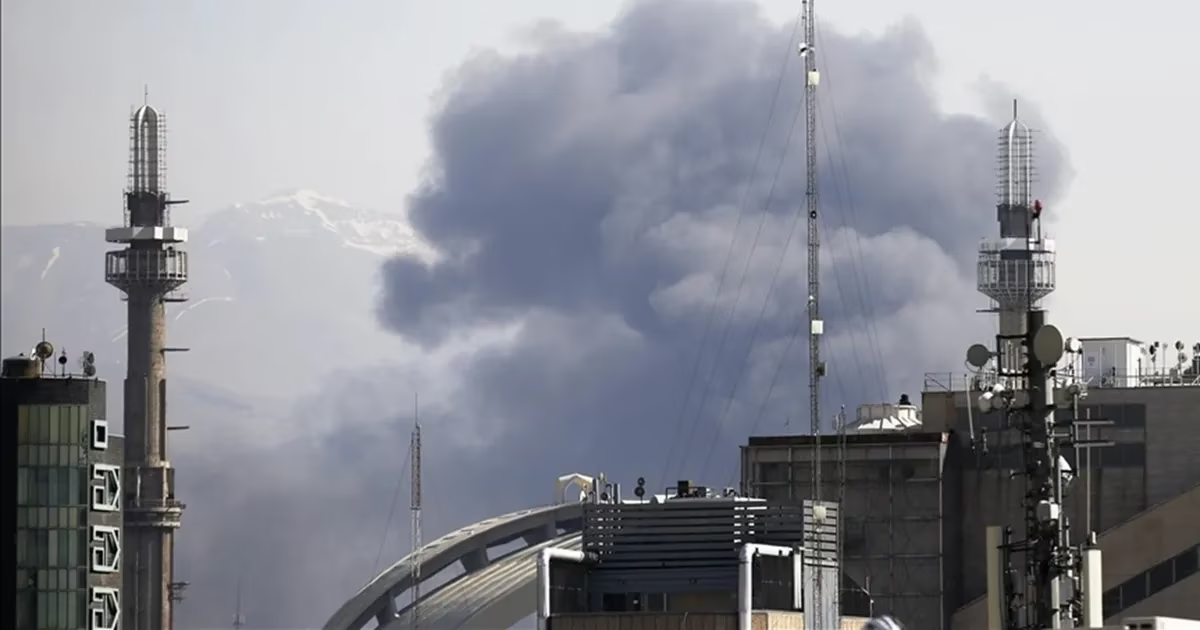







Major General (res.) Yaakov Amidror, former head of the Israeli National Security Council, emphasized that the Iranian state possesses elements of resilience that make its surrender in the near term highly unlikely. In press statements, he explained that Iran differs fundamentally from many regional states he described as 'artificial,' given its deep political and cultural structure and well-established institutional roots.
Amidror pointed out that betting on the collapse of the Iranian regime immediately after receiving major military strikes is a mistaken assessment not based on an understanding of the nature of the state there. He considered that any retreat by the regime due to pressure would not necessarily lead to the disappearance of the state, but might open the door for limited opposition movements without affecting its core ability to threaten Israeli interests.
Regarding the American role, the former security official revealed the existence of extensive military preparations led by Washington against Tehran. He affirmed that U.S. forces have amassed a deliberate campaign that goes beyond mere transient responses, as it includes multi-stage strategic options aimed at systematically undermining Iranian influence in the region.
The scenarios presented to the American administration, according to Amidror, include the possibility of working to open the Strait of Hormuz by military force if it is closed, in addition to the option of occupying the vital Kharg Island. Plans also include targeting uranium extraction facilities to ensure the paralysis of Iranian nuclear capabilities and prevent them from reaching the military manufacturing stage.
Amidror explained that these military options would be presented to the U.S. President for final decision, stressing that the current strategy relies on the gradual destruction of capabilities. He believes that the continuation of military operations serves Israel's interests, as each day of confrontation reduces Iran's relative strength and increases the pressure on its leadership.
He also noted precise coordination between Israeli and American forces to target dozens of vital sites deep within Iranian territory. These targets include major steel factories and sensitive military installations, with the aim of weakening the infrastructure that supports the Iranian war effort and its allies in the region.
On the northern front, Amidror affirmed that the Israeli army continues its operations against Hezbollah in Lebanon with high focus, but without allowing this front to distract from the main objective. He explained that military movements are primarily aimed at pushing Hezbollah's capabilities north of the Litani River and securing border settlements from any direct threat.
The former official ruled out a large-scale ground attack in Lebanese territory at present, considering that the current strategy favors active defense in southern Lebanon. He noted that most of the rockets launched by Hezbollah currently target Israeli troop concentrations, keeping the confrontation within tactical control limits.
Amidror mentioned that refraining from expanding operations in Lebanon allows the Israeli Air Force to concentrate its full power towards Iranian targets without the need to distribute air efforts. He considered that this policy makes operations more effective and ensures not being drawn into a long war of attrition in two different places simultaneously.
He affirmed that the ultimate goal remains the elimination of threats posed by organizations he described as 'terrorist,' but according to a timing that serves supreme strategic interests. He stressed that full military force would be used at the moment that guarantees decisive action without endangering other fronts.
In the context of his analysis of the nature of the conflict, Amidror called for a deep understanding of regional complexities before making fateful decisions. He explained that dealing with Iran requires patience, continuous and cautious planning, away from optimistic expectations of a rapid collapse of the regime due to external military pressure.
He pointed out that continuous air operations contribute to the erosion of Iranian deterrence, a path that must be maintained to ensure Israeli superiority in the region. He considered that success in this mission depends on close coordination with international allies, especially the United States, to ensure political and military cover for operations.
Amidror concluded by emphasizing that Israel will not allow developments in Lebanon to divert it from its strategic path towards Tehran. He considered that protecting the eastern sector and west of the Litani River represents a current defensive priority, while the Iranian file remains the existential challenge that requires the focus of all intelligence and operational efforts.
These statements come at a time when the region is witnessing escalating tensions, with international circles awaiting the nature of mutual responses between active parties. Amidror's vision reflects a trend within the Israeli security establishment that favors measured and organized escalation rather than rushing into comprehensive confrontations with uncertain outcomes.
Iran is a real state with clear organization, academia, and institutional strength, and anyone who expects its rapid collapse after military strikes is completely mistaken.
شارك برأيك
Former Israeli National Security Council Head: Iran is a Resilient State and Will Not Surrender to Military Strikes