






The aggressive war launched by US President Donald Trump against Iran has entered its third week, amidst what can be described as an 'American predicament.' The White House faces an impasse in achieving its strategic goal of overthrowing the Islamic Republic regime and transforming the country into a تابع (follower) orbiting in the American and Zionist spheres.
Observers believe that from the very first moment, Trump sought to replicate the Venezuelan scenario in Tehran, coveting control over Iranian resources and neutralizing the largest strongholds of resistance in the region. However, this plan encountered unexpected obstacles due to the cohesion of the Iranian internal front, despite the intensity of the American firepower used.
This war has created a kind of Arab and Islamic consensus rejecting the aggression, not necessarily out of love for the Iranian regime, but out of fear of the repercussions of upsetting the balance of power in favor of the Zionist project. Regional countries realize that Trump's success in his endeavor would threaten the political and existential map of all neighboring countries without exception.
Despite the martyrdom of Imam Ali Khamenei in the first week of the confrontation, Iran demonstrated strategic steadfastness that surprised Western intelligence circles. Tehran absorbed the initial military shock and quickly moved to a phase of organized response at political, military, and popular levels.
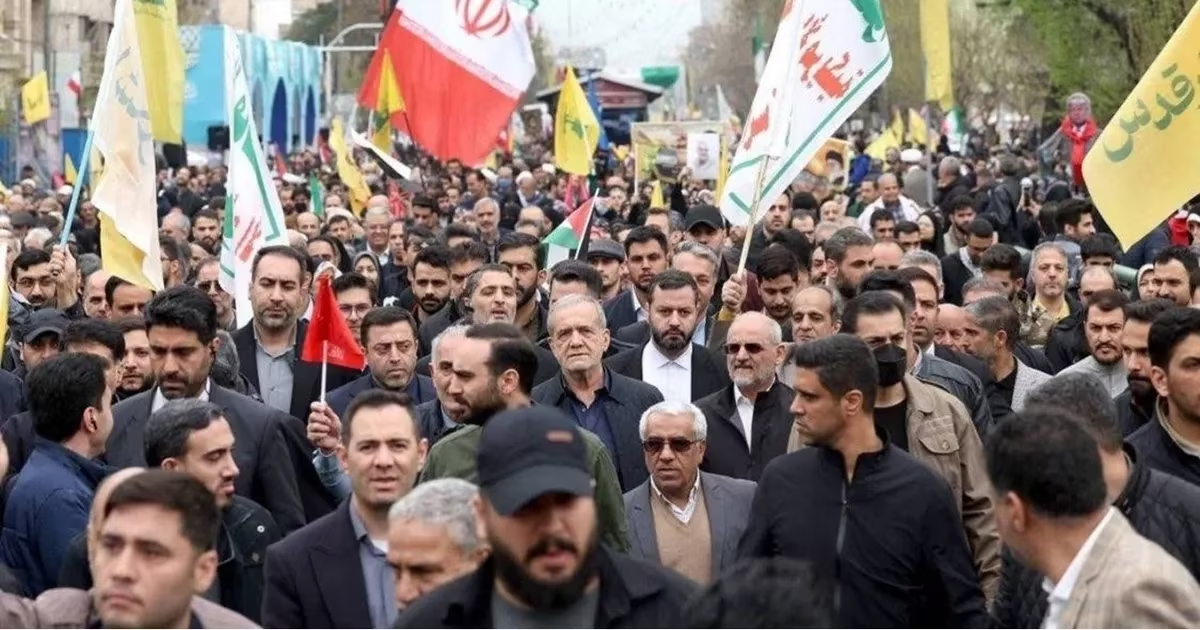
Iranian cities witnessed millions of citizens taking to the streets in massive demonstrations, confirming popular support for the new leadership. This popular movement sent a clear message to Trump that the war would not be a short stroll, but a long-term, systematic, and popular confrontation that would not accept surrender.
At the beginning of the third week, Imam Mojtaba Khamenei assumed leadership, and Iran began to impose counter-conditions that mediators conveyed to the American side. The new leadership insists that any understanding for a ceasefire must be comprehensive for the entire region, rejecting any partial solutions related to Iran's internal affairs alone.
Military operations in the second week evolved to take on a coordinated regional character, manifested in the night of joint shelling between the Revolutionary Guard and Lebanese Hezbollah. This direct field coordination disrupted American and Zionist calculations and proved that the resistance front operates according to a unified operations room.
The escalation was not limited to the Lebanese front but extended to include the effective and influential entry of the Iraqi Popular Mobilization Forces into the confrontation. This expansion of the conflict area confirmed the failure of the strategy to isolate Iran and turned the war into a widespread attrition that threatens American interests in several countries.
Israeli Prime Minister Benjamin Netanyahu is betting on American technological and air power to decide the battle, but field realities have proven the limitations of this bet. Despite overwhelming technical superiority, missiles and aircraft have not succeeded in breaking the will of the fighters in the Revolutionary Guard, Basij, and the Iranian army.
Trump is currently experiencing a state of despair regarding the possibility of achieving a quick victory or bringing about a radical change in the structure of the Iranian political system. The steadfastness shown by Tehran in the first and second weeks has presented the American administration with choices, the least bitter of which is still harsh, amidst increasing international pressure to de-escalate.
The military buildup assembled by Trump, the largest since the end of World War II, has not succeeded in extracting an unconditional Iranian surrender. On the contrary, Washington is now seeking diplomatic exits to save face before its allies and adversaries alike.
The current experience has proven that absolute air superiority does not necessarily mean winning the war on the ground, especially against peoples willing to sacrifice. The millions of masses who filled the squares formed a political shield that cannot be penetrated by smart missiles or concussion bombs.
World capitals are awaiting what the coming days of the third week will bring, in light of the hardening Iranian stance and the expansion of the engagement circle. It appears that the American bet on 'shock and awe' has eroded against the reality of 'war of attrition' mastered by regional forces allied with Tehran.
In conclusion, 'Trump's predicament' remains the title of the current phase, as he finds himself stuck in a war with no clear end in sight. While Washington was expecting a phone call requesting surrender, it is now receiving harsh conditions to restore calm to the inflamed region.
It has been proven that control of the air, no matter how great the initial shock, does not win a war against a composed leadership and millions of people.
شارك برأيك
Trump's Predicament in the Third Week: Iranian Resilience and Expanding Fronts of Confrontation