






The military confrontation between the US-Israeli alliance and Iran has entered a critical phase in its third week, with observers noting that this conflict has become the greatest burden on the structure of US national security since the end of the Cold War. Sources reported that the US administration was forced to withdraw air defense systems and troops from strategic areas in East Asia and Europe to compensate for shortages on the Middle East front, raising questions about its efficiency and ability to manage multiple crises simultaneously.
On the ground, Washington boasted of targeting some 6,000 sites within Iranian territory in attacks that began with a swift strike that killed Supreme Leader Ali Khamenei. Despite these intensive strikes, the Iranian government showed no signs of imminent collapse, as Mojtaba Khamenei was appointed to succeed his father, while President Masoud Pezeshkian and security officials appeared in the streets of Tehran, confirming the regime's continuity.
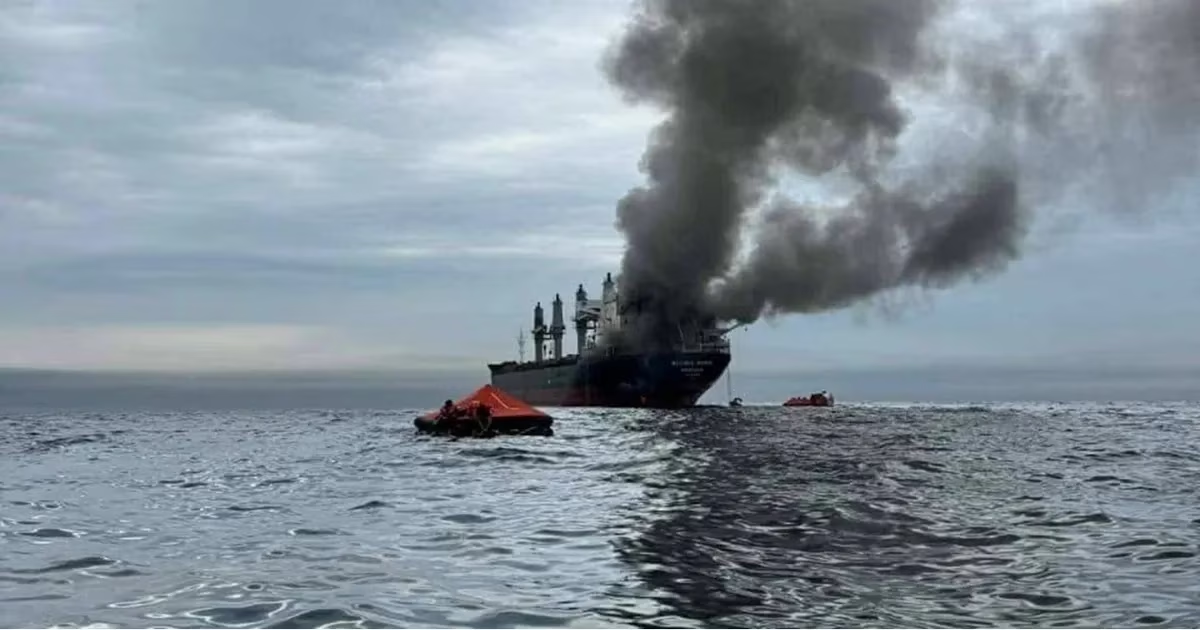
The war caused severe disruptions in the global energy market, especially with the closure of the Strait of Hormuz, through which 20% of the world's supplies pass. Sources indicated that Iran, despite continuous raids, managed to target at least six ships in the strait, in addition to launching a missile strike that shook Tel Aviv, reflecting its ability to inflict severe damage on the infrastructure of its opponents and their allies.
Fawaz Gerges, a professor of international relations, described this moment as a new 'Suez Crisis' for the United States, likening the situation to what happened to Britain and France in 1956. Gerges considered the failure to protect waterways and secure allies as a decline in the prestige of the superpower, emphasizing that the world is heading towards a more chaotic multipolar system with the erosion of American credibility.
In the Gulf region, Washington's traditional allies began to re-evaluate their security bets as a result of what they described as uncertainty in American commitments. Saudi Arabia signed a mutual defense agreement with Pakistan, while the UAE moved to strengthen its military relations with China, a step reflecting the desire to diversify security sources away from total reliance on US bases that no longer provide adequate protection against cheap drones.
The repercussions of the conflict extended to East Asia, where South Korea expressed deep concern after the withdrawal of 'Patriot' and 'THAAD' systems from its territory and their transfer to the Middle East. Experts believe that reducing the US military presence in the Indo-Pacific region serves Chinese interests and weakens deterrence against North Korea, casting doubt on US defense commitments to its Asian allies.
In Europe, NATO was forced to transfer surveillance equipment and air defense systems from Germany and Greece to support US bases in Turkey and Romania. This move coincided with immense economic pressure on European countries suffering from the disruption of fuel supplies from the Gulf, prompting the Trump administration to ease sanctions on Russian oil in an attempt to curb soaring global prices.
Reports indicated that major countries such as France, Italy, and India began direct communication channels with Tehran to secure the passage of their tankers through the Strait of Hormuz, a clear bypass of the American leadership role. This independent diplomatic move reflects a loss of confidence in Washington's ability to enforce order in international maritime lanes, which had been a cornerstone of its global hegemony for decades.
In the context of military movements, the Pentagon sent the amphibious ship 'USS Tripoli' with thousands of Marines from Japan to the region in an attempt to bolster its field presence. However, analysts believe that these movements further drain US resources and make deployed forces easy targets for Iranian missile attacks, which have proven effective despite the sanctions imposed on Tehran for forty years.
The report noted that Russia is playing a supporting role for Iran in confronting US attacks, which President Trump himself acknowledged. This Russian-Iranian cooperation further complicates the military landscape, as Tehran benefits from technical and intelligence support to counter the superior military technology of the US-Israeli alliance, prolonging the conflict and increasing its human and material cost.
On the internal political level in Iran, American bets on a popular uprising to overthrow the regime after Khamenei's death failed. Instead, the military and security establishment appears to have tightened its grip, maintaining the ability to threaten regional capitals with 'Shahed' drones that deplete expensive American interceptor missiles in a clear strategy of attrition.
Professor Peter Frankopan considered the real problem the United States will face in the future to be 'loss of credibility,' as Washington opened 'Pandora's Box' without a clear post-war plan. He explained that restoring international trust in American power will take years, especially after the war proved that regional powers are capable of challenging American will and causing paralysis in global trade.
Gulf states face increasing pressure to engage directly in the war, which most of these countries refuse for fear of their oil facilities being subjected to retaliatory strikes. This pressure has accelerated the pace of 'strategic diversification,' as these countries seek weapon systems and security investments from China and other countries, threatening the American monopoly on the arms market in the region.
In conclusion, experts believe that the results of this war will inevitably lead to a redefinition of the balance of power, as the United States is no longer the sole power capable of imposing stability. With continued mutual shelling and tension in waterways, the old world order appears to be fading in favor of a new reality where decision-making centers are diversified and unipolar hegemony declines.
We are witnessing a 'Suez Crisis' moment for the United States, as this conflict represents an imperial overreach that could lead to a more chaotic and multipolar world.
شارك برأيك
Iran War Puts US Hegemony to the Test: A New 'Suez' Crisis Reshapes the Global Order