






Concepts of control in international politics have undergone fundamental transformations over the past centuries, shifting from direct military occupation of land to more complex methods. After World War II, colonial powers abandoned large armies in favor of a strategy of managing balances and conflicts between local powers in vital regions.
This approach relies on ensuring that no regional power capable of imposing self-stability or unilateral hegemony emerges, thereby keeping the region in a constant state of need for external intervention. In the Middle East, this has been clearly manifested through the continuous competition between multiple poles including Turkey, Iran, the Arab system, and Israel.
The state of fragmentation that the region has experienced for decades created an unstable balance, which allowed major powers to influence political trajectories from outside without the exorbitant costs of occupation. This idea is based on the principle of selective support and shifting political pressures to ensure that everyone remains in a state of mutual attrition.
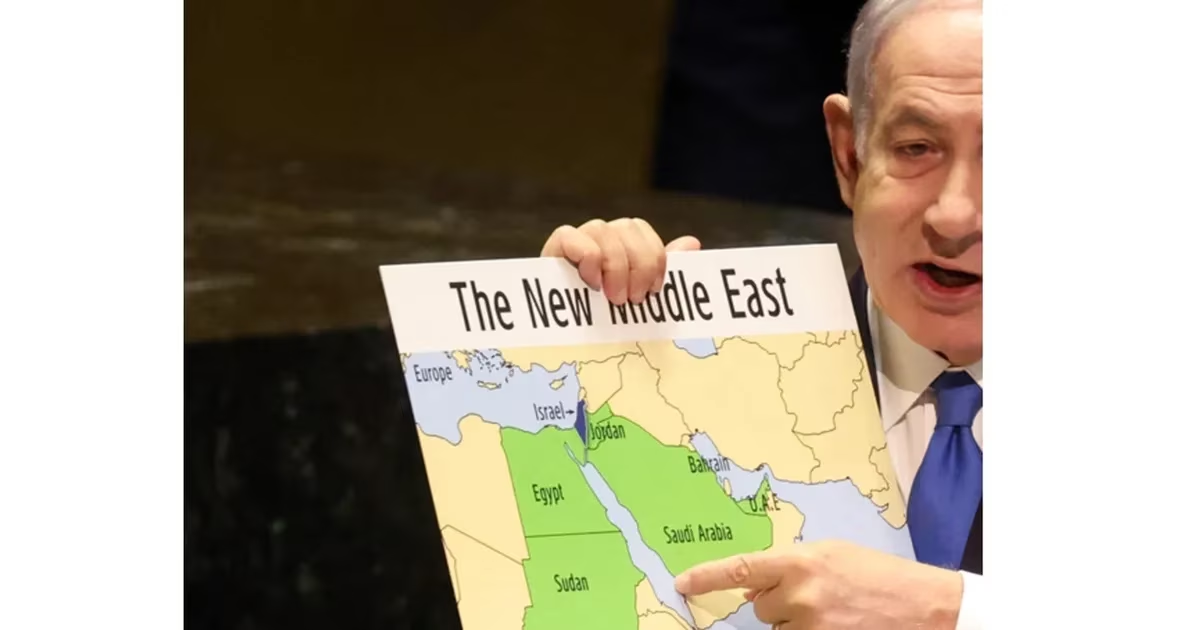
While major powers previously contented themselves with the role of a 'maestro' managing chaos, current transformations indicate a desire to end this traditional model. There appears to be a new trend leaning towards favoring a single regional actor to be the exclusive agent and hegemon over the affairs of the entire region.
Israel emerges in this scene as the primary candidate for this leading role, supported by overwhelming technological and military superiority and an unwavering American political cover. This shift means moving from a stage of managing fragile balances to a stage of imposing a new regional order centered around Israeli power.
The fragmented regional environment and internal wars in several Arab countries have paved the way for this structural change in the geopolitics of the region. The requirement is no longer merely to contain adversaries, but to definitively diminish them to prevent them from obstructing the new path being drawn by major international powers.
This context explains the unprecedented military and political escalation against regional powers that reject this arrangement, foremost among them the axis led by Iran. The current confrontation is not merely a border conflict, but a war over the shape of the coming regional order and who will lead it in the coming decades.
For its part, Tehran realizes that the success of the 'single central power' project means the end of its regional influence and a direct threat to its political entity. Therefore, Iran is striving with all its might to disrupt this transformation through military strategies aimed at reproducing the state of chaos that allows it to survive.
Iranian attempts to restore the 'chaos management' model include expanding the scope of the conflict to include Gulf states and other areas, sending a message that stability will not be achieved without it. This distribution of bombardment and tension aims to prove that the cost of favoring Israel will be exorbitant for everyone.
The ongoing conflict in Gaza, Lebanon, and other arenas is but one chapter in the reshaping of geopolitics. The issue has gone beyond historical rights to become an existential struggle over who has the right to manage the Middle East and determine its strategic destiny.
Amidst this scene, Arab countries find themselves facing fateful challenges, as their traditional role recedes in favor of non-Arab regional powers. This reality necessitates a re-evaluation of alliances in light of an international system that no longer believes in multipolarity within a single region.
The transition to the 'central power' phase will necessarily lead to a change in the nature of security and economic alliances in the region. Political agreements will not merely be fleeting understandings, but will be part of a solid security structure led by the new dominant power under international supervision.
In conclusion, the Middle East stands on the threshold of a historical phase that may end a century of managing anxious balances. Whether attempts to impose a central power succeed or Iran continues to impose 'chaos management,' the only constant is that the old form of the region has irrevocably ended.
The region is moving from a stage of chaos management through multiple balances to a rearrangement of the region around a single central power.
شارك برأيك
From Chaos Management to Unilateral Hegemony: Geopolitical Transformations in the Middle East