






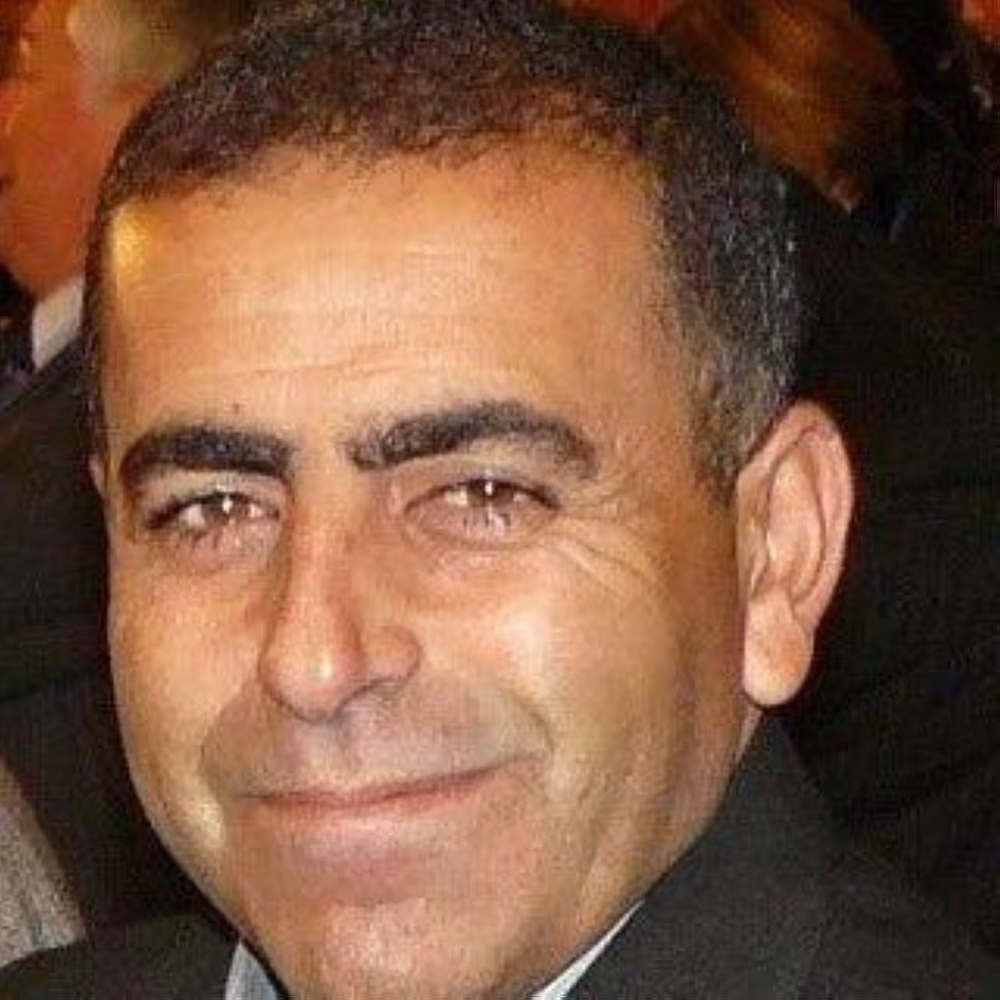
Dr. Ibrahim Nairat
In the world of international politics, the words of leaders have become more powerful than any traditional weapon. Donald Trump's statements are not just fleeting remarks, but a political tool that moves markets, redraws the calculations of allies and adversaries, and sometimes opens new paths to crises. Amidst the war with Iran, his contradictory statements and strategic ambiguity reveal a unique way of managing crises, while a consistent clarity appears in his stance towards Israel. This contrast presents world leaders with a practical lesson: how to distinguish between a media storm and a strategic decision, and how to deal with Trump cautiously and intelligently.
Since his arrival at the White House, Trump has adopted a different approach from traditional diplomatic methods. He has embraced a direct and confrontational rhetoric, often announcing his positions through the media, making his statements daily fodder for discussion and spreading rapidly, sometimes exceeding the boundaries of traditional politics.
However, the war with Iran exposed the limits of this approach and raised serious questions about the nature of political discourse during times of military crisis. Amidst military operations, Trump made contradictory statements within a short period: from declaring the war "completely over" to asserting that military operations would not stop before achieving a "complete defeat of the enemy." These rapid shifts created confusion among observers and contributed to global market volatility.
The problem escalates when the strategic objectives of the war are not precisely defined. Statements varied between destroying Iran's nuclear program, crippling Tehran's missile capabilities, bringing about a change in political leadership, and ultimately imposing "unconditional surrender." While these objectives seem interconnected, each requires a different level of military and political escalation, leaving the fundamental question: what is the ultimate goal of the war? Does Washington seek only to weaken Iran militarily, or to change its political regime?
Matters were further complicated by complex regional balances and economic interests related to energy corridors, especially the Strait of Hormuz, one of the most important arteries of global oil trade. The escalation of the confrontation led to disruptions in navigation and trade, which directly impacted global markets.
And the impact did not stop at the war's boundaries but extended to how other countries deal with American rhetoric. Allies and adversaries found themselves facing a dilemma: are these statements official policy or merely shifting political discourse?
In this context, many world leaders began to learn how to deal with Trump based on his contradictions. They realized that every statement does not necessarily mean official policy, but could be a means of testing reactions or a tactic for political pressure. This awareness made them more cautious, as the focus shifted to monitoring actual actions and policies rather than being drawn into every media statement.
Perhaps what distinguishes Trump's style is his use of strategic ambiguity with most countries of the world, in contrast to complete clarity in his stance towards Israel. While he creates contradictions to confuse and control reactions, his position on Israel remains constant and consistent, as demonstrated in several situations:
Close coordination with Israel in the war against Iran, where Trump indicated that any decision to end operations would be in consultation with Israeli Prime Minister Benjamin Netanyahu, reflecting a high degree of cooperation.
Rapid military support for Israel, including approving arms deals worth hundreds of millions of dollars to support military operations.
Managing policy towards Iran in partnership with Israel, an indication that US-Israeli relations are not as confused as in other files, but are managed with clear and strategic coordination.
These examples confirm that Trump's contradictions are not random or a sign of confusion, but a deliberate political tool that grants him freedom of maneuver, while showing complete clarity when his political position requires it, as is evident in dealing with Israel.
However, ambiguity with the rest of the world also carries its risks, especially during times of military crisis, as conflicting messages can confuse adversaries, allies, and global markets alike. Herein lies the challenge in international politics: the ability to distinguish between media noise and actual policies.
Between contradictory statements and actual policies, there is a dividing line. And whoever recognizes this distance can deal with political discourse with greater calm and realism. In Trump's case, perhaps the wisest response to his statements is simply not to take them completely seriously, but to observe what American policy will actually do, not just what it says.
شارك برأيك
Trump's Statements: Between Media Storm and Strategic Decision