







Washington – Said Arikat - 10/3/2026
News Analysis
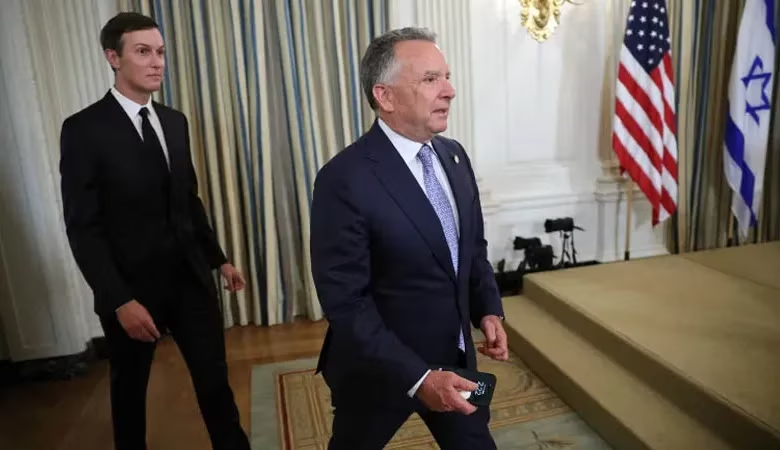
The cancellation of the planned visit by US envoy Steve Witkoff and the President's son-in-law and former White House advisor Jared Kushner to Israel has raised widespread questions in political and media circles, especially in light of the accelerating escalation in the region and the increasing tension associated with the confrontation with Iran. Israeli media reported that the visit, which was supposed to include meetings with Israeli officials to discuss security and political developments, was suddenly canceled without an official explanation from Washington or Tel Aviv.
Normally, such decisions are not viewed as mere ordinary logistical arrangements, especially when it comes to high-level diplomatic visits at a politically and security-sensitive time. Visits of this kind often carry political and strategic messages that go beyond the protocol framework, and are used to demonstrate the level of coordination between allies or to affirm political positions at critical regional moments. Therefore, the cancellation of a visit at this level opens the door to multiple interpretations regarding what might be happening behind the scenes at this stage.
One possible explanation for this decision is related to increasing security considerations. In light of current tensions and mutual threats in the region, US and Israeli security agencies may have concluded that a visit by prominent American figures could entail unforeseen security risks. With the escalation of potential retaliatory responses or mutual military operations, the concerned parties may see that reducing the public appearance of prominent political figures represents a precautionary step to avoid any unexpected developments that could embarrass both sides or raise the level of tension.
However, the security dimension is not the only possible explanation. The cancellation of the visit may also reflect a state of reassessment within the US administration regarding how to deal with the next phase of the crisis. Normally, public political visits reflect a degree of clarity in the adopted strategy, while their cancellation may indicate that discussions within Washington are still ongoing about the nature of the next steps and the limits of possible escalation.
The US administration may be reviewing its options between continuing to support military escalation or seeking diplomatic paths that could contribute to containing the crisis. In such cases, Washington may prefer to postpone public moves until the strategic picture becomes clearer, especially if there are considerations related to international or regional reactions that may result from any further escalation.
The timing of the decision may also reflect an American tendency to prioritize broader consultations with other regional partners. Current tensions are not limited to Israel and Iran alone, but their effects extend to a number of countries in the region, especially those that host US military bases or are part of regional security arrangements. From this perspective, Washington may be seeking to conduct a series of quiet consultations with its allies in the region before making a public political visit to Israel.
However, a deeper reading of the visit's cancellation may also lead to questions about the nature of the relationship between Washington and Tel Aviv during moments of sharp escalation. Despite the strength of the strategic alliance between the two parties, this alliance is often not without discrepancies in assessment or in the prioritization of issues. These discrepancies often emerge during major crises when security calculations intertwine with broader political and economic interests.
In this context, it may be simplistic to assume that the United States always plays the role of a "balancer" that seeks to de-escalate in contrast to a greater Israeli impetus towards confrontation. The political reality over the past years shows that Washington has not always been a restraining force for escalation, but has often been a direct partner in policies of pressure and confrontation, whether through extensive military support or by providing political and diplomatic cover for Israel in international forums.
Moreover, the talk about the United States' constant endeavor to maintain regional stability faces increasing criticism in the region, where many observers believe that US policies often combine rhetoric calling for stability with practices on the ground that may lead to opposite results. The almost unconditional support for Israel in a number of sensitive issues, along with punitive policies towards its regional adversaries, has sometimes contributed to deepening regional polarization instead of containing it.
From this perspective, any potential discrepancy between Washington and Tel Aviv at this stage may not necessarily relate to the principle of escalation itself, but perhaps to its degree, timing, and potential repercussions on broader American interests. The United States, as a global power with multiple commitments and partnerships in the Middle East, is compelled to take into account the calculations of other countries, whether concerning energy security, the stability of regional allies, or its balances with other international powers.
In the event of differences in views regarding the limits or timing of military operations, postponing such a visit could give both sides additional time to coordinate positions and narrow the gap of discrepancies before moving to the stage of public political moves. Postponing the visit could also help avoid sending contradictory signals at a sensitive political moment where any diplomatic step might be interpreted as unconditional support for a specific path of escalation.
Ultimately, the cancellation of Witkoff and Kushner's visit may not be merely a fleeting protocol decision, but may reflect an indication that the regional scene is still in a state of great fluidity and that many important decisions related to the course of the crisis have not yet been settled. In such circumstances, diplomacy often moves in invisible paths, where crucial decisions are made away from the spotlight until the features of the next phase become clear.
While the real reason behind the cancellation of the visit remains undisclosed so far, this step most likely reflects the magnitude of the complexities surrounding the current crisis, and indicates that the calculations of major powers in the region may be more intricate and cautious than public political statements suggest.
شارك برأيك
Cancellation of Witkoff and Kushner's Visit to Israel: What Does the Move Reveal About Washington's Calculations and Alliance Discrepancies?