






Washington – Said Arikat – 3/5/2026
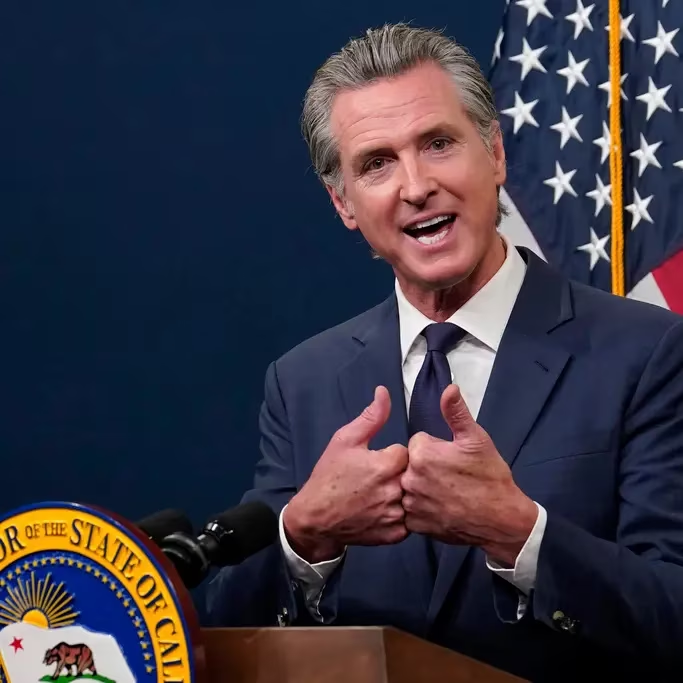
Los Angeles — In a striking stance that reflects a rapidly accelerating shift in political discourse within the United States, California Governor Gavin Newsom likened Israel to an "apartheid state," considering that its current leadership is pushing Washington towards an inevitable moment of reviewing its military support for its primary ally in the Middle East.
Newsom's statements came during his participation in an event in Los Angeles to promote his new memoirs, when Jon Favreau, host of "Pod Save America," asked him whether the United States should reconsider its military support for Israel in the future. The Democratic governor replied: "It pains me to say it, but the current leadership in Israel is leading us down a path where I don't think we have a choice but to seriously consider this issue."
Newsom's position carries implications beyond the media moment. Newsom, widely seen as a potential candidate for the 2028 presidential election, had visited Israel after the October 7, 2023, attacks carried out by Hamas, and at the time affirmed his solidarity with Israelis. But today he takes a clear critical distance from Prime Minister Benjamin Netanyahu's government, pointing to what he described as Netanyahu's internal crises, from judicial battles to pressing electoral calculations, in addition to pressures from hardline right-wing currents pushing for the annexation of the West Bank.
Newsom said that some observers "talk about Israel as an apartheid state," referring to policies that critics consider to be an entrenchment of a long-standing discriminatory system. He also sharply criticized the military operations against Iran, which the Donald Trump administration recently supported, asking: "Are we talking about regime change? After two years, even the Hamas file has not been resolved."
The timing of the statements is not incidental. The United States is witnessing escalating internal debate about the limits of unconditional support for Israel, especially among the Democratic Party. During the 2024 presidential election, sharp divisions emerged between the progressive wing and the traditional leadership of the party over the war in Gaza and Israeli policies in the Palestinian territories. Newsom, who previously made sure to emphasize that he had not received donations from the American Israel Public Affairs Committee (AIPAC), tried to balance highlighting the "deep ties" between California and Israel with addressing a party base that is moving towards more critical positions.
It is noteworthy that the description "apartheid" is no longer exclusive to human rights activists or marginal progressive voices; rather, it is being echoed in key political circles. Although Newsom did not explicitly call for an end to military support, his reference to "no choice" but to reconsider it represents a significant shift in the discourse of one of the most prominent rising Democratic figures, especially since 60% of Americans oppose the war launched by Trump on Iran on February 28, according to a new CNN poll published on Tuesday, March 3, 2026.
Politically, Newsom is trying to walk a tightrope: on the one hand, he does not want to break with a decades-old strategic alliance, and on the other hand, he realizes that public sentiment, especially among youth and progressive Democrats, has become less tolerant of Israel's policies in Gaza and the West Bank, and more willing to link military aid to political and human rights conditions.
Ultimately, the California governor's statements do not only reflect an individual position, but embody a broader shift in the American debate about the nature of the relationship with Israel, its limits, and its moral and political cost.
American sentiment towards Israel is undergoing a clear negative shift. While older generations have viewed Israel from the perspective of a solid strategic alliance and shared values, young people — especially within the Democratic Party — tend to evaluate the relationship from the perspective of human rights and international law. This shift does not necessarily mean hostility towards Israel, but it reflects a growing willingness to openly criticize its policies and link American support to clear conditions, a precedent that was not common just a decade ago.
Social media has played a pivotal role in reshaping the narrative within the United States. Images of war and destruction spread instantly, bypassing traditional media channels, which has weakened governments' ability to monopolize the narrative. This constant exposure has created popular pressure on politicians, pushing figures like Newsom to adopt more explicit language. Evasive diplomatic discourse is no longer sufficient to contain the anger of electoral bases that see silence as complicity.
The shift in sentiment is not separate from internal political calculations. With rising polarization, Israel has become part of an identity battle within the Democratic Party itself. A broad current believes that unconditional support harms American interests and undermines Washington's credibility in defending democracy globally. In contrast, others fear that any sharp retreat would weaken a traditional strategic alliance. This tension is likely to escalate as the 2028 presidential race approaches.
شارك برأيك
Newsom Describes Israel as an "Apartheid State" and Calls for Reconsidering US Military Aid