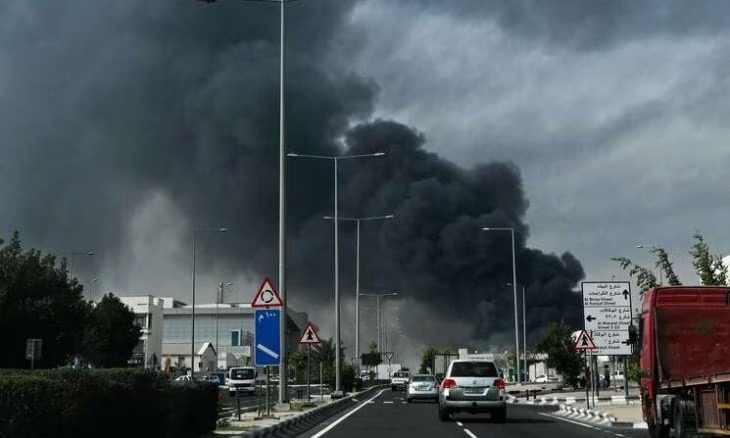







A report by the Soufan Center for Research stated that the ongoing conflict in the Middle East has transcended the boundaries of traditional regional confrontation, moving into a phase of deliberate targeting of the global energy sector. The report clarified that Tehran, through this strategy, seeks to send sharp political and economic messages, asserting its ability to destabilize international markets, which reveals significant challenges facing the United States and Israel in their attempts to contain the spread of the war.
As the direct confrontation with Iran entered its third day, Iranian forces expanded the scope of their operations to include American military targets and strategic assets in the region, coinciding with concentrated strikes on oil and gas facilities. The attacks included vital locations such as the Ras Tanura facility in Saudi Arabia, which is a key pillar of the global oil industry, in addition to the Ras Laffan facility in Qatar, causing a state of severe concern in international economic circles.
In a striking field escalation, Iranian military sources, speaking through Brigadier General Sardar Ibrahim Jabbar, an advisor to the Revolutionary Guard, announced that the Strait of Hormuz is now completely closed to navigation. Jabbar warned that any vessel attempting to cross this strategic waterway would be subject to direct targeting and incineration, which represents a direct threat to the energy supply lines on which the world's major economies depend.
On the ground, Iranian attacks targeted the oil tanker 'Athena Nova', registered in the United Arab Emirates, via drones, while Qatar Energy announced the suspension of production operations following the attack on its facilities. These developments caused an immediate shock in energy markets, with natural gas prices in Europe jumping by up to 50%, while crude oil prices recorded a 10% increase within a few hours.
On the other hand, Israeli authorities took precautionary security measures, including the temporary closure of a number of offshore gas fields, most notably the 'Leviathan' field operated by the global company Chevron. Inside Iran, sources reported hearing explosions on the strategic Kharg Island, through which most Iranian oil exports pass, amidst ambiguity surrounding the extent of the damage resulting from these explosions and their impact on Tehran's export capabilities.
Politically, Ali Larijani, Secretary of Iran's Supreme National Security Council, affirmed that his country would not enter into any negotiations with the current US administration, denying media reports about channels of communication for renegotiation. Larijani stressed that Tehran views the current conflict as a 'regime survival' battle, indicating that the previous rules of engagement have ended and that Iran no longer recognizes any red lines in defending its interests.
Analytical studies expect these attacks to lead to a long-term disruption in the global supply and demand balance, especially in Asian and European markets that are highly dependent on the region's gas. With the 'S&P Global Japan-Korea Marker' index rising by 39%, fears are growing that the global economy will enter a new inflationary wave resulting from a shortage of energy supplies and rising marine shipping insurance costs in the turbulent region.
Iran sends a clear message about its ability to impose global economic repercussions, indicating the limited ability of Washington and Tel Aviv to contain the war.
شارك برأيك
International Research Center Warns of Middle East Conflict Spiraling Out of Control and Deliberate Targeting of Energy Lifelines