







Washington – Said Arikat – 2/28/2026
News Analysis
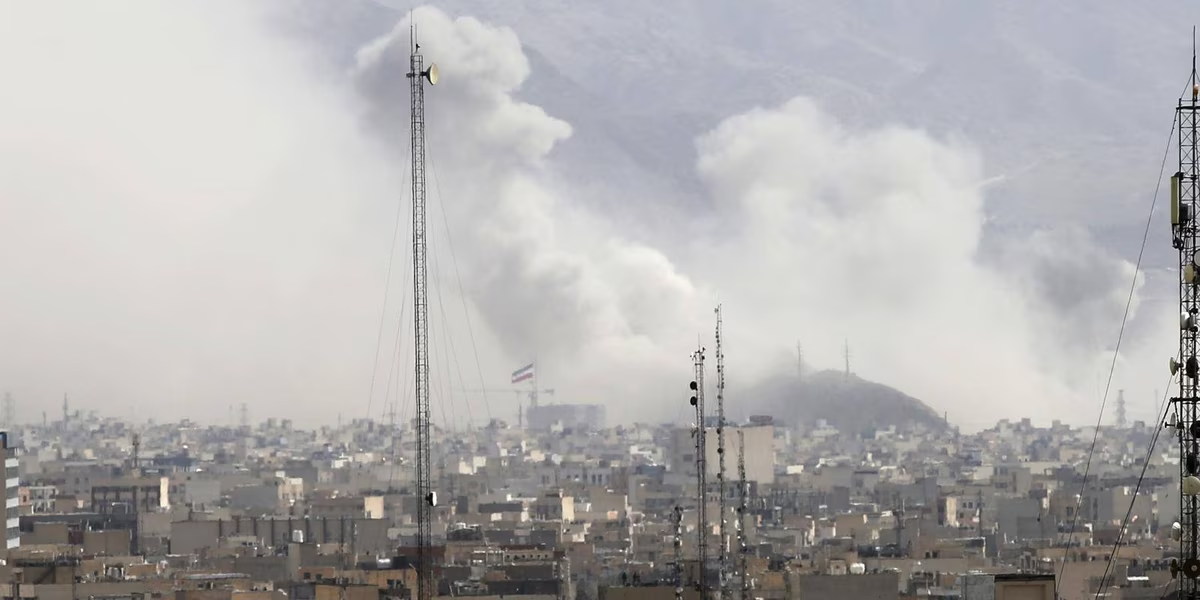
In an unprecedented escalation, the United States and Israel launched widespread military attacks on targets inside Iran on the dawn of February 28, 2026, targeting military and leadership sites and strategic facilities in several cities, amidst Washington's announcement of the start of "major combat operations" and public calls for regime change in Iran. Tehran quickly responded with missile and drone attacks targeting American bases and Israeli sites in the region, indicating from the first hours that the confrontation has entered an open war phase that will be difficult to contain quickly.
Field and political indicators suggest that the conflict will not be a limited strike or a short deterrence operation, but rather the beginning of a long war of attrition that could drag the Middle East into a new cycle of intertwined wars. The attacks did not target only a specific program, but included the Iranian state's security and military structure, while accompanied by American statements calling on Iranians to overthrow their government, which reinforces the impression that the true goal goes beyond deterrence towards reshaping the political system by force.
The war is presented as a preemptive step to prevent future threats, but the absence of evidence of an imminent danger raises questions about the legitimacy of resorting to military force of this magnitude. The American-Israeli discourse is based on a long record of accumulated conflicts and accusations against Iran, but it does not provide a convincing explanation for the necessity of launching an immediate war, which makes the operation closer to an optional war with long-term political goals.
The central assumption that seems to govern the current strategy is that intensive strikes will weaken the Iranian regime and push the internal society to revolt against it. However, recent history shows that external bombardment often strengthens nationalistic tendencies and grants targeted regimes defensive legitimacy, rather than leading to their collapse. Under external threat, societies tend to rally around the state, even if they oppose it internally.
More dangerous is the absence of a clear vision for the day after. The war does not seem to be accompanied by a political plan to manage a transitional phase in a large and complex country like Iran, whose population exceeds ninety million and possesses deeply rooted security and military institutions. Previous experiences in Iraq, Libya, and Afghanistan have shown that overthrowing regimes without a vision for reconstruction often leads to a security vacuum and extended chaos that transcends the borders of the state itself.
Moreover, the limited international support for the operation deepens the risks. The campaign is practically managed by a narrow alliance, which reinforces the image of unilateral military action and weakens its political and diplomatic cover. With the start of the Iranian response and the targeting of regional bases and interests, the risk of the conflict expanding to include other countries increases, either directly or through unconventional conflict arenas.
Potential scenarios range from widespread regional escalation, or a long war of attrition, or a partial collapse of the Iranian state that opens the door to security chaos and competing armed forces. In all these possibilities, military force alone does not seem capable of achieving stability or imposing a viable political system.
Most dangerously, the war could turn into a continuous series of strikes and responses, where no party can achieve a decisive victory, while human and economic losses accumulate and the circle of instability expands. With each round of escalation, exiting the conflict becomes more difficult, and the war transforms from a political decision into a permanent geopolitical reality.
In conclusion, the current confrontation appears to be a major strategic gamble, relying on optimistic assumptions about the speed of the adversary's collapse, while historical experiences indicate that wars that begin without a clear political vision often last much longer than expected or planned for.
شارك برأيك
A Dangerous Gamble: An American-Israeli Attack on Iran and the Beginning of a War That May Not End Soon