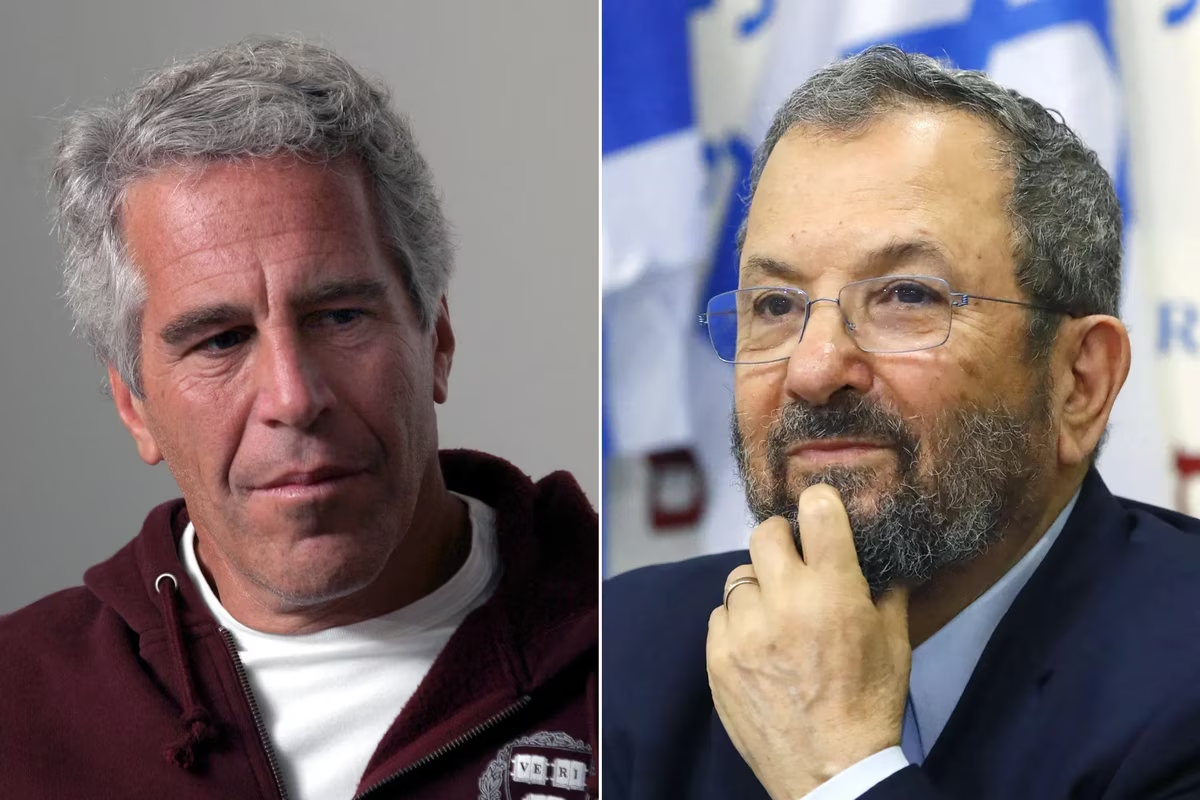








Documents, correspondence, and leaks from files related to Jeffrey Epstein have revealed the nature of a years-long relationship between him and Ehud Barak, the former Israeli Prime Minister and Minister of Defense. The circulated materials indicate that communication between the two was not merely social, but involved political and strategic discussions, including sensitive issues related to the region and its demographic and technological balances.
According to parts of these leaks, Epstein and Barak discussed various issues since 2013, including perceptions related to Iran, the utilization of advanced technology including artificial intelligence tools, in addition to ideas related to geopolitical transformations in the Arab world after the major wave of unrest the region witnessed.
However, the most dangerous aspect of this issue lies not only in the content of the discussions but in the model of influence it reflects: where money becomes a platform for access to decision-making rooms, and "consultations" turn into a cover for advancing interests. Even if the documents do not prove the existence of a military decision or an official plan, the mere continuation of communication between a high-ranking official and an individual with a documented criminal record raises serious ethical and political questions about the boundaries between "dialogue" and "planning," and between "advice" and "direction."
Among the most striking aspects in these materials was what was attributed to Barak regarding the possibility of transferring approximately one million immigrants of Russian origin to Israel, within the context of discussions about immigration and population balance. This issue is central to internal Israeli political calculations, as immigration policies have long been linked to matters of identity and the distribution of electoral power, as well as reshaping demographic reality to serve the state's long-term visions.
Conversely, the circulated data shows that Epstein was not merely a financial or social figure, but tried – according to the leaks – to play the role of a mediator connecting political influence with technology and capital networks. There were indications of his interest in directing Barak towards American technology companies related to data analysis and artificial intelligence, in a context that seems closer to building multi-faceted influence than to abstract intellectual discussions.
Here, a highly sensitive point emerges: the discussion of artificial intelligence in this context is not an innocent technical detail, but a sign of the shift of influence from traditional politics to "data power." When artificial intelligence becomes part of political discourse, the real question becomes: for whose benefit are these tools built? And who are they targeting? The danger increases when Epstein—historically associated with suspicions of blackmail and exploitation—appears as a link between technology and political decision, making the story more akin to an early warning than a fleeting scandal.
As for the more severe allegations circulating on social media platforms—such as talk of planning a military strike against Iran, or seeking systematic profit from the chaos of Arab countries—the documents published so far do not provide conclusive evidence for them, but the margin of "possibility" widens with each new batch of leaks from Epstein's files.
However, this does not diminish the seriousness of the overall picture reflected by this correspondence: dealing with the Middle East as a space amenable to re-engineering, people, borders, and demographics, and with tools managed away from public oversight and accountability. Even when "plans" are not directly announced, the nature of the language used and the way of thinking reveal a political mind that sees the region only as raw material for arrangement and redistribution.
While it cannot be definitively stated that these discussions turned into official policies or executive decisions, they at least reveal a dark side of the network of relationships that may form behind the scenes: where interests intersect, technology intertwines with power, and peoples are reduced to numbers and maps, not rights.
شارك برأيك
Epstein–Barak Correspondence: Documents Raise Questions About Influence, AI, and Demographics