







News Analysis
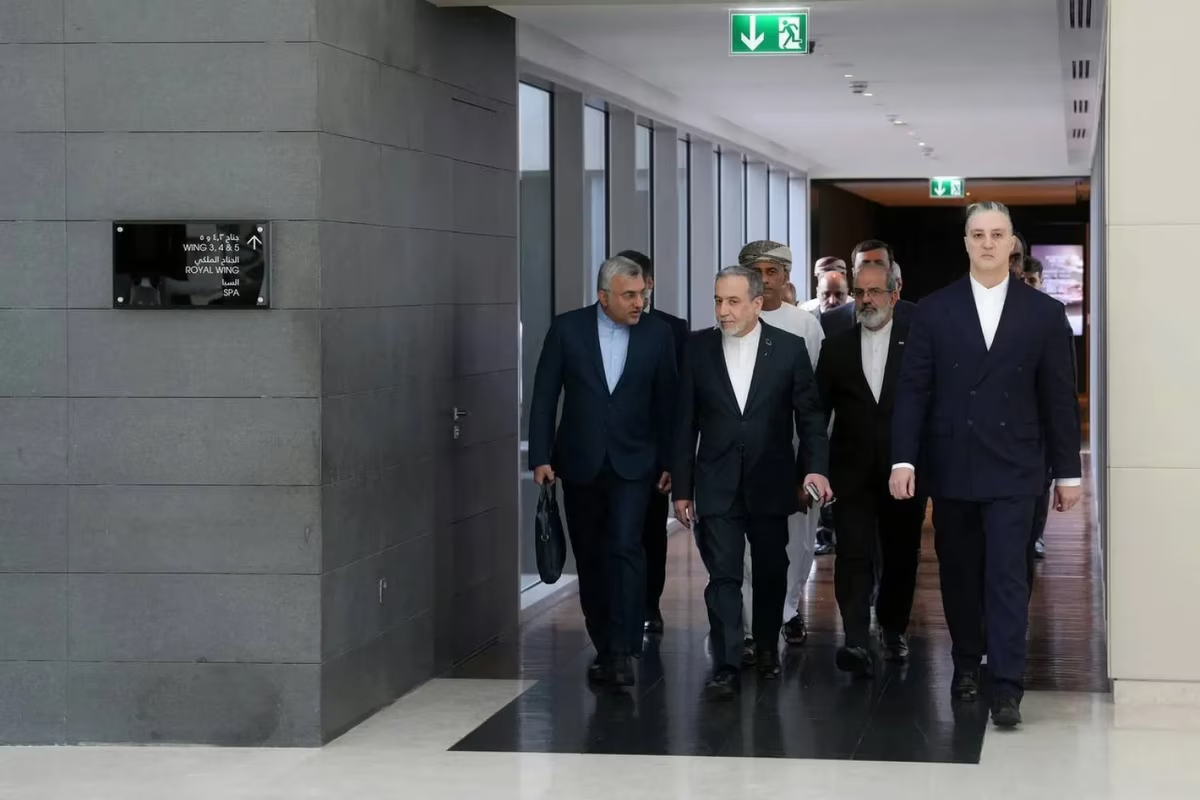
All eyes are on Muscat, Oman, where talks are being held that are considered among the most sensitive stops in the strained relationship between Iran and the West. Muscat gains its importance from being a reliable communication channel in regional crises, and a place that has long been used to exchange messages and turn corners when direct channels are closed. This round comes at a time when political and economic pressures on Tehran are escalating, against indications of a mutual desire to avoid sliding into an open confrontation.
Although the nuclear file dominates the headlines, the broader framework of the talks relates to Iran's position in the regional system and the limits that Washington and its allies seek to impose on Tehran's influence. In return, Iran is trying to establish an equation that says it is not a party that can be indefinitely besieged, and that any settlement must include recognition of its role and its security interests. Therefore, Muscat is not just a technical stop related to enrichment rates or inspection mechanisms, but a political test that goes beyond the nuclear issue to a bigger question: What is the ceiling of Iran's role in the Middle East?
Within this context, Iran presents itself in its political discourse as confronting what it calls "savagery," referring to the policies of subjugation and collective punishment that it says are practiced through sanctions and threats. This discourse is not just a propaganda detail, but reflects an attempt to frame the conflict as a struggle over the rules of international conduct: Are crises managed through law and institutions, or through the balance of power and political blackmail?
The central question remains: Is the nuclear issue the basis? Practically, the nuclear program represents the clearest point of contact, but it does not encapsulate the essence of the crisis. A large part of the tension is linked to Iran's ability to build deterrence tools and expand its regional influence, which makes the nuclear agreement, for its adversaries, an insufficient step unless accompanied by broader political and security restrictions. Here, the talks turn into a double test: a technical test on nuclear commitments, and a political test on the nature of the "possible deal" in the region.
In this framework, it appears that both parties possess mutual pressure tools, but they also have strong reasons to avoid an explosion. Washington needs de-escalation that prevents rising regional and economic costs and reduces the risks of energy market disruption or the expansion of tension in the Gulf. Tehran needs a window that alleviates the effects of sanctions and grants it negotiating legitimacy, or at least prevents a rapid deterioration that could threaten its internal stability. However, the fundamental problem remains the lack of trust: every concession is read as weakness, and every flexibility is interpreted as a potential deception.
Related to this point is the issue of double standards, which is one of the most prominent files in Iranian and regional discourse. Criticizing Iran for a nuclear program under supervision, while remaining silent about nuclear arsenals not subject to any supervision, creates a gap in the credibility of the international system. Moreover, selective dealing with international law weakens the ability of international institutions to play a balancing role, and gives conflicting parties additional justifications for escalation.
In contrast, another equally influential axis emerges, which is the international community's inability or limited capacity to impose balanced rules, or its movement within limits set by major powers. This reality explains why Muscat acquires additional value: it is not a substitute for institutions, but an attempt to reduce the impact of international deadlock through a more flexible and less noisy negotiating path.
As for Trump's actual goals, they are read within a broader framework than merely returning to a policy of pressure. The American approach in his era was not focused on amending the terms of a nuclear agreement only, but on reshaping regional balances, providing guarantees to allies, and demonstrating Washington's ability to impose its conditions. From this perspective, any talks in Muscat will be a reflection of an American equation that believes pressure must precede settlement, not be a substitute for it.
On the Iranian side, power cards are a decisive factor in determining the course of negotiations. Iran possesses military capabilities, regional influence, and networks of relationships that allow it to influence more than one arena. It has also developed tools to adapt to sanctions by redirecting trade and economic alliances. These cards give it a negotiating margin, but at the same time, they are used by its adversaries as an argument for continued pressure, on the pretext that Tehran invests its resources in expanding its influence instead of improving internal conditions.
If Muscat does not produce a breakthrough, the most likely scenario is a return to a cycle of slow escalation: additional sanctions, mutual security operations, and a long war of nerves. The danger of this path is that it does not require a clear declaration of war; rather, the accumulation of small steps is enough to generate a major clash. In a charged regional environment, any naval or security incident could turn into an explosion point. Therefore, Muscat appears to be an attempt to freeze the path before reaching the point of no return.
Ultimately, the question of "what does the fall of Iran mean?" is no longer just a political proposition or a theoretical debate, but has become a scenario whose consequences are seriously discussed within decision-making circles. Iran is not a marginal state in the region; any major upheaval in it could have direct impacts on Gulf security, the stability of energy markets, and the safety of maritime passages, in addition to the balances of countries such as Iraq, Syria, and Lebanon. Moreover, a collapse of this kind could open the door to extended internal chaos, and establish a dangerous model based on overthrowing states through tools of pressure and dismantling instead of political settlements.
Accordingly, the Muscat talks are understood as an attempt to establish a minimum level of understanding, or at least prevent a slide towards a rapid deterioration whose outcomes cannot be controlled. Although these talks do not include guarantees of success, they remain one of the few opportunities available to reintroduce politics into a file that has long been governed by the logic of escalation and confrontation.
شارك برأيك
Muscat Talks: A Highly Sensitive Stop in the Strained Relationship Between America and Iran