







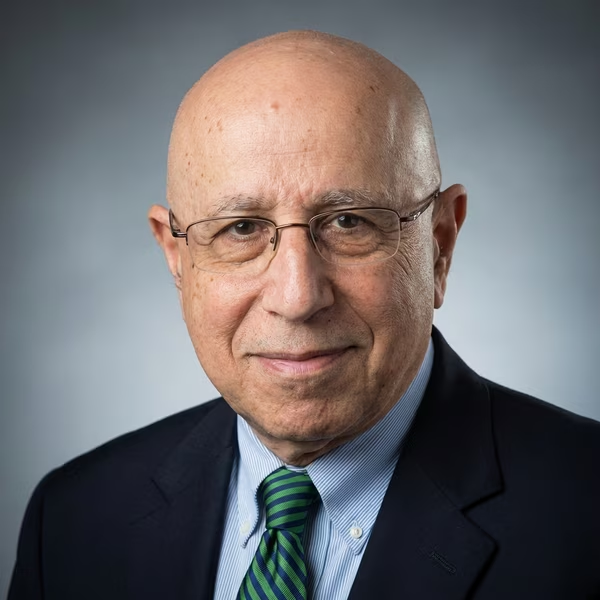
In a moment the White House intended to appear as the opening of a post-war phase, Jared Kushner, former advisor and son-in-law to US President Donald Trump, presented a multi-stage vision for reshaping Gaza during the World Economic Forum in Davos, Switzerland, on Thursday. Kushner stated emphatically that there is "no alternative plan" for the reconstruction of the sector, which has been exhausted by a two-year war between Israel and Hamas, and that it is time to move from managing destruction to engineering a new future that promises "peace and prosperity."
The "Peace Council," signed by US President Donald Trump, along with a handful of world leaders, on the sidelines of the Davos Economic Forum on Thursday, has become part of political history. However, what is striking about this event is not the fanfare of the signing or the handshake photos, but rather the emptiness of meaning surrounding it. So far, not a single clarification has been issued explaining the nature of the council's mission, its boundaries, its tools, or how it is supposed to touch the reality of Gaza and its citizens, whom Israel has not stopped killing, according to field reports, since the ceasefire began on October 10. While the council is supposed to be a title for reconstruction and post-war calm, Gaza appears before a world celebrating a new entity without providing a single guarantee to stop death or restore life.
Kushner, who played a pivotal role in the ceasefire negotiations that ended the fighting in October, presented what he described as a 20-point "roadmap," some details of which are based on elements of the truce agreement that has only been partially implemented so far. The plan, according to what was presented, starts from the south: by reopening the Rafah crossing on the Egyptian border, then gradually moving north, stage by stage, until the complete reconstruction of the entire Gazan geography is completed. The vision includes provisions related to establishing a port and an airport, re-establishing basic infrastructure, and developing tourism projects that contribute to creating a new economy for the sector.
However, the backbone of this vision, as Kushner stressed, is the condition of "disarming Hamas" as the key to any real reconstruction. He went further by saying that reconstruction will only begin in areas where disarmament is actually taking place, and that the implementation mechanism will be based on the principle of "security first" before cement and cranes. He also hinted at a controversial option: granting limited amnesty to some Hamas elements who agree to lay down their arms, with the possibility of integrating them into a new security apparatus in Gaza, as a transitional framework to stabilize the situation and prevent the return of fighting.
Kushner, despite his optimistic tone, admitted that a project of this magnitude would not be without obstacles: it would require many years, funding of no less than $25 billion, as well as complex political and regional agreements. But he said the White House chose to "plan for spectacular success," referring to a political will that wants to transform the ceasefire from a temporary stop to a permanent path.
Concurrently, Trump held what was called a "signing ceremony" in Washington to launch the new Peace Council; an entity originally designed to follow up on Gaza arrangements, but Trump hinted that its scope might expand to include other international conflicts. Despite the United States inviting about 60 countries to join, the ceremony was attended by only about 20 countries, including Hungarian Prime Minister Viktor Orbán, Argentine President Javier Milei, and officials from Qatar and Saudi Arabia.
Orbán was the only European leader present, after other European capitals refused to engage in the council or expressed fears of a potential composition that might include Russia, and the possibility that the council could become a parallel platform that weakens existing international institutions—especially given Trump's rhetoric, which does not hide his disdain for some of these bodies.
But what attracted the most attention, politically and symbolically, was Israel's absence from the launch ceremony. Despite Prime Minister Benjamin Netanyahu's statement that Israel would join the initiative with reservations about the presence of Turkey and Qatar—as supporters of Hamas—he was not present in Davos, where Switzerland is a party to the International Criminal Court, which issued an arrest warrant against him. Israeli President Isaac Herzog, who was in Davos, also did not participate in the ceremony, leaving a question mark about the extent of Israeli enthusiasm for the new path.
In a notable development, an Egyptian official announced during the event that the Rafah crossing—closed since the October 7, 2023 attack—would be reopened in both directions next week. This announcement comes as Israel had linked the opening of the crossing to the return of the last Israeli hostage in Gaza, Ran Gvili, which Hamas agreed to as part of the ceasefire arrangements.
In the face of criticism and skepticism regarding the effectiveness and composition of the council, Kushner called on those with reservations to temporarily suspend their judgments, saying: "Just calm down for 30 days... The war is over. Let's work together," in an attempt to give political and media momentum to a project that the White House sees as an entry point for consolidating its influence in a highly sensitive issue.
Experts believe that what Kushner is proposing is not a "reconstruction plan" in the traditional sense, but an attempt to redefine Gaza politically, security-wise, and economically all at once. Reconstruction here is conditional on disarmament, meaning that the restoration of life becomes a reward linked to changing the power structure within the sector. This logic creates a dilemma: Can lasting stability be built without a comprehensive political settlement that guarantees Palestinians a horizon and rights? Or will focusing on security alone reproduce the crisis in a new form?
As for the "Peace Council" launched amidst semi-empty seats, it appears to be an American declaration of desire to form a platform outside traditional international frameworks, based on selective alliances rather than broad consensus. Israel's absence from it, despite its direct involvement in Gaza, weakens its symbolism from the very first moment, revealing that the project has not yet matured to become a comprehensive framework. Peace councils are not measured by celebrations, but by their ability to bind parties and provide enforceable guarantees.
شارك برأيك
Jared Kushner Presents "New Gaza Plan" in Davos