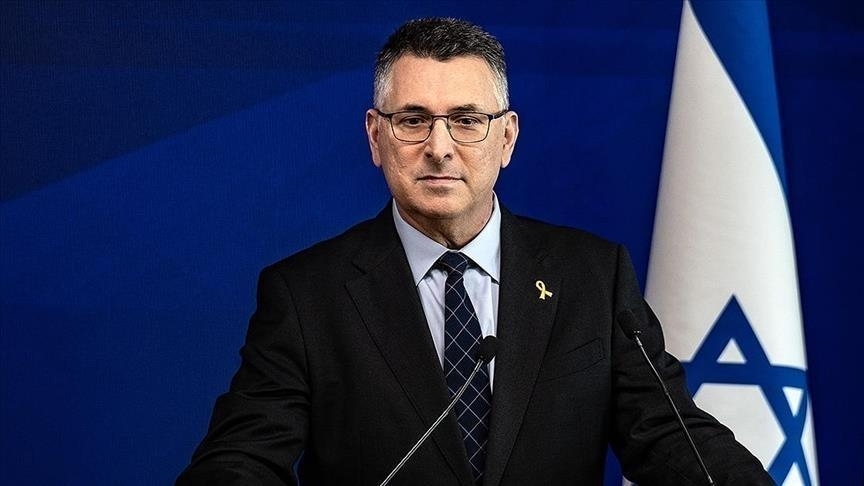







Israeli Foreign Minister Gideon Sa'ar claimed on Friday that Tel Aviv does not intend to launch a new attack on Iran at this stage, a position that seemed contradictory to statements made by Prime Minister Benjamin Netanyahu a few days earlier.
In an interview with the "Jerusalem Post," Sa'ar claimed that "Tehran is working to restore its nuclear capabilities," but he considered that its current level of enriched uranium production is "lower than it was before, and less than it had planned."
He added: "The Iranian threat will not disappear, but the assessment at this stage is not to head towards a new military strike."
Between June 13 and 24, Israel launched a war on Iran with American support, during which Tehran responded by launching missiles and drones, before the United States announced a ceasefire.
Last Tuesday, Netanyahu threatened during an event in West Jerusalem to continue striking Iran, saying: "We have struck the Iranian terrorism axis, and our hand is still extended for more," as he put it.
In this context, Sa'ar considered that the wars waged by his country over the past year imposed on it a "parallel battle in the international arena," which included efforts to prevent European sanctions on Tel Aviv and to deal with the increasing wave of recognitions of a Palestinian state.
He explained that the Israeli Foreign Ministry focused on "strengthening relations with countries in Central and Eastern Europe, such as Germany, the Balkans, the Czech Republic, Hungary, and the Baltic states."
Sa'ar considered that these countries represent a "counterweight" to the positions of other European countries "more preoccupied with the Palestinian issue."
He pointed to the "closure of the Israeli embassy in Ireland," in contrast to the opening of new missions in Estonia, Moldova, and Zambia.
Amid the ongoing Israeli genocide against Gaza, which continued for two years starting from October 8, 2023, countries recognized the State of Palestine during United Nations meetings in September, raising the number of countries recognizing it to 160 out of 193 member states in the international organization, according to the Palestinian Foreign Ministry.
In this regard, Sa'ar reiterated his government's rejection of any path leading to the establishment of a Palestinian state, criticizing the American decision regarding the formation of an international force in Gaza, which was approved by the Security Council on November 18, which included "a path towards a Palestinian state."
He claimed that the recognition by several countries of the State of Palestine over the past year is "not a success" from his perspective, but he asserted that Tel Aviv succeeded in convincing other countries, such as Germany and some European and Asian countries, not to take a similar step.
He considered that "maintaining calm (in Gaza) at this time serves Israel's interest, and it should be shown that Tel Aviv has given the American plan for disarming Hamas a diplomatic opportunity before considering resuming military operations."
A ceasefire agreement between Tel Aviv and Hamas was based on a plan presented by Trump consisting of 20 points regarding the genocide committed by Israel in the Gaza Strip with American support over two years since October 8, 2023, which resulted in more than 69,000 Palestinian deaths and over 170,000 injuries, most of whom are children and women, with reconstruction costs estimated by the United Nations at around $70 billion.
The Iranian threat will not disappear, but the assessment at this stage is not to head towards a new military strike.
شارك برأيك
In contrast to Netanyahu, Saar claims that Israel does not intend to attack Iran.