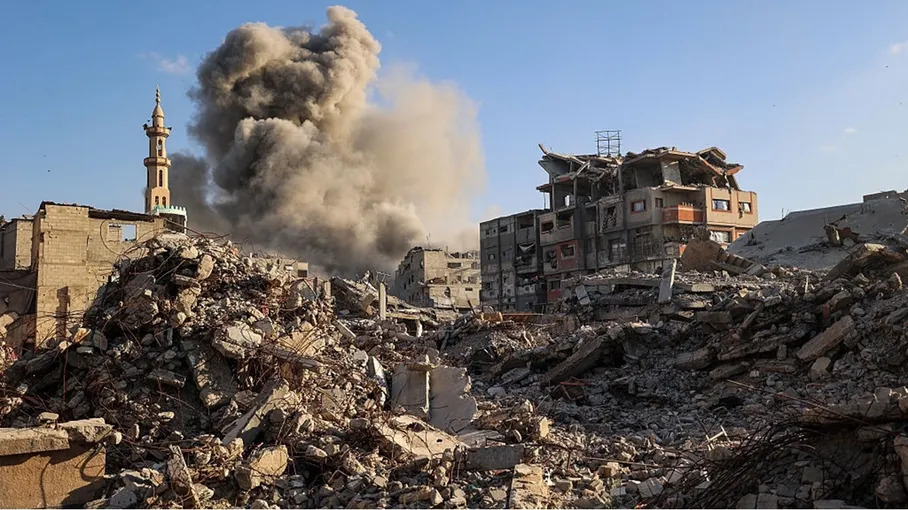







The United States is pushing for the establishment of Hamas-free zones in Gaza, through a plan to divide the Gaza Strip into areas controlled by the movement and the Israeli occupation army, and to build 'temporary communities' for displaced Palestinians in the south, starting from Rafah.
The Wall Street Journal reported that the United States is quietly presenting a plan to divide the Gaza Strip into areas of control and to begin building 'temporary housing' for Palestinians in areas controlled by the Israeli occupation army.
The newspaper stated, 'This announced initiative represents a shift in expectations regarding the dismantling of Hamas, which is officially listed as a goal for the second phase of the 20-point peace plan proposed by U.S. President Donald Trump, but is not expected to happen soon.'
It added, 'The U.S. plan will designate areas under Hamas control in red, while areas controlled by the Israeli army will be marked in green. Within these green areas - defined as regions located behind the 'yellow line' that delineates Hamas's influence, Washington is reportedly promoting the construction of what are called 'alternative safe communities' for displaced Palestinians.'
U.S. officials told the newspaper that engineering teams have already been sent to Gaza to begin planning for the removal of debris and unexploded ordnance in preparation for these new sites. While construction has not yet begun, the planned communities will provide 'temporary housing and educational and healthcare facilities, including schools and hospitals, until more sustainable rebuilding is possible.'
The newspaper noted that 'the first such site is set to be in Rafah, a city in southern Gaza controlled by Israeli occupation forces, and despite ongoing fighting with Hamas terrorists who are still holed up in underground tunnel networks there, Israeli forces maintain operational control above ground.'
Reports indicated that some Hamas members emerged from the tunnels on Friday; many were killed and others captured.'
Israeli occupation army Chief of Staff Eyal Zamir stated on Friday that 'all remaining terrorists in Rafah will be eliminated or forced to surrender.'
Sources in both Israel and the United States confirmed to the newspaper that the Rafah site is viewed as a test site for the first 'temporary settlement.'
This initiative comes amid an international debate about the feasibility of reconstructing Gaza while Hamas remains in power.
The newspaper pointed out that no potential donor country has shown willingness to fund reconstruction in areas under Hamas control.
According to the report, Arab countries have expressed their objections to dividing Gaza into actual areas of control and creating housing under Israeli supervision.
Reports indicate that Egypt, in particular, is concerned about the potential for the crisis to extend from Rafah to the Sinai Peninsula and has warned against any step that might encourage displacement across the border.
The U.S.-backed plan is still in its early stages, and its implementation is likely to depend on ongoing military developments and political coordination between 'Israel', the United States, and regional actors.
The newspaper's spokesperson stated, 'There is a significant question looming about the security of the planned temporary housing communities in Gaza. It remains unclear how the U.S.-backed initiative will ensure that only innocent civilians, and not Hamas terrorists, can enter these areas.'
It added, 'One idea is to involve local groups in Gaza that have been armed by Israel. They have Israeli support, and according to Israeli and Arab sources, this was one of the proposals under discussion.'
It clarified, 'Some of these groups - such as those led by Yasser Abu Shabab - are already managing de facto communities in the areas under their control; for example, reports indicate that Abu Shabab runs a school and stores selling essential goods.'
An American official quoted in the report stated that Washington is not currently considering using these militias, noting that some of their members are viewed as criminals and are unlikely to be effective against Hamas in the event of a confrontation.
Instead, American sources expressed hope that the areas controlled by Hamas would 'shrink' over time and eventually disappear. In such a scenario, an International Stabilization Force (ISF), supported by a mandate from the United Nations Security Council, would take on security responsibilities in Gaza, working alongside a Palestinian police force.
During the transitional period, the peace council proposed by the Trump administration would oversee civilian governance and reconstruction in the sector, with long-term control ultimately handed over to a Palestinian governing body.
For its part, Hamas continues to reject the entire proposal, denouncing it as international guardianship over Gaza that separates it from the Palestinian people.
The movement rejected the United Nations Security Council's decision this week that endorsed the plan, asserting that it is an attempt to impose a new regime that serves foreign interests and infringes on the rights of
شارك برأيك
American focus on dividing Gaza: temporary housing settlements and efforts to reduce Hamas control