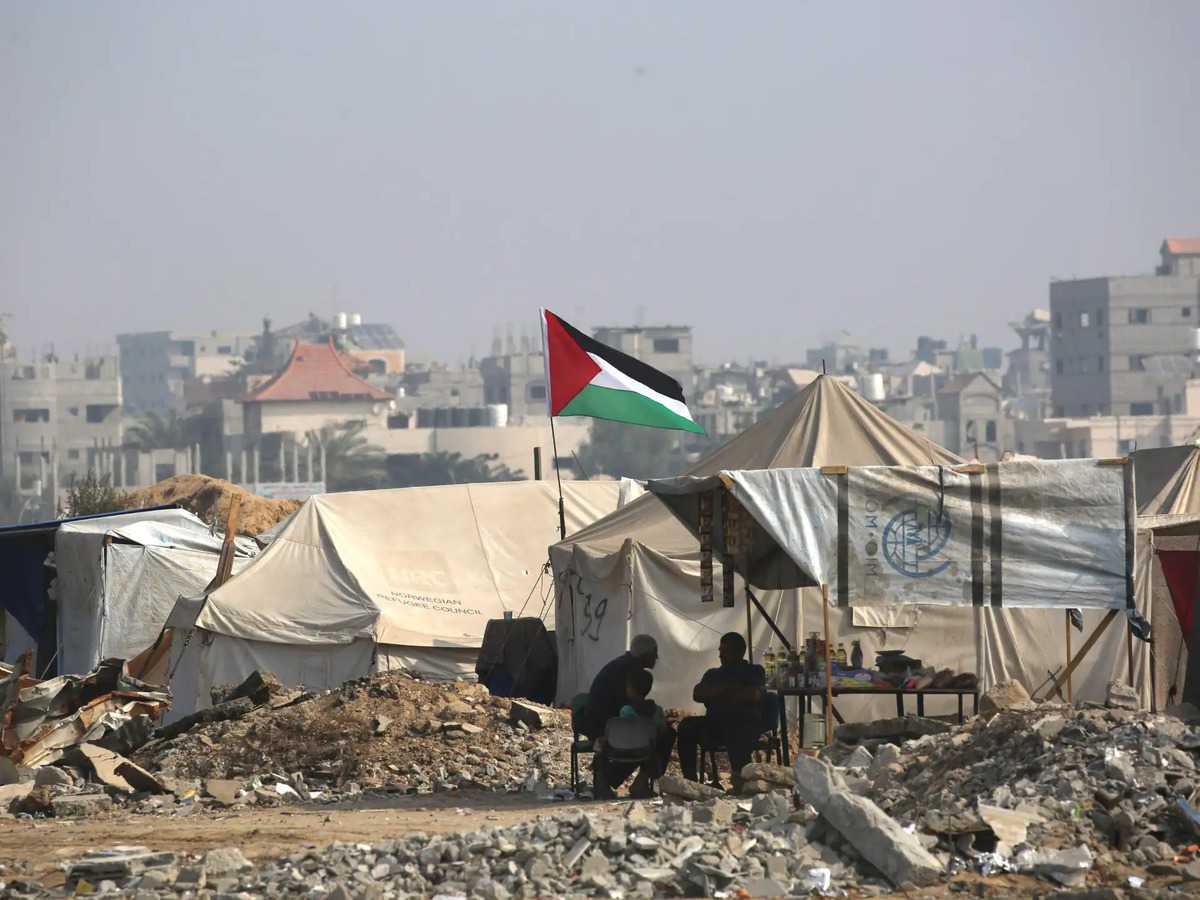







The United States and its Arab and Muslim partners are trying to establish a ceasefire in the Gaza Strip by adopting a resolution from the Security Council that supports Donald Trump's peace plan, despite reports from Israeli media about fundamental disagreements between Washington and Tel Aviv.
The resolution, which is expected to be voted on next Monday, is anticipated to include provisions that were not included in Trump's plan, foremost among them the right of the Palestinian people to self-determination and the establishment of a path that leads to the creation of an independent Palestinian state.
The resolution also stipulates that the United States will play a role in initiating dialogue between the Palestinians and Israel to achieve peaceful coexistence, as well as affirming the temporary nature of the Peace Council that will govern the Gaza Strip for a period of up to two years.
However, Yedioth Ahronoth reported from informed sources that Trump's plan includes provisions that are uncomfortable for Tel Aviv, while Channel 13 stated that fundamental disagreements still exist between the U.S. and Israel regarding moving forward with the implementation of the agreement.
The plan still faces many obstacles, which former U.S. National Security Advisor Mark Feivel says require further discussions to prevent the stabilization forces from coming into conflict with the Palestinians.
Significant challenges According to Feivel, speaking on the "Event Path" program, the current discussion revolves around deploying 20,000 soldiers from various countries who will operate for a maximum of two years before the management of the sector transitions to the Peace Council, which will be chaired by Trump himself.
The anticipated resolution is not without Arab-American disagreements, as Arab and Muslim leaders wish to explicitly state the establishment of a Palestinian state, while the United States and Israel do not want this, according to Feivel.
The United States wants to implement reforms within the Palestinian Authority so that it becomes possible to transition to discussions about an independent state, which Feivel says needs a clear roadmap for Washington to agree to include it in the resolution.
At the same time, Russia has proposed a resolution in recent hours that is clearer regarding the Palestinian state, but Feivel says this step aims to obstruct peace efforts, describing Moscow as "not the right place to achieve peace."
He hopes that the veto will not be used to obstruct the resolution. Russian President Vladimir Putin made a call on Saturday to Israeli Prime Minister Benjamin Netanyahu, who is wanted by the International Criminal Court, during which they discussed the safety process in the region.
However, Israeli affairs expert Dr. Mohannad Mustafa says that Israel knows that the Russian role is marginal in this issue, and that the real decision is in the hands of the United States.
Two achievements and two failures Mustafa attributes the Israeli-American disagreement regarding the anticipated resolution to the fact that it includes two achievements and two failures for Tel Aviv from the perspective of the current government, which he says is facing a complex moment.
Israel will determine the countries that will participate in the international force that will enter the sector, and it will set conditions that cannot be met before reaching a Palestinian state, and these are two significant achievements in Netanyahu's view, according to Mustafa.
Conversely, Netanyahu views the mere mention of "an independent Palestinian state" in any resolution as a major failure for him in front of his current government coalition, while the second failure relates to the complete withdrawal of occupation forces from the sector, according to the spokesperson.
The withdrawal from the sector represents the most dangerous point - in Mustafa's view - because replacing the occupation forces with international troops within the yellow line means that Israel will exit while the Islamic Resistance Movement (Hamas) remains, according to Mustafa.
For his part, Middle East policy expert Dr. Mahjoub Al-Zuwairi believes that the Arabs' and Muslims' efforts to stop the genocide in the Gaza Strip and Trump's desire to save Israel's image globally have contributed to the ambiguity that has dominated the scene following the agreement's implementation.
The ceasefire agreement did not stipulate the establishment of a Palestinian state nor the right of Palestinians to self-determination, but both will be included in the anticipated resolution as a result of deep consultations that Al-Zuwairi believes Arab and Islamic countries have conducted with Washington.
Therefore, the discussion of an American-Israeli disagreement regarding this resolution becomes understandable as it will completely end the occupation of Gaza and prevent Israel from shaping the day after the war, according to Al-Zuwairi.
However, the failure to issue the resolution under Chapter VII of the Security Council means that the United States will be responsible for deterring Israel, according to Al-Zuwairi, who expects this to lead to violations after the resolution is passed.
Feivel ruled out the

شارك برأيك
The future of Gaza in the Security Council.. What does each party want from the upcoming resolution?