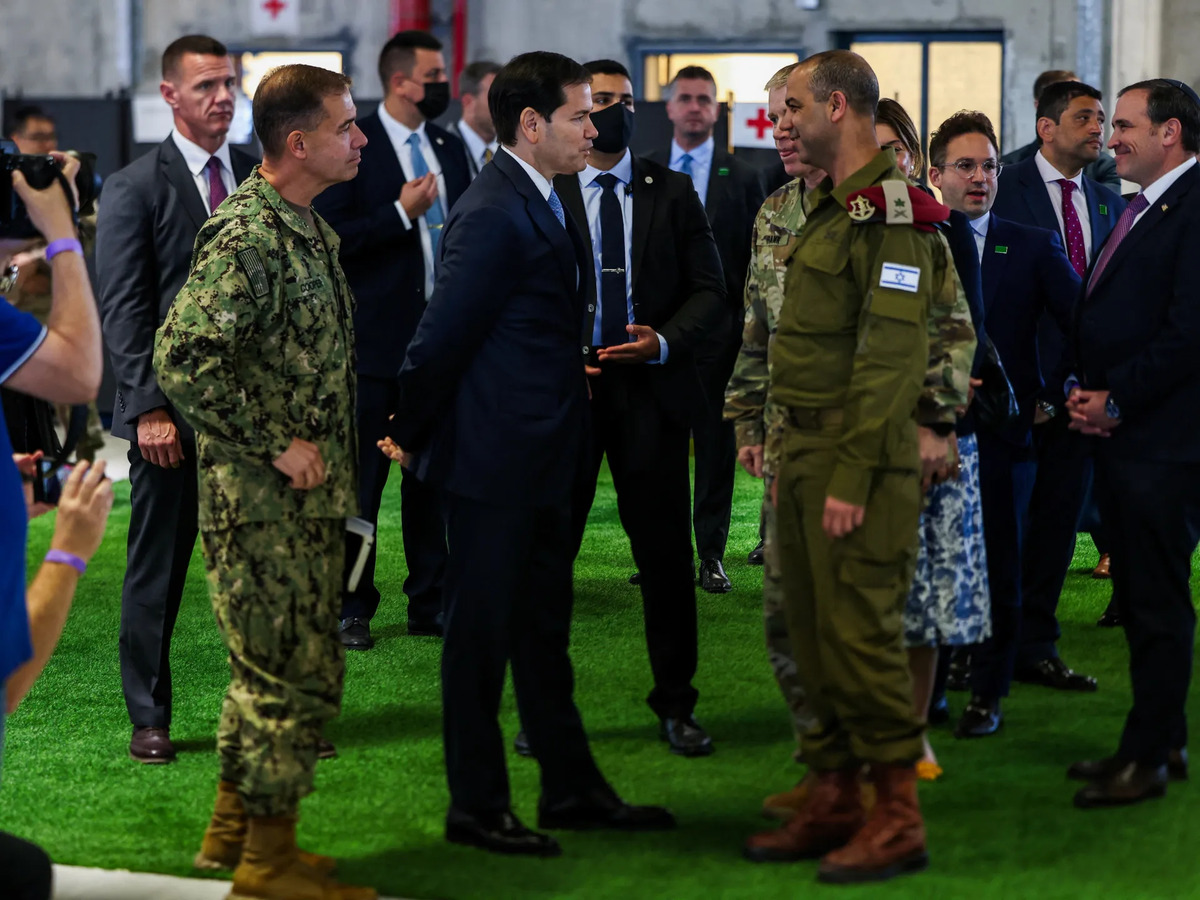







Israeli researcher and former officer Michael Milshtein stated in an article published by Yedioth Ahronoth on Sunday that the United States has become a present party in the field regarding the Gaza Strip, as it intervenes in military and political decisions and dictates to Israel the limits of its movements.
He added that the United States is now exercising unprecedented influence in shaping the Israeli and Palestinian reality, especially in Gaza, and that it is no longer just a 'traffic cop' issuing orders from afar.
Milshtein wrote that what is happening today represents a new phase in the relations between Washington and Tel Aviv, fundamentally different from previous decades that witnessed American directives or situational pressures, as it is now transforming into direct field management that includes civil affairs in the Gaza Strip, with a gradual intention to replace Israeli control with an international American administration, first in humanitarian matters and then perhaps in security.
Milshtein noted that Israeli history is 'saturated with American interventions,' but he points out that 'the current intervention is not top-down directives, but rather internal participation,' as Washington established the Civil-Military Coordination Center in Kiryat Gat to serve as an operations room managing the Gaza file.
He observed that Prime Minister Benjamin Netanyahu's government contributed to reaching this reality by 'clinging to many illusions, the most prominent of which is the refusal to discuss the day after the war, relying on military power as if it were a strategic compass, in addition to the mistaken belief that President Donald Trump's administration would always stand by it no matter what happened.'
He explained that this mentality peaked when Netanyahu militarily attacked Qatar, which Milshtein described as 'a strategic mistake that led to ending the war under American duress,' as Washington feared the collapse of Israeli control on the ground, thus imposing a ceasefire, while Qatar emerged with more influence in the regional arena.
The writer points out that prominent figures in the American administration, such as Trump, his Vice President J.D. Vance, his envoy Steve Witkoff, and his advisor Jared Kushner, have explicitly stated in their recent remarks that Washington forced Israel to stop the war, and that any military or diplomatic move in Gaza requires prior approval from the United States.
Milshtein expressed his opinion that it is better for Israel 'to face reality as it is' rather than repeating misleading narratives that beautify the facts.
He wrote, 'Israel is not an American protectorate, but its scope of movement has become significantly limited, and the United States is the one that sets the pace in Gaza.'
He also stated that the current ceasefire is fragile, but it will remain in place as long as Trump wants it to, suggesting that this may lead to a new settlement that includes establishing an alternative Palestinian administration to the Islamic Resistance Movement (Hamas), and a partial disarmament of the movement, while it remains in the scene in a manner similar to Hezbollah in Lebanon, that is, with limited political presence and unofficial field influence.
From his perspective, Israel should set realistic and achievable goals, which are to ensure the return of all prisoners and missing persons, maintain the freedom to act against any threat in Gaza according to the Lebanese model, establish an effective monitoring mechanism for distributing humanitarian aid, and prevent reconstruction materials from reaching Hamas.
Milshtein also emphasizes the necessity of having an American oversight system on the Philadelphia axis and the Rafah crossing to prevent the arrival of weapons to the sector.
Milshtein concluded his article with a clear warning that 'insisting on the hope of returning to a comprehensive war or reoccupying the sector prevents the government from understanding the dramatic changes taking place. The possible achievements today are not ideal, but they are better than scenarios of attrition or chaos.'
He noted that dogmatism and disdain for relations with the world, as seen during the war, not only harmed Israel's image but also hindered the achievement of its goals.
He concluded that 'recognizing the reality of American influence does not weaken Israel, but rather gives it the opportunity to reshape its relations with Washington on new rational bases instead of being beholden to illusions.'
Israel is not an American protectorate, but its scope of movement has become significantly limited.
شارك برأيك
Israeli Analyst: Gaza Launches a New Phase in Relations Between Washington and Tel Aviv