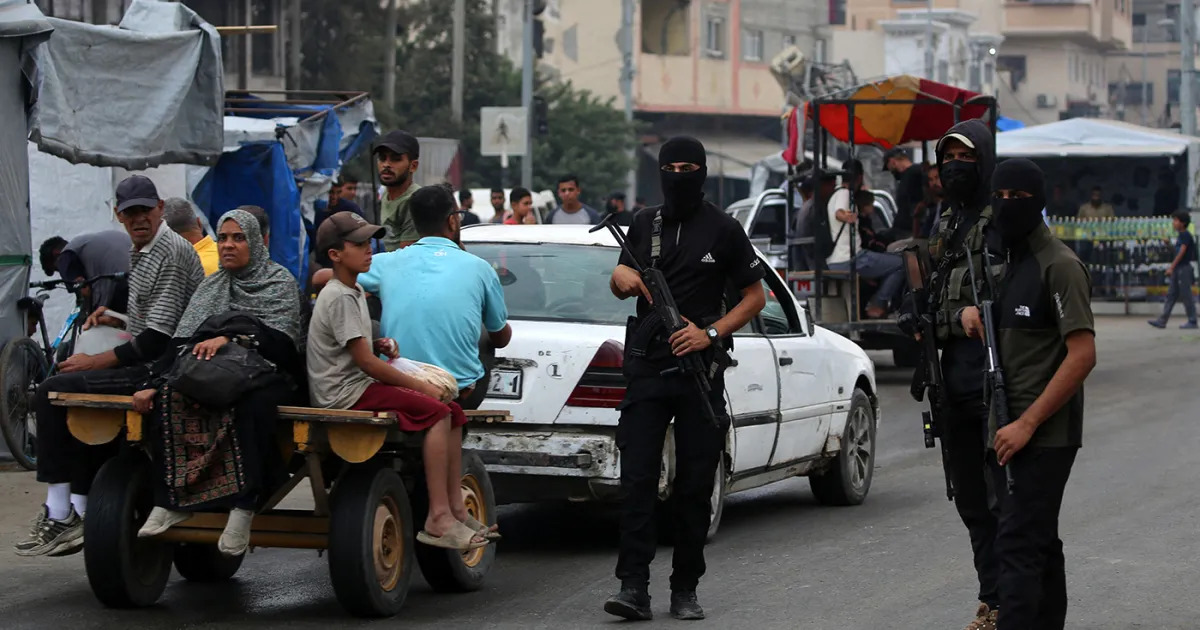







An Israeli security institution report indicates that the Islamic Resistance Movement (Hamas) has succeeded in strengthening its control over the Gaza Strip since the ceasefire agreement came into effect on October 10.
According to military correspondent Yaniv Kubowitz, estimates within the occupying army suggest that Hamas "has not lost control over the sector for even a single day," and that it had prepared in advance for this phase by keeping thousands of fighters in reserve to regain control of governance as soon as military operations ceased.
He confirmed that the movement has practically regained authority, administration, and security positions in the sector, while Israel's recent attempts to create local alternatives from tribes or collaborators have faded.
According to the report, the Israeli military is closely monitoring the growing signs of organization and discipline among Hamas police officers who have returned to regular fieldwork in most cities of the sector, currently undertaking tasks of maintaining public order and pursuing thieves and criminals.
It noted that the movement has regained control over municipal offices and government institutions in Gaza, Khan Younis, and Rafah, appointing its affiliated figures to leadership positions within the civil apparatus, indicating that the "post-war" phase is proceeding according to Hamas's vision rather than the Israeli or American plan.
The security institution acknowledges that Israel's recent attempts to strengthen some local tribes against Hamas have failed, with Haaretz's report relying on sources that spoke of "the dismantling of most tribal formations that emerged in recent weeks, and their leaders facing threats, pursuit, or even elimination by Hamas elements."
A senior Israeli officer told the newspaper that "the tribes no longer exist as an organized force, and Hamas has re-established complete deterrence in Gaza."
The report indicates that the Israeli army has observed in recent weeks Hamas elements firing at anyone attempting to cooperate with Israel.
It adds that "the message quickly reached everyone: no one contests Hamas's rule."
In contrast, no protests or popular uprisings against the movement have been recorded despite the harsh living conditions, surprising some analysts in Israel who expected a social explosion against it after two years of war.
The security institution clarifies that the few manifestations observed on social media do not pose a real threat, and it is not expected that they will turn into a widespread protest movement.
Haaretz's report states that the Israeli army believes that the entry of any external party into the sector - especially Turkey - could further enhance Hamas's position and provide it with a political and security umbrella that protects it from Israeli pressures.
Therefore, there is increasing concern within the security institution that the U.S. plan to form an international force in Gaza with Turkish participation "could translate on the ground into rehabilitating Hamas under a humanitarian cover," which Israel considers a direct threat to its post-war strategy.
At the same time, the Israeli army acknowledges that the residents of the sector do not seem eager to return to their homes in northern Gaza despite the ceasefire being in effect.
According to the figures provided in the report, about 150,000 people remained in the north during the fighting, and after the ceasefire agreement came into effect, only about 200,000 have returned.
The army attributes this hesitation to fears of renewed fighting and the absence of infrastructure, as tens of thousands have lost their homes completely.
However, the greater concern for the army now lies in the possibility of tens of thousands of civilians moving out of the "humanitarian areas" crowded towards what is known as the "yellow line," which is the Israeli withdrawal line established under the agreement.
The military leadership fears that this random movement could lead to clashes between civilians and Israeli soldiers deployed along the line, potentially igniting unintended field confrontations.
Haaretz points out that the army is facing difficulties in preparing a coherent plan amid the political ambiguity regarding the future of the sector.
So far, no basic details have been agreed upon in the "second phase" of the understandings with Hamas, including "rules of engagement, mechanisms for thwarting attacks, the nature of the multinational force and its field authorities, and the extent of its cooperation - or lack thereof - with Hamas."
The newspaper confirms that foreign teams that were supposed to participate in formulating this mechanism have already arrived in Israel (the newspaper did not specify the identity of these teams), but they have been unable to establish a practical model for implementation due to disagreements over the distribution of powers between the Israeli army and international forces.
Leaders in the army believe that the absence of this clarity makes it difficult to build a "sound operational defense line," keeping the forces in a state of constant readiness without a clear strategic vision.
In a related context,

شارك برأيك
Haaretz: Hamas strengthens its grip on Gaza and the influence of the tribes is fading.