






By: Said Arikat
July 28, 2026
News Analysis
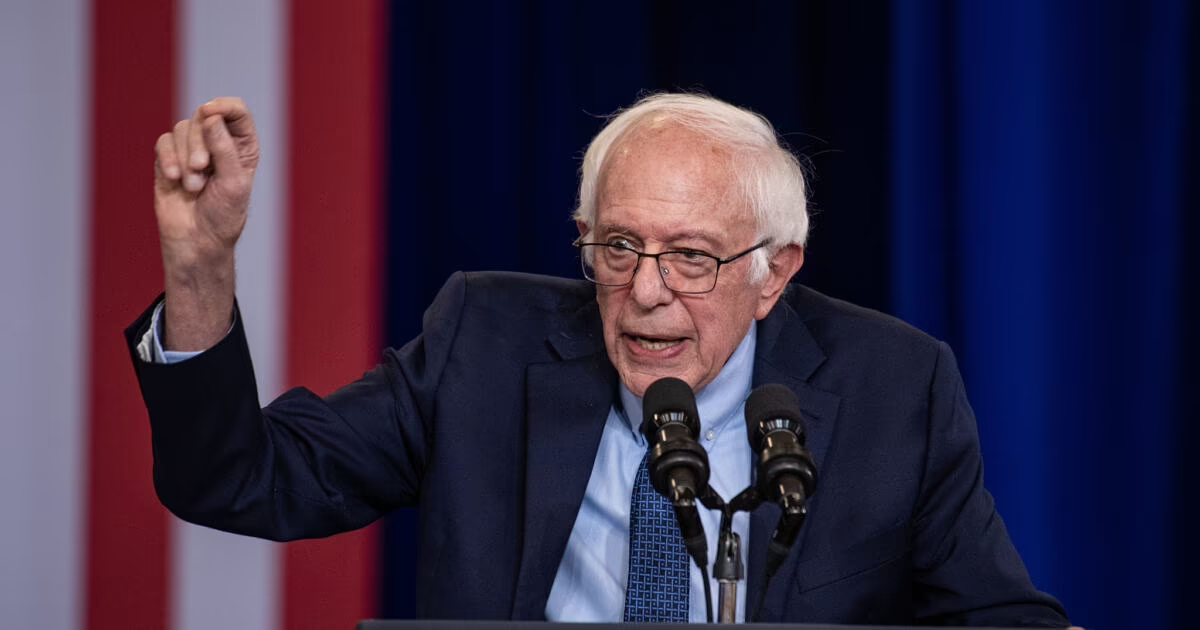
Washington, D.C- For decades, support for Israel has been one of the few constants in American foreign policy, surviving changes in administrations, party control, and shifting geopolitical priorities. Republicans and Democrats have often differed over settlements, peace negotiations, and regional strategy, but they have remained largely united in preserving military aid and diplomatic protection for Israel. That bipartisan consensus, however, is beginning to fracture under the weight of the Gaza war. Senator Bernie Sanders has long been one of its most persistent critics, but his latest remarks are significant not because they represent a new position, but because they increasingly reflect a broader shift in American public opinion that Washington can no longer afford to dismiss.
Sanders’ charge that the United States is “complicit” in what is happening in Gaza is among the sharpest indictments ever delivered by a sitting U.S. senator against his own government’s Middle East policy. His argument is straightforward: after providing tens of billions of dollars in military assistance while continuing to shield Israel diplomatically, Washington cannot plausibly claim to be a bystander to the destruction unfolding in Gaza. Whether one agrees with Sanders’ characterization of Israeli policy or his description of Prime Minister Benjamin Netanyahu as a war criminal is almost secondary. His larger point is that American military support carries political and moral consequences, making the United States inseparable from the conduct of the war it continues to finance.
Sanders argues that Israel’s military campaign has evolved well beyond its stated objective of defeating Hamas. Pointing to Israel’s reported control of roughly 70 percent of Gaza and the establishment of dozens of military positions throughout the territory, he contends that the conflict increasingly resembles an open-ended project of military domination rather than a temporary wartime operation. If that perception continues to spread, the central international debate will shift away from questions of proportionality or battlefield tactics toward a more fundamental question: whether Israel is laying the foundations for a permanent occupation of Gaza under another name.
The implications extend well beyond Israel itself. For decades, successive American administrations have presented the United States as the principal defender of a rules-based international order founded on respect for sovereignty, international law, and the protection of civilians. Yet critics increasingly argue that those principles are applied selectively, particularly when Israel is involved. The resulting perception of double standards has weakened American credibility across much of the Global South, where Washington’s repeated appeals to international law are increasingly viewed through the lens of its unwavering support for Israel despite mounting civilian casualties and widespread humanitarian devastation.
Perhaps the most politically significant element of Sanders’ remarks is his insistence that the American public is moving faster than its elected representatives. He argues that growing numbers of Democrats, Republicans, and independents now favor ending unconditional military assistance to Israel and want Washington to use its considerable leverage to halt the war and alleviate Palestinian suffering. Polling over the past two years has pointed to widening generational divisions over the conflict, with younger Americans expressing significantly greater skepticism toward Israel’s military campaign and stronger support for conditioning U.S. military assistance. Congress has historically been slower than the electorate to adjust its positions on Israel, but political consensus rarely changes from the top down. It erodes first among voters before eventually reshaping legislative priorities.
Sanders has expanded that critique to include the war against Iran, arguing that it violated both the U.S. Constitution and international law and should never have begun. His call for negotiations reflects a broader rejection of the interventionist assumptions that have shaped American policy in the Middle East for a generation. After the costly experiences of Iraq, Afghanistan, Libya, and Syria, many Americans have become deeply skeptical of military solutions that promise quick victories but produce prolonged instability. Sanders contends that another extended confrontation with Iran would repeat those mistakes while imposing significant economic costs at home through higher energy prices, rising inflation, and increased financial pressure on American households.
His criticism of Israel’s military operations in both Gaza and Lebanon also reflects a notable transformation in the language of American politics. Terms such as occupation, apartheid, ethnic cleansing, and genocide, once largely confined to academic debate and human rights organizations, now appear regularly in congressional speeches, university campuses, and mainstream political discourse. Regardless of whether one accepts those characterizations, the vocabulary itself illustrates how profoundly the national conversation has changed. The boundaries of acceptable criticism have expanded, and arguments that were once politically marginal have become increasingly difficult to dismiss.
The significance of Sanders’ intervention therefore extends beyond the substance of his criticism. He is articulating a broader political realignment that challenges assumptions that have governed U.S.-Israel relations for decades. The institutional foundations of that relationship remain formidable, and there is little reason to expect an immediate reversal of American policy. Yet political transformations seldom occur suddenly. They begin when the public ceases to accept long-standing orthodoxies and elected officials gradually find themselves responding to a new political reality.
Sanders did not create that reality, but he has become one of its clearest and most influential voices. Whether Congress ultimately embraces his conclusions remains uncertain, but the questions he is raising have clearly moved from the political margins to the center of the national debate. The real test is no longer whether Washington can silence criticism of its Israel policy, but whether it can continue to ignore an American electorate that is becoming increasingly unwilling to accept unconditional support for a war whose human, legal, and strategic costs are mounting by the day.
שתף את דעתך
Bernie Sanders Is Saying What Washington Can No Longer Ignore