






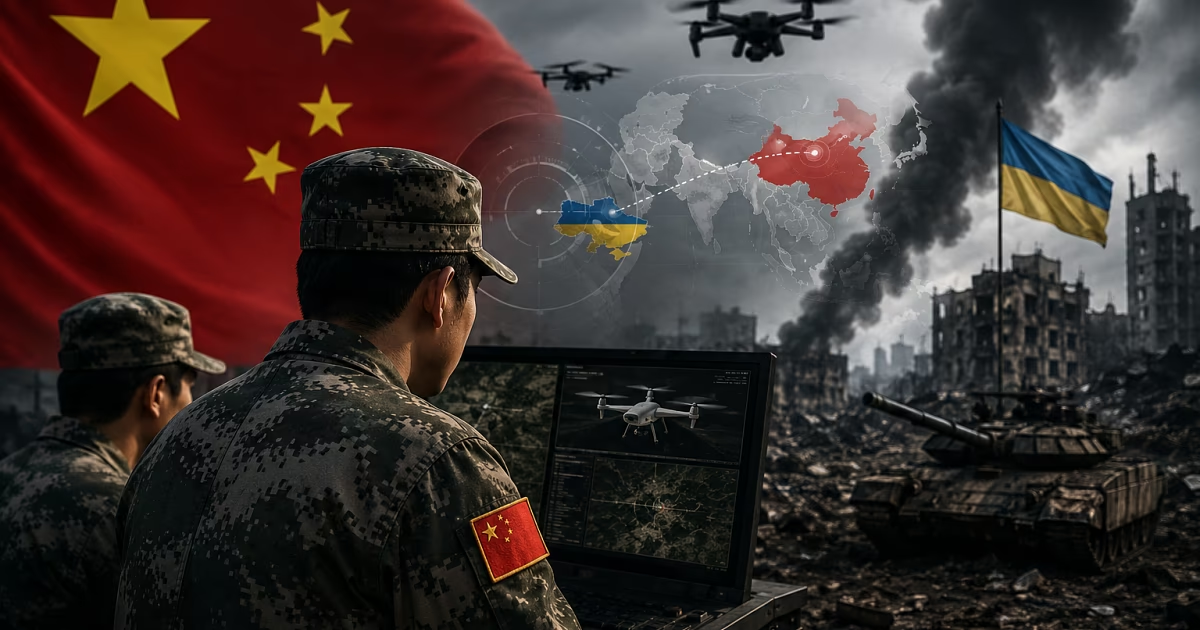
China's view of the ongoing war in Ukraine has transcended the boundaries of a traditional geopolitical crisis, transforming into a rare strategic opportunity to extract field lessons. Through observing this conflict, Beijing seeks to address the clear lack of combat experience in its army, which has not participated in large-scale conflicts for many decades.
International media sources reported that Beijing now views the Ukrainian arena as a practical laboratory for studying modern combat methods. This includes analyzing field tactics and advanced military technologies that have proven effective or failed in actual and ongoing combat conditions.
Since early 2024, Russia has begun implementing specialized training programs for elements of the Chinese army, primarily focusing on drone operation. These trainings aim to transfer experiences gained from confronting Western technologies in highly complex geographical and electronic environments.
Chinese military experts are focusing on studying a wide range of technologies that have emerged in the war, especially offensive and reconnaissance drones. Chinese interests also include developing jamming and electronic warfare technologies to counter the potential technological superiority of adversaries in any future conflict.
Particular interest has emerged in fiber-optic guided drones, a technology aimed at effectively reducing the impact of hostile jamming systems. Beijing also seeks to integrate artificial intelligence into managing complex military operations and organizing the battlefield based on data derived from the Ukrainian fronts.
Joint military exercises between China and Russia have seen significant development recently, now including simulations of confronting swarms of drones. These exercises also focused on enhancing integrated air defense capabilities and conducting advanced naval operations involving attack submarines.
Military cooperation between the two countries is not limited to tactical field aspects but extends to exchanging expertise in highly sensitive technical areas. Among these areas are noise reduction technologies in nuclear submarines, which gives Beijing a strategic advantage in underwater stealth.
The technical partnership also includes the development of long-range air defense systems and early warning capabilities against missile attacks. This type of cooperation provides China with a golden opportunity to develop its defensive capabilities by benefiting from direct Russian experience in managing a large-scale war of attrition.
Observers believe that these moves enhance the Chinese army's readiness to deal with unconventional combat patterns that future wars may impose. Beijing considers that good preparation requires understanding all technological changes that have occurred in military doctrines over the past two years.
The issue of Taiwan remains strongly present in Chinese calculations when analyzing the results of the war in Ukraine and how to counter external interventions. Serious questions arise about the extent to which this acquired experience can be utilized in any potential confrontation in the Taiwan Strait, despite the absence of any official decision for military action.
Ultimately, Beijing no longer sees the Ukrainian war as merely a regional conflict far from its borders and direct interests. Instead, this war has become a primary source of lessons that may reshape Chinese military strategy and combat readiness in the coming years.
For China, the war in Ukraine has transformed from a geopolitical crisis into an opportunity to extract military lessons and bridge the gap in combat experience.
שתף את דעתך
The Ukrainian Laboratory: How China Extracts War Lessons to Develop Its Army?