





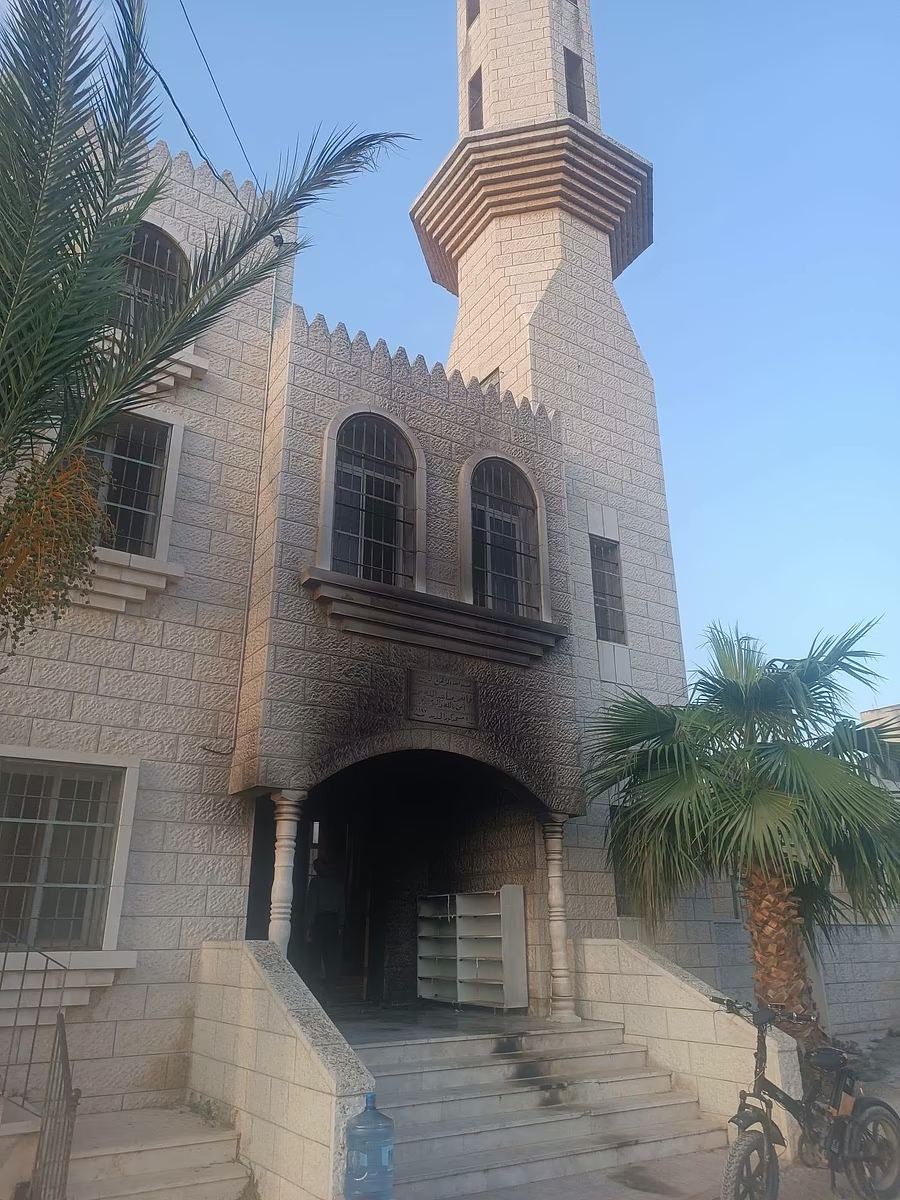
Abdullah Abu Rahma: The current government is investing its remaining time before the Israeli elections to intensify settlement expansion and control over land amidst competition among right-wing parties. Khalil Tafakji: The approaching elections and the Likud party's decline in opinion polls are pushing Netanyahu to strengthen rhetoric and policies supporting settlement, given the consensus on it. Fayez Abbas: The election campaign period is expected to witness an additional escalation in these attacks on Palestinian villages and towns, as they enjoy popular support within Israel. Dr. Suhail Diab: Netanyahu seeks to exploit these developments by presenting the upcoming elections as a confrontation between those who reject the establishment of a Palestinian state and those accused of seeking it. Numan Tawfiq Al-Abed: The continuation of these policies may lead to a widespread explosion and perhaps a new intifada of a different nature, with the widening scope of friction between settlers and Palestinians. Dr. Tamara Haddad: The escalation of attacks by the occupation and its settlers is not only linked to electoral calculations but is consistent with a strategic settlement project aimed at annexing the West Bank. Ramallah - Exclusive to "Al-Quds" - The pace of settler attacks in the West Bank is accelerating in parallel with the approaching Israeli Knesset elections, amidst warnings that the field escalation reflects the fierce competition within the right-wing camp to win voters' support by adopting more hardline policies towards Palestinians. Specialists, experts, officials in settlement resistance, writers, political analysts, and experts in Israeli affairs, in separate interviews with "Al-Quds", view the increasing attacks on Palestinian villages, the latest of which was in the village of Tal southwest of Nablus, leading to the martyrdom of four citizens and the killing of two Israeli soldiers, and continuous settlement expansion, and imposing new realities on the ground, as a scene that transcends the security dimension to become part of an electoral battle waged at the expense of Palestinian blood, with right-wing parties seeking to present themselves as the most capable of expanding settlements and thwarting any future political path. Despite acknowledging that what is happening is being exploited in the electoral context, they agree that what is happening cannot be reduced to mere election propaganda, but rather falls within a long-term strategic project aimed at changing the geographical and demographic reality in the West Bank, through intensifying settlement, linking settlement outposts, weakening the Palestinian presence, and imposing control over the largest possible area of land. However, the approaching elections give this project additional momentum, amidst a race among right-wing parties to prove their hardline stance, and exploit the field escalation to strengthen their electoral presence. They warn that the continuation of attacks on Palestinian villages, along with tightened military measures, may push the situation towards a more dangerous stage, with the increasing possibility of an explosion in the West Bank, calling for more effective Palestinian and international action to stop settlement policies and provide protection for civilians, amidst fears that the Israeli electoral competition will become a factor driving further violence, settlement expansion, and the imposition of realities that will be difficult to change in the future. A very dangerous development. The acting deputy head of the Wall and Settlement Resistance Commission, Abdullah Abu Rahma, confirms that what happened in the village of Tal southwest of Nablus and the neighboring villages and towns represents a very dangerous development, and reflects the settlers' transition to a new stage in implementing their plans, based on directly targeting Palestinian villages, after the focus in recent years was on Bedouin communities and small Palestinian communities scattered throughout the West Bank. Abu Rahma explains that the recent attacks indicate that the current stage targets Palestinian villages themselves, by storming them, taking control of homes, and expelling citizens from them, coinciding with an unprecedented escalation in the level of violence. Abu Rahma confirms that attacks previously focused more on Palestinian property, by targeting agricultural lands, trees, livestock farms, industrial facilities, vehicles, and homes, but the current reading shows an acceleration in the implementation of the plan, so that it now directly targets Palestinians, reflecting a transition to a stage of killing and liquidating citizens. Creating an expelling environment for Palestinians. Abu Rahma believes that these settlement groups are proceeding with their program to achieve a goal of creating an expelling environment for Palestinians and forcing them to leave, stressing that this is happening in parallel with Israeli army measures, through closing roads, imposing sieges, and carrying out arrests against citizens who try to defend themselves, in addition to imposing fines on them, considering that these measures constitute an integrated system between the army and settlers and what the government and Knesset approve of laws, thus providing cover for the continuation of violence against Palestinians. Elections contribute to strengthening the settlement path. Abu Rahma believes that what is happening is not directly related to Israeli election propaganda, although elections contribute to strengthening this path, explaining that the plan was prepared years ago, and went through stages that began with writing slogans on Palestinian property, then attacking property, leading to the killing of Palestinians. Abu Rahma confirms that the current government is investing its remaining time before the upcoming Israeli elections to intensify settlement expansion and control over land, amidst competition among right-wing parties, foremost among them the parties of Itamar Ben-Gvir and Bezalel Smotrich, in addition to the Likud party. Consistency with the decisive plan. Abu Rahma indicates that these policies are consistent with what Smotrich proposed in 2017 under the name "The Decisive Plan," which he said is based on displacing Palestinians and forcing them to leave, explaining that targeting and besieging villages aims to push residents to move from their outskirts to their centers, then to cities, in preparation for emigration outside Palestine. Abu Rahma believes that the implementation of these plans will not be easy, because Palestinians will defend their existence, as what happened in Tal warns of the possibility of an explosion of the situation, given the citizens' insistence on resisting these policies and thwarting their goals. Replacement and emptying policy. The expert in settlement affairs, Dr. Khalil Tafakji, confirms that what the West Bank is witnessing, especially the village of Tal and its surrounding villages, falls within an Israeli policy based on "replacement and emptying," and aims to empty the areas that Israel seeks to annex of their Palestinian residents, thus allowing control over the largest possible area of land with the fewest number of residents. Tafakji explains that the villages of Tal, Al-Mughayyir, Turmus Ayya, Al-Lubban Al-Sharqiya, and Al-Sawiya are located opposite a large settlement bloc extending from the Kafr Qasim area towards the Jordan Valley, which makes them a direct target for pressure policies and attacks. Tafakji confirms that the attacks carried out by settlers in these areas cannot be separated from long-term Israeli goals, considering that settlers represent the executive tool of the Israeli government in achieving the annexation project without direct intervention from it, by pushing Palestinians to leave their villages and lands. Transition towards targeting villages. Tafakji indicates that what is happening today resembles what happened previously in the Jordan Valley, where Bedouin communities were subjected to displacement operations, considering that the same policy has now moved to Palestinian villages adjacent to large settlement blocs, pointing out the existence of settlements such as "Bracha," "Yitzhar," and "Kedumim" within this settlement extension. Tafakji explains that demographic shifts in the number of settlers have reinforced this trend, explaining that at the signing of the Oslo Accords, the number of settlers in the West Bank, excluding Jerusalem, was approximately 115,000, while today it is about 520,000 settlers, which has given the settlement movement greater weight in imposing its vision that considers the West Bank part of the "Hebrew state" and the "Promised Land," and is based on a strict religious doctrine. Netanyahu and electoral exploitation of what is happening. Tafakji links the escalation of attacks with the Israeli political scene, considering that the approaching elections and the decline of the Likud party in opinion polls are pushing Prime Minister Benjamin Netanyahu to strengthen rhetoric and policies supporting settlement, given an Israeli consensus on settlement and Jerusalem, citing the incursions into Al-Aqsa Mosque and the ongoing developments in the West Bank. Tafakji believes that the ultimate goal is to impose a fait accompli before any potential international pressure related to the establishment of a Palestinian state, stressing that Israel does not recognize this option, but rather views the area between the river and the sea as one state. Fears of expanding attacks. Tafakji describes what is happening in the West Bank as an "ethnic cleansing operation," indicating that its implementation is carried out by ideological settlers, including groups of "hilltop youth" and extremist right-wing currents, supported by weapons. He explains that settler attacks are not limited to the village of Tal, but extend to other villages in the West Bank, and are expected to later affect other villages near the Green Line, considering that continued American support for Israel and the absence of effective international pressure contribute to the continuation of these policies on the ground. Official Israeli policy. The writer specializing in Israeli affairs, Fayez Abbas, believes that what the village of Tal southwest of Nablus and neighboring villages witnessed in terms of settler incursions and attacks falls within an official Israeli policy being implemented in the West Bank for about four years, coinciding with the assumption of responsibility for managing the occupied West Bank by political, security, and military figures from the Israeli right. According to Abbas, these leaders have given the "green light" to settlers to carry out attacks including killing, burning, bulldozing, and displacing Palestinians from their homes and lands, stressing that what happened in Tal represents a practical continuation of this policy. Imposing new realities on the ground. Abbas confirms that the ruling settlement right in Israel seeks to intensify its activity in the West Bank with the aim of imposing new realities on the ground, by expanding field control, dissecting the West Bank, and transforming it into isolated cantons, which leads to suffocating Palestinian citizens and strengthening Israeli control. Electoral escalation with blood. Abbas indicates that this trend is also linked to the political reality within Israel, explaining that opinion polls indicate the possibility of the right losing the upcoming elections and not returning to power, which pushes it to accelerate the implementation of its current policies before any potential government change. He believes that any new government may try to reduce these practices, but Abbas rules out their complete cessation, considering that the continued control of security leaders belonging to the fascist right, many of whom are settlers, will keep this policy in place. Abbas expects that the Israeli election campaign period will witness an additional escalation in these attacks on Palestinian villages and towns, as they enjoy popular support within Israel. A clear imbalance of power. The professor of political science and specialist in Israeli affairs, Dr. Suhail Diab, believes that what the village of Tal and neighboring villages witnessed on Friday, in terms of attacks and violations, reflects an extended situation in the West Bank, represented by a clear imbalance of power between the Palestinian people on the one hand, and the Israeli government, settlers, and right-wing currents on the other. Diab considers that what happened represents an expression of a long-term strategy aimed at subjugating Palestinians and liquidating the Palestinian issue geographically and demographically, rather than being an isolated event. "Tal" and self-defense. Diab confirms that the recent settler attacks are not an exception, but rather an extension of a daily reality witnessed in the West Bank, citing UN reports indicating more than 1900 attacks carried out by settlers against Palestinians, and the evacuation of more than 118 residential communities and inhabited areas during the last three years, in addition to the establishment of 104 new settlements and 189 new settlement outposts, considering that these indicators reflect the magnitude of the transformation taking place on the ground. Diab confirms that what distinguished the events of the village of Tal this time is that Palestinian citizens did not content themselves with receiving the attacks, but rather tried to defend themselves, considering that this reflects the magnitude of the pressures faced by Palestinian villages, given the unequal capabilities between Palestinians and the occupation and "settler militias," in addition to the absence of an effective role for the international community, the continued Arab and Islamic silence, and the lack of a comprehensive Palestinian national project that strengthens the steadfastness of citizens and farmers on their lands. The need for a broader political vision. Diab believes that confronting this reality requires a broader political vision than merely describing violations, based on formulating a comprehensive Palestinian national project that supports the Palestinian presence on the ground, in parallel with effective international action that puts an end to the occupation's savagery, including demanding the dispatch of a UN force to provide protection for Palestinian citizens in the West Bank. Diab believes that the ongoing attacks are not directly related to the Israeli election campaign, but rather stem primarily from a strategic vision adopted by the Israeli government and settlers to change the geographical and demographic reality, considering that elections represent a factor for political gain from these developments, not their primary motive. Electoral exploitation of developments. Diab explains that Israeli Prime Minister Benjamin Netanyahu seeks to exploit these developments electorally by presenting the upcoming elections as a confrontation between those who reject the establishment of a Palestinian state and those accused of seeking it, while the right-wing arena is witnessing a parallel competition between the Likud party and both Itamar Ben-Gvir and Bezalel Smotrich to attract far-right votes, which is reflected in the escalation of policies in the West Bank. Diab indicates that this escalation may not necessarily achieve electoral gains for Netanyahu, warning that the widening Palestinian, Arab, and Islamic reactions, and the possibility of an explosion of the situation in the West Bank and the outbreak of a new intifada before the elections, may overturn the equation and limit the ability of any party to exploit these events electorally. Settlement decisiveness. The writer, political researcher, and specialist in international relations, Numan Tawfiq Al-Abed, confirms that what settlers are carrying out in the West Bank, and the accompanying settlement expansion, falls within the implementation of Smotrich's "Decisive Plan," considering that the occupation government has directly approved it and is working to implement it on the ground by controlling the largest possible area of West Bank lands and establishing a new settlement reality. Al-Abed explains that the plan is based on several axes, most notably "settlement decisiveness," through seizing Palestinian lands using various pretexts, including state lands, pastoral settlement, military outposts, and expanding existing settlements, which leads to an increase in the number of settlers at the expense of the original landowners, and a reduction in the areas available to Palestinians, in addition to establishing bypass roads and buffer zones, and creating a settlement presence within Palestinian neighborhoods with the aim of presenting it as normal and permanent. Organized attacks. Al-Abed indicates that settlers, according to this vision, play an organized role that includes restricting Palestinians, carrying out attacks against residents, and expanding settlements, stressing that this is happening after they are armed by the Israeli government, and provided with legal and political cover, in addition to the field protection provided by the occupation army, and even its participation in some of these practices. Al-Abed considers that what is happening is not reactions or individual actions, but rather the implementation of a clear government plan. Al-Abed links the escalation of these policies with the upcoming Israeli elections, explaining that the Palestinian issue constitutes one of the most prominent tools of election propaganda for right-wing parties, especially extremist religious parties, which seek to attract Israeli voters by adopting more hardline positions. Race against time to resolve the conflict. Al-Abed believes that the current Israeli government is racing against time before the elections scheduled for the end of October to implement its vision regarding "resolving the conflict" and imposing new realities on the ground. Al-Abed indicates that this policy is not limited to the West Bank, but also includes East Jerusalem, by restricting Palestinian residents, seizing homes, preventing construction, and linking settlements surrounding the city, which is consistent with Smotrich's statements regarding expanding the municipal boundaries of Jerusalem and preventing the establishment of a Palestinian state. He believes that these policies present Palestinians with three options: accepting to live without political or sovereign rights and contenting themselves with limited civil and economic rights, or emigrating due to tightening living conditions, or confronting military force if these policies are rejected, considering that attacks on homes, mosques, and lands fall within this framework. He confirms that the continued implementation of this plan is based on the Palestinian weakness, regional preoccupation, and American support for Israel, calling for unified Palestinian action, and Arab action through the League of Arab States, in addition to international efforts from the Security Council and European countries to pressure the American administration to stop these policies. Al-Abed warns that the continuation of these policies may lead to a widespread explosion in the West Bank, and perhaps a new intifada of a different nature, with the widening scope of direct friction between settlers and Palestinians. An additional link in the chain of organized violence. The writer and political researcher, Dr. Tamara Haddad, confirms that the attacks carried out by settlers in the village of Tal southwest of Nablus, along with attacks targeting other neighboring villages and towns and in other parts of the West Bank, represent an additional link in a escalating chain of organized violence in the West Bank, but they differ in terms of timing, size, and the nature of the political and field messages they carry. Haddad explains that what happened goes beyond being friction between settlers and Palestinians, to reflect a policy aimed at imposing new realities on the ground through the use of violence to reshape the geography and demography in the West Bank. Integration of roles. Haddad indicates that the targeting of Palestinians and their property coincides with tightened Israeli military measures, which reflects an integration of roles between settlers and the Israeli army, as settlers often move under the protection of the army and in the absence of any intervention to stop their attacks, which reinforces the impression that these attacks are not individual acts, but rather part of a broader strategy to increase pressure on Palestinians and push them to leave their areas. Elections and showing greater toughness against the West Bank. Haddad stresses that the escalation of these attacks comes amidst fierce competition among leaders of right-wing parties in Israel to show greater toughness towards the West Bank, explaining that the West Bank has become one of the most important arenas of political competition, where each party seeks to present itself as the most capable of expanding settlements, tightening security control, and imposing Israeli sovereignty over the largest possible area of Palestinian lands. A strategic settlement project targeting the West Bank. Haddad believes that this escalation is not only linked to electoral calculations, but is consistent with a strategic settlement project aimed at annexing the West Bank, noting that the approaching political deadlines or increasing pressure on the government are usually accompanied by an escalation of right-wing rhetoric and field measures. Haddad confirms that reducing what is happening to an election campaign is not enough, because the current attacks are consistent with a broader project based on expanding settlements, linking settlement outposts, and weakening the Palestinian presence in areas classified (B) and (C), leading to the creation of a reality that makes any future political settlement more difficult. Preparing public opinion to adopt harsher policies. Haddad believes that the statements of ministers in the Israeli government, especially calls to deal with some West Bank villages in the same way that the Gaza Strip was dealt with, reveal a shift in rhetoric from the level of threat to preparing Israeli public opinion to adopt harsher policies through military operations and imposing collective restrictions. In her reading of the upcoming scene, Haddad expects three main scenarios. The first is the continuation of the escalation, with intensified incursions, settler attacks, settlement expansion, and tightened security restrictions. The second scenario is the implementation of a broader Israeli military operation in the northern West Bank, especially in Nablus, Jenin, and Tulkarm. The third scenario is based on the Israeli government exploiting the escalation to accelerate undeclared annexation projects, expand settlements, and weaken the Palestinian presence. Haddad confirms that all these indicators reflect an integrated policy to redraw the field and political reality in the West Bank, warning that its continuation may lead to radical changes, with the possibility of a new intifada remaining, although its timing cannot be predicted.

שתף את דעתך
Escalation by settlers.. Palestinian blood as a ballot paper