






Urgent
Urgent: Washington's Message
Washington – Said Arikat - 24/7/2026
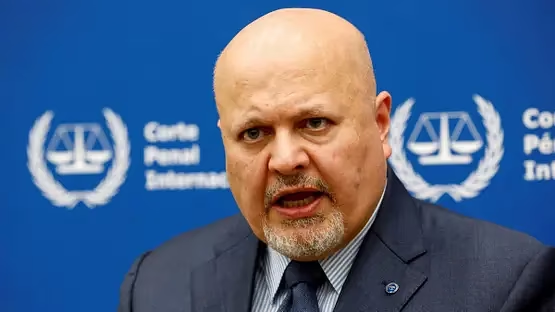
In one of the most controversial stations in the history of the International Criminal Court, member states voted to dismiss the Court's Prosecutor, Karim Khan, from his position, in a precedent of its kind since the Court's establishment. The decision came after long months of investigations and accusations related to sexual misconduct, but it simultaneously reignited the debate about whether the case was purely legal, or if it was influenced by the political context surrounding Khan's decision to issue arrest warrants against Israeli Prime Minister Benjamin Netanyahu and his former Defense Minister Yoav Gallant in connection with the war in Gaza.
The vote was by secret ballot, with 82 members supporting Khan's dismissal, 13 opposing, and 15 abstaining. This is the first time a Prosecutor of the Court has been removed by this mechanism, reflecting the extent of division within the international judicial institution regarding the issue.
Accusations began within the Court
The roots of the case date back to May 2024, when a young legal officer who worked directly under Khan's supervision filed an internal complaint, stating that the Prosecutor, shortly after she joined his office in March 2023, began to exert sexual pressure on her, including repeated attempts to approach and touch her without her consent.
According to her account, these actions continued for months, in an unequal professional relationship that made it impossible, she said, to speak of any consensual relationship, given that Khan was “her direct superior and the head of all Court staff.”
These accusations came at a very sensitive time, as the Court was preparing to announce the issuance of arrest warrants against Netanyahu and Gallant, along with a number of Hamas leaders, including Yahya Sinwar, Ismail Haniyeh, and Mohammed Deif. Information indicates that the decision to issue the warrants had already been made before Khan was informed of the complaint against him.
Khan denies… and the investigation expands
Khan rejected all accusations from the outset, asserting that they were "completely baseless," and said that he had spent thirty years in judicial and international work without any similar complaint being made against him.
In November 2024, the Court announced the opening of an independent external investigation, before Khan decided, in May 2025, to temporarily step down and take administrative leave pending the conclusion of the investigations.
During that period, a second complaint emerged from a former intern in the Prosecutor's office, who stated that Khan used to invite staff to work from his home, and that each time, he would try to harass, touch, kiss, and push her towards an intimate relationship, which his defense team categorically denied.
Mixed investigation results
Last March, the investigation concluded that there was evidence indicating "non-consensual sexual contact," however, a judicial panel of three judges found that the evidence did not rise to the level of proving a legal violation warranting conviction under the Court's Statute.
But the Court's Executive Office was not satisfied with this, and decided to continue with disciplinary proceedings, before suspending Khan's work in June, and then later concluded that he had engaged in an inappropriate relationship with a subordinate employee, which it considered sufficient grounds for terminating his service.
A few days before the final vote, the first complainant gave her first television interview, confirming that the pressures she was subjected to lasted for about a year, and that she was later pressured to withdraw her statements or claim that they were fabricated, accusations that Khan also denied.
Division over justice and procedures
Despite the dismissal decision, the debate within legal and human rights circles has not ended. The former Executive Director of Human Rights Watch, Kenneth Roth, considered that the case concerned Khan's personal conduct and not his legal positions towards Israel or others, stressing that the Court's credibility requires accountability for any official proven to have committed ethical transgressions.
In contrast, more than 180 Palestinian and international organizations issued a joint statement affirming that they do not take a position on the validity or invalidity of the accusations, but expressed concern that the disciplinary procedures may have been mixed with political considerations, especially in light of the pressure and sanctions campaign the Court faced from the United States and Israel.
These organizations also warned that the Court's Executive Office, as a political body comprising diplomats, is not the most appropriate body to override judicial assessments issued after reviewing thousands of pages of evidence and testimonies, considering that this could weaken the Court's independence and undermine confidence in the rule of law.
Escalating American and Israeli pressure
These developments come at a time when the International Criminal Court is facing an unprecedented campaign of political pressure.
Since the issuance of arrest warrants against Israeli officials, the administration of US President Donald Trump has imposed new sanctions on Court officials, after Trump's first administration had imposed similar measures following the opening of an investigation into potential US war crimes in Afghanistan.
Israel, according to multiple reports, has also intensified its campaigns aimed at undermining the Court's work and questioning its officials, while US Secretary of State Marco Rubio, just days before the vote, announced the launch of a campaign aimed at “dismantling” the International Criminal Court and reducing its influence.
In contrast, the main complainant stressed that her case has nothing to do with Israel or the Gaza file, affirming that she fully supports the Court's investigations into crimes committed in the Palestinian territories, and that mixing personal accusations with political files has harmed her rights and the case itself.
Karim Khan's dismissal opens the door to a highly sensitive question regarding the International Criminal Court's ability to separate the ethical accountability of its officials from its judicial independence. On the one hand, ignoring serious accusations could undermine the institution's credibility, and on the other hand, the timing of the case coinciding with unprecedented legal prosecutions against Israeli officials, and with escalating American and Israeli pressure on the Court, makes it difficult to convince many that the two paths are completely separate. This explains the continued international division over whether justice has taken its course or has been affected by political polarization.
The crisis also reveals the fragility of international judicial institutions when they enter into direct confrontation with major international powers. Since the start of investigations related to the war in Gaza, the Court has been subjected to unprecedented political and media campaigns and economic sanctions, which has put its independence to a difficult test. Although the investigation into Karim Khan's conduct was based on internal complaints and institutional procedures, its timing and the way it was handled will remain a subject of long debate, especially in the absence of a clear legal consensus on the final results of the investigation.
As for the cases pending before the Court, Karim Khan's departure is not expected to lead to the cancellation or dropping of arrest warrants issued against Israeli officials or others, as these decisions are issued in the name of the Court and are not linked to the Prosecutor alone. However, the crisis may give the Court's opponents an additional opportunity to question its legitimacy and credibility, and may also delay some sensitive files until a new Prosecutor capable of restoring internal and external confidence in an institution facing one of the most serious crises in its history is appointed.
שתף את דעתך
Karim Khan's Dismissal Shakes the International Criminal Court: Between Allegations of Sexual Misconduct and Political Pressure in the Gaza File