






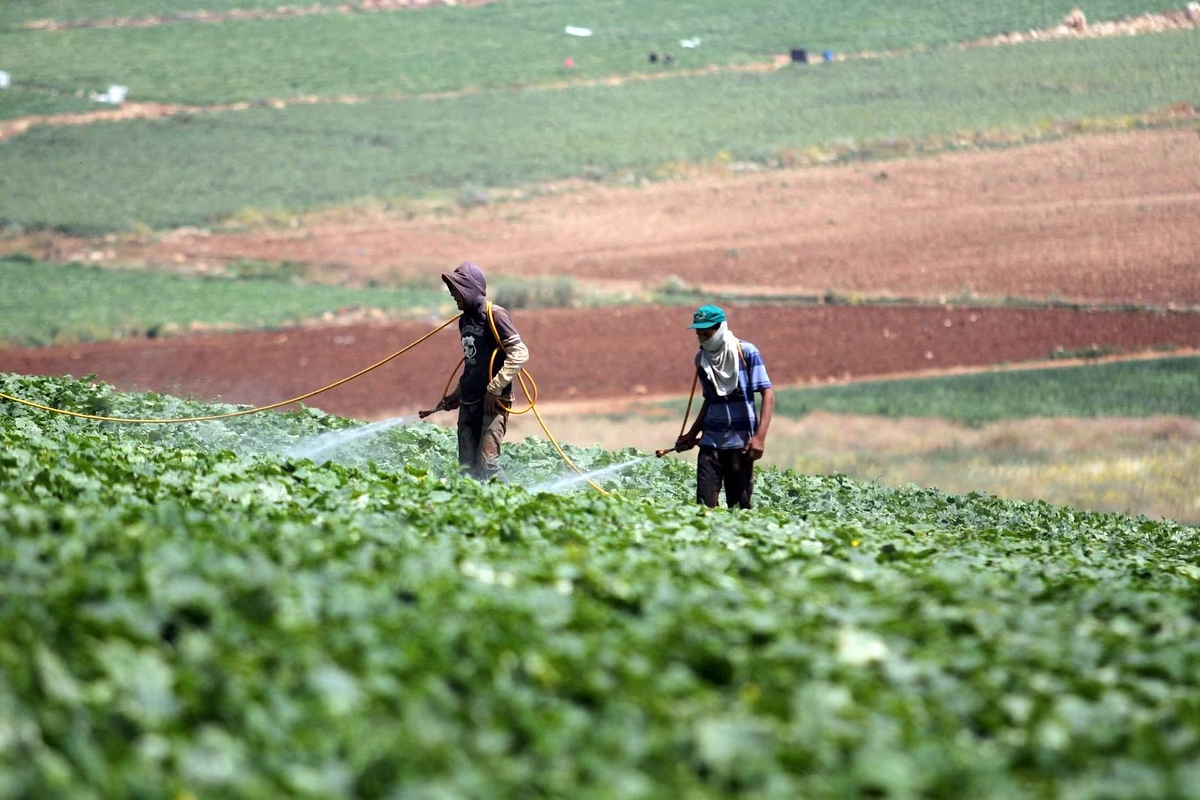
The crisis of Palestinian agriculture is not a crisis of seasons, nor a climate crisis, nor even a funding crisis. It is, at its core, a political and strategic crisis that reflects the nature of the conflict over land, economy, and sovereignty. Since the establishment of the Palestinian Authority after the Oslo Accords, agriculture has declined not only due to economic factors, but as a result of a complex interaction between systematic Israeli policies aimed at undermining the foundations of Palestinian production, and Palestinian policies that failed to transform agriculture into a fundamental pillar in the project of building the state and the national economy.
Historically, agriculture was not merely an economic activity for Palestinians; it was one of the most important tools for holding onto land and preserving the relationship between people and place. Therefore, targeting it was not just targeting a productive sector, but an assault on one of the foundations of national existence and steadfastness.
Perhaps the most dangerous outcome of the post-Oslo period was not only the re-division of Palestinian land into Areas (A), (B), and (C), but the reshaping of the Palestinian economy itself. The economy gradually shifted from an economy striving for production, despite limited resources, to a restricted economy increasingly dependent on imports, services, and aid, while productive sectors, primarily agriculture, declined.
Israel realized early on that control over land is not completed by walls and checkpoints alone, but by weakening the Palestinian's ability to invest in their land and remain on it. Therefore, Israeli policies towards the agricultural sector were not isolated measures, but part of a broader path to reshape geography and economy together.
Land confiscation, settlement expansion, control over water resources, restricting farmers' access to their lands, and controlling crossings and markets have made the agricultural sector operate within an environment lacking the foundations of economic sovereignty. Pressure tools did not stop at land and water, but extended to various links in the production process.
Agriculture begins before harvest; it begins with seeds, fertilizers, pesticides, equipment, and technology, and only ends with processing, marketing, and export. While the Israeli agricultural sector operates within an advanced system of research, development, control, and technical support, the Palestinian farmer often works in a more fragile environment, characterized by high costs, weak services, and varying quality of some agricultural inputs.
Many farmers point to the declining effectiveness of some agricultural inputs, such as pesticides, fertilizers, and seeds, and their high prices compared to production returns. This issue should not be treated as an individual complaint, but as an indicator of the need for an integrated national system for control, testing, and accreditation that ensures the quality of agricultural inputs and protects the farmer, producer, and consumer.
The effects of this problem are not limited to decreased productivity, but extend to increased risks of losing agricultural seasons, higher production costs, and a decline in the competitiveness of Palestinian products in local and foreign markets. The gap between Palestinian and Israeli agriculture lies not only in the type of inputs used, but in the entire production system; from scientific research and variety development, laboratories, and agricultural extension, to technology, financing, processing, and marketing.
Three Decades of Structural Decline
Economic indicators reveal the extent of the transformation that has affected the status of Palestinian agriculture over the past three decades. Agriculture's contribution to GDP declined from about 13% in the mid-1990s to about 6% in recent years. The percentage of workers in the agricultural sector also decreased from levels ranging between 12% and 16% during the early years of the Palestinian Authority to about 6%-7% in recent years.
These figures do not merely reflect economic changes, but reveal a deeper shift in the position of agriculture within the Palestinian economy; it moved from a central productive sector to a sector that lost part of its strategic weight due to political and economic restrictions, weak investment, and the absence of an integrated development vision.
Continued restrictions on land utilization, especially in classified Area (C), and increased reliance on food imports, have also made Palestinian food security more fragile in the face of political and economic crises.
However, reducing the crisis to the occupation alone, despite its primary responsibility, does not absolve the Palestinian side of the responsibility for review. After more than three decades, Palestinian policies have not succeeded in making agriculture a real national priority, nor has a vision been built that makes it part of an integrated economic project linking agriculture with industry, scientific research, innovation, technology, and value chains.
In political discourse, the Palestinian farmer has become a symbol of steadfastness, but steadfastness cannot remain a mere slogan. The farmer needs a production system that enables them to survive: water, land, reliable inputs, productive financing, and a fair market.
What has happened over the past decades can be described as a dual politicization of agriculture; on the one hand, Israel used agriculture as a tool to control land and markets and weaken Palestinian productive capacity, and on the other hand, Palestinian agriculture remained captive to crisis management and short-term projects, and did not become a central focus in the national development strategy.
The decline of agriculture was not just a loss for an economic sector, but an indicator of a broader imbalance in the Palestinian economic model; a model that became more dependent on imports, more linked to the Israeli economy, and less capable of building an independent productive base.
Therefore, saving agriculture should not be viewed as a limited sectoral policy, but as an entry point for rebuilding the national economy on the foundations of production, sovereignty, and self-reliance. Countries facing siege or conflicts do not abandon their productive sectors, but place them at the heart of their national strategies, because they realize that food security is an integral part of national security.
The issue today is not about increasing the number of greenhouses or distributing more seedlings or launching seasonal olive planting campaigns, despite their importance. The issue is deeper: it is about redefining the position of agriculture in the Palestinian national project.
Agriculture is not an administrative file belonging to a specific ministry, but a sovereign issue that intersects with land, water, energy, scientific research, investment, and food security.
This requires a shift from crisis management to a long-term productive strategy based on establishing a national fund for agricultural investment, strengthening agricultural scientific research and linking it to farmers' needs, developing food industries and value chains, building an effective national system for controlling agricultural inputs, and investing in smart farming technologies and sustainable water and energy management.
The future of Palestinian agriculture will not be decided in the fields alone, but in the nature of economic choices and national policies. Sovereignty is not measured only by who raises the flag over the land, but also by who has the ability to produce their food, protect their resources, cultivate their land, and transform their economy from a dependent consumer economy to a productive economy capable of steadfastness.
Restoring dignity to agriculture is not an issue for farmers alone, but it is restoring dignity to the idea of the state itself, and to the national liberation project in one of its most important economic manifestations. If the past three decades have shown how the occupation can use the economy as a tool for hegemony, then the next phase must prove that a productive economy, primarily agriculture, can be one of the most important tools for steadfastness, liberation, and building Palestinian sovereignty.
שתף את דעתך
Palestinian Agriculture... From a Pillar of Liberation to a Battlefield for Economic Sovereignty