






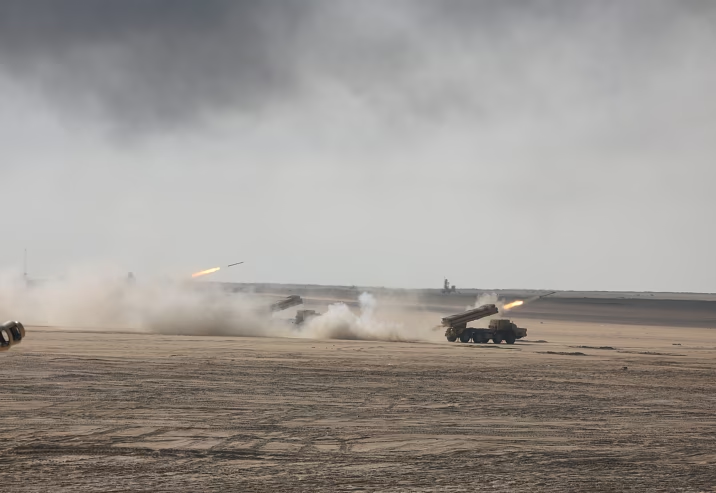
The Arabian Gulf region witnessed a dangerous military escalation today, Tuesday, as authorities in both Kuwait and the Kingdom of Bahrain announced that their territories were subjected to coordinated aerial attacks launched by Iranian forces. Official sources confirmed that the air defense systems in both countries entered a state of maximum alert to deal with waves of missiles and drones that targeted various locations.
In Kuwait, the General Staff of the Army issued an urgent statement clarifying that air defense forces are currently confronting hostile targets resulting from Iranian aggression. The statement indicated that the sounds of explosions heard across the capital and other areas are a result of successful interception operations carried out by defense systems to protect Kuwaiti airspace.
Kuwait's General Staff called on citizens and residents to strictly adhere to security and safety instructions issued by the competent authorities and to stay away from military operation sites. It also stressed the importance of obtaining information from official sources and not being swayed by rumors during these critical circumstances the country is experiencing.
For its part, the official Kuwait News Agency reported that sirens sounded in various governorates to warn residents of imminent attacks. These developments come just hours after a previous attack targeted Kuwaiti facilities, indicating a continuous Iranian escalation aimed at destabilizing the region.
In Manama, the General Command of the Bahrain Defense Force announced the activation of early warning systems and sirens throughout the Kingdom following the detection of an Iranian aerial attack. In an official statement, Bahrain accused Tehran of continuing its systematic aggressive approach through attacks directly targeting civilian areas and safe residents in the Kingdom.
Bahrain's General Command clarified that air defenses were able to intercept and destroy a number of treacherous missiles and drones before they reached their targets. The Bahraini armed forces affirmed that they are at the highest levels of combat readiness and prepared to defend the homeland and protect its assets from any external threat.
Bahraini authorities warned residents not to approach any strange objects or debris resulting from air interception operations, emphasizing that they could pose a danger to public safety. They called on everyone to immediately report any suspicious debris to enable specialized technical teams to deal with and dismantle it safely.
Bahrain's Royal Engineering Unit indicated that its specialized teams are deployed in the field to deal with the repercussions of the Iranian attack. The Bahraini forces stressed that deliberately targeting civilians and private property constitutes a blatant violation of all international humanitarian laws and norms that criminalize such hostile acts.
Internationally, this escalation has raised widespread concerns about navigation security in the Arabian Gulf and the stability of global energy supplies. The International Energy Agency warned that the continuation of armed conflict in this vital region threatens major disruptions in oil markets, calling for the necessity of securing the Strait of Hormuz passage.
In a related context, political observers considered the simultaneous Iranian attacks on Kuwait and Bahrain to represent a dangerous shift in the rules of regional conflict. Analysts pointed out that directly targeting Gulf states reflects Tehran's desire to expand the scope of confrontation and pressure the international community by threatening the security of Washington's allies in the region.
These developments come at a time when the region is witnessing escalating tensions, with increasing warnings of the situation sliding into an all-out war. Major capitals are closely monitoring the situation, amidst expectations of firm international stances regarding the attacks that targeted the sovereignty of two Arab states and endangered civilian lives.
Military sources in both countries concluded by affirming that the armed forces will remain the protective shield against any attempts of aggression. Kuwait and Bahrain affirmed their continuous coordination within the framework of joint Gulf action to confront common threats and ensure the security and stability of the GCC states in the face of current challenges.
Kuwaiti air defenses are currently confronting hostile missile and drone attacks, following the sinful Iranian aggression.
שתף את דעתך
Military Escalation in the Gulf: Kuwait and Bahrain Counter Iranian Missile and Drone Attacks