






Washington Message
Washington – Said Arikat -
The US State Department announced on Monday the start of work on what it described as "experimental zones" in the southern Lebanese villages of Froun, Srifa, and Zawtar Al-Gharbiya, a step it said comes "within the tripartite framework and under the auspices of the special military coordination group for Lebanon," stressing that this step represents a direct outcome of the discussions that brought together Lebanese and Israeli officials in Rome last week.
The ministry added in its statement that the United States will continue to work closely with both the Lebanese and Israeli sides to ensure the implementation of this framework until a "successful conclusion" is reached, a reference that reflects the continued American role as a key sponsor of the ongoing security negotiations between the two parties, after months of military escalation on the southern border.
The American announcement is the first official confirmation that the security understandings have entered the phase of field implementation, after negotiations had revolved around undeclared political and military contacts in recent months. The selection of three southern villages as a prototype indicates the adoption of a gradual approach aimed at testing implementation mechanisms before expanding them to include other areas along the Blue Line.
This step comes at a time when Washington is intensifying its efforts to consolidate the ceasefire and prevent the return of military confrontation between Israel and Hezbollah, amid continued fears of the collapse of the fragile calm achieved after months of widespread clashes that almost escalated into a comprehensive regional war.
Observers believe that the concept of "experimental zones" goes beyond mere local security arrangements, as it includes reorganizing military presence, enhancing the deployment of the Lebanese army, and activating the role of UN forces operating in southern Lebanon (UNIFIL), in line with the American vision for a stricter and more effective implementation of Resolution 1701.
The American statement also reflects the continued reliance on what is known as the "tripartite framework," which includes Lebanon and Israel under American patronage, as the primary mechanism for managing security and border issues, away from any direct political paths between the two countries, which allows both parties to maintain their traditional political positions, while proceeding with practical field understandings.
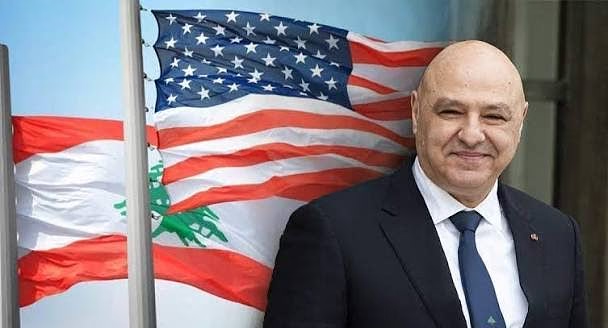
The American announcement gains additional importance because it comes before the anticipated visit of Lebanese President Joseph Aoun to Washington, a visit seen as a pivotal station in Lebanese-American relations, where it is expected that the issues of the South, the implementation of Resolution 1701, the future of military aid to the Lebanese army, and reconstruction will top the agenda of talks with senior American officials.
Diplomatic circles indicate that the American administration wishes for President Aoun to arrive in Washington carrying concrete indicators of the success of the security arrangements in the South, which would give the talks additional momentum, and allow the American administration to present what it considers a diplomatic success in containing one of the most dangerous hotspots in the Middle East.
In return, Lebanon seeks to leverage this American involvement to obtain guarantees regarding the Israeli withdrawal from positions it still occupies within Lebanese territory, the cessation of aerial violations, and the securing of economic and military support that enables the Lebanese state to strengthen its presence in the South, thereby limiting the possibilities of renewed confrontation.
Despite the positive atmosphere that the American statement tries to portray, the success of this experiment is considered weak and will remain linked to the ability of all parties to adhere to their field commitments, especially in light of the accumulated distrust between Lebanon and Israel, and the continued contentious issues related to land borders and disputed points, as well as the future of Hezbollah's weapons and its role in the Lebanese security equation.
In this context, Washington appears keen to transform limited security successes into a long-term political and security path that consolidates stability on the borders and prevents the region from sliding back into a widespread confrontation. However, achieving this goal will remain contingent on regional developments and the extent to which all parties are willing to make mutual concessions that go beyond narrow military calculations.
The launch of "experimental zones" reflects the transition of American mediation from a crisis management phase to a phase of engineering a new security reality in southern Lebanon. The United States is no longer content with merely de-escalating, but seeks to build a gradual model that redefines the rules of military deployment and grants the Lebanese army a greater role on the ground. However, the success of this approach requires a delicate balance between Israeli security demands and Lebanese sovereignty requirements, because any impression that arrangements are being imposed from outside may provoke internal objections and undermine the chances of sustaining the understandings that Washington is working to consolidate.
President Joseph Aoun's visit to Washington gains exceptional importance because it comes at a moment when the American administration is trying to link political and economic support for Lebanon to the success of implementing security arrangements in the South. Washington is likely to offer a package of incentives, including enhanced support for the Lebanese army and assistance in reconstruction, in exchange for continued implementation of security commitments. However, the Lebanese leadership will face the challenge of achieving these gains without giving an internal impression that Lebanese decision-making has become contingent on American or Israeli conditions.
The American initiative also reveals that southern Lebanon has become part of a broader strategy to reshape regional balances after years of escalation. The stability of the Lebanese border is not seen as merely a local goal, but as an entry point to reduce the likelihood of a regional war that could extend to more than one arena. However, any success will remain fragile unless it is accompanied by addressing the political causes of the conflict, foremost among them the continued Israeli occupation of some Lebanese territories, repeated violations of sovereignty, and the absence of a comprehensive settlement that guarantees mutual security and lasting stability.
שתף את דעתך
Launch of experimental zones in southern Lebanon opens a new phase of security arrangements on the eve of Aoun's visit to Washington