






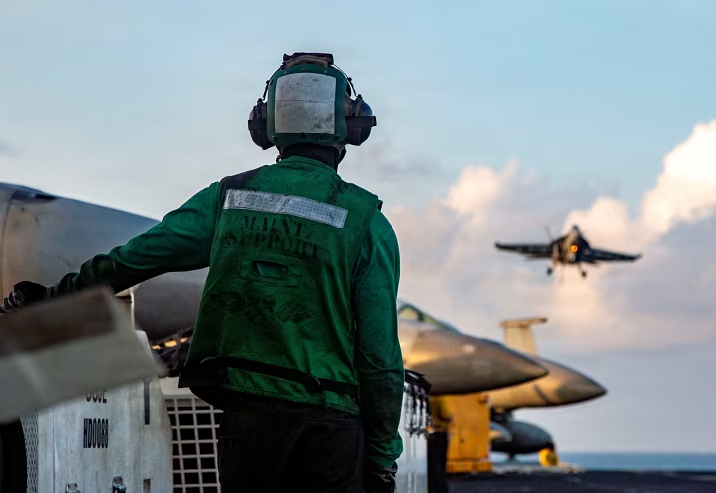
The Middle East region faces the specter of a comprehensive military confrontation following the first human casualties among American forces from direct Iranian fire. Sources reported that a missile attack targeting a military base in the region led to the death of two American soldiers, while the search is still ongoing for a third soldier who went missing after the shelling.
In an immediate reaction, the US Central Command launched a wave of what it described as preliminary air attacks, targeting vital facilities belonging to the Iranian military. The American target bank included coastal observation points and air defense systems, in addition to storage sites for drones and missiles used by Tehran in its regional operations.
Field escalation did not stop at the limits of direct confrontation but extended to neighboring countries, where facilities in Kuwait and Bahrain were subjected to attacks by Iranian drones and missiles. Field reports confirmed that the Jordanian city of Aqaba and the Sulaymaniyah region in Iraq were not spared from the shrapnel of this exploding conflict, reflecting the widening scope of Iranian targeting.
For its part, Tehran officially announced the targeting of Al-Adeeri camp and Ali Al-Salem Air Base in Kuwait using suicide drones. This announcement came in the context of an Iranian response to what it described as continuous American aggression against its infrastructure and civilian bridges during the past eight days of continuous shelling.
Politically, Iranian authorities announced the suspension of the memorandum of understanding signed with Washington last month, considering that the understandings were no longer valid. Iranian Supreme Leader Mojtaba Khamenei accused the American administration of breaking promises, indicating that Washington has once again proven to be an unreliable party in any diplomatic path.
In contrast, US President Trump showed a tough stance on political developments, emphasizing that he no longer cared about Iran's decision to withdraw from the memorandum of understanding. The White House clarified that military options have become the primary tool to force Tehran to comply with American conditions and stop its threats to international navigation.
Israel entered the crisis by declaring a state of maximum alert among its forces, in anticipation of any escalation of the conflict towards a major regional war. Media sources reported that the Israeli security establishment is closely monitoring Iranian movements, amidst fears of opening multiple fronts simultaneously if the current escalation continues.
US Central Command stressed that its operations primarily aim to undermine the capabilities of the Iranian Revolutionary Guard to threaten navigation in the Strait of Hormuz. Military sources indicated that Washington's punitive messages have shifted from targeting proxies and agents to striking deep into Iran and directly targeting military infrastructure.
Observers believe that the death of American soldiers represents a strategic turning point that could end the era of limited confrontations and push towards an 'open war.' The Pentagon has already begun mobilizing stealth fighters and strengthening its naval presence in the region, indicating preparations for broader and more lethal military operations.
Iran, for its part, justified its attacks on neighboring countries by stating that they are in response to the facilities granted to American forces operating from those bases. Tehran accuses some regional countries of participating in the 'military blockade' imposed on it, which explains its targeting of civilian and military facilities in Kuwait and Jordan.
In the context of Arab reactions, Kuwait condemned the targeting of its civilian facilities, affirming its full right to defend its sovereignty and territories by all available means. Popular fears are growing in Gulf countries that their territories will become a battleground for settling scores between the two major powers in the absence of a political solution.
Reports from Washington indicate that the decision to launch a 'major war' is now on the table for discussion in the closed rooms of the Pentagon. Military experts confirm that the type of weapons used in recent days, by both sides, reflects a desire to break the traditional rules of engagement that have prevailed for years.
Despite international calls for restraint, the language of threat remains dominant in the statements of officials from both sides. While Washington insists on protecting its interests and navigation, Tehran asserts that it will not back down in the face of what it describes as 'American arrogance,' even if it leads to a comprehensive confrontation.
The lingering question in political circles is about the ability of international parties to contain this explosion before it is too late. Field indicators, from casualties and military mobilization to the suspension of agreements, all suggest that the countdown to a major confrontation has already begun.
American strikes reflect the widening scope of military objectives by targeting infrastructure that supports Tehran's operations deep within the country.
שתף את דעתך
Portents of an Open War: American Casualties in Direct Confrontations with Iran and Escalation Affecting Regional Countries