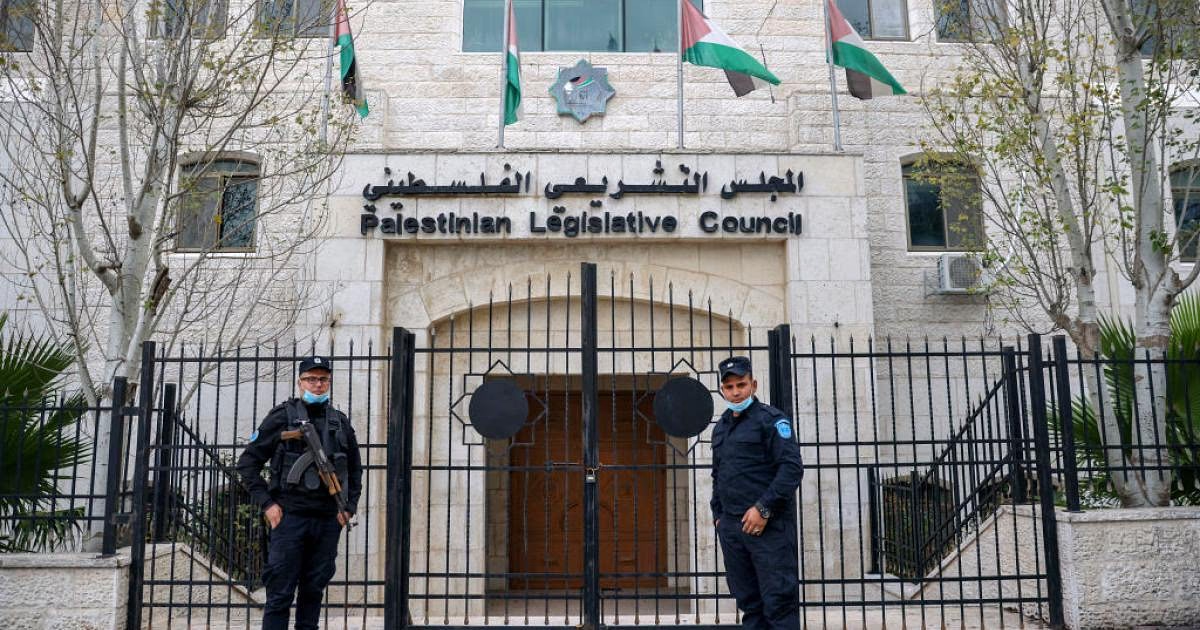







Palestinian President Mahmoud Abbas issued a presidential decree setting November 28th as the official date for holding the Palestinian legislative elections. This step aims to bring the democratic process back to the political forefront after a state of stagnation and procrastination that lasted for nearly two decades.
According to the issued decree, all Palestinians in occupied Jerusalem, the West Bank, and the Gaza Strip were invited to participate in a free and direct vote to elect members of the Legislative Council. The electoral process is scheduled to be conducted based on the provisions of General Elections Law No. (1) of 2007 and its subsequent amendments.
The electoral system approved in the decree adopts the principle of full proportional representation, where candidacy is through unified electoral lists instead of the district system or individual candidacy. This system aims to ensure broader representation for various political forces within the upcoming Palestinian parliament.
This announcement comes at a sensitive time when the Palestinian political system has suffered from a long absence of constitutional entitlements, with the last legislative elections dating back to early 2006. Moreover, the presidency has not seen any elections since 2005, leading to an erosion of institutional legitimacy.
The Palestinian street recalls the decision to postpone the elections scheduled for 2021, which were then canceled by a presidential decision under the pretext that the occupation authorities would not allow them to be held in Jerusalem. Concerns are currently escalating about a repeat of the same scenario if real international guarantees are not provided.
The anticipated electoral process faces a series of complex field and political challenges, foremost among them the mechanism for organizing voting within the city of occupied Jerusalem. The biggest challenge also emerges in the Gaza Strip, which is reeling under the weight of a devastating war that has left unprecedented humanitarian and security repercussions.
Political and human rights circles criticized the decree for being limited to legislative elections without setting a binding date for presidential elections simultaneously. Despite the indication that they might be organized in the first quarter of next year, the absence of a precise date raised suspicions among forces demanding a comprehensive electoral path.
In the context of analytical readings, observers believe that elections alone may not be enough to bring about the desired reform within the Palestinian Authority and the Palestine Liberation Organization. They emphasize that renewing legitimacy requires deep institutional reforms that end the long-standing internal division.
Hani Al-Masri, Director of Masarat Center for Policy Research, considered that the announcement of the date raises fundamental questions about the political circumstances surrounding the decision. He pointed out that the reasons that led to the postponement of the 2021 elections are still valid, and have even become more complex under the current circumstances.
Political sources questioned whether there were international guarantees or approval from the occupation authorities to allow Jerusalemites to exercise their electoral right. These sources affirmed that the absence of comprehensive national consensus before issuing decrees could weaken the chances of success for the entire democratic process.
Al-Masri indicated in media statements that the current preparations suggest a tendency to manage the electoral process unilaterally. He warned that imposing certain conditions or issuing laws without broad national consultations could lead to political exclusion that limits equal participation.
Palestinian human rights organizations stressed the necessity of linking the legislative and presidential paths, given the concentration of broad powers in the presidency. They considered that separating the two entitlements could lead to more constitutional and political crises in the near future.
The current experience brings to mind what happened in the 2006 elections, when the results were obstructed and confiscated due to external and internal interventions. Analysts warn that the continuation of the war on Gaza and the escalation of settlement expansion in the West Bank constitute a material obstacle to the integrity and inclusiveness of the vote.
Estimates concluded that elections must be part of a comprehensive national vision aimed at confronting the fateful challenges facing the Palestinian cause. Without this consensus, ballot boxes might become a tool to perpetuate the current crisis instead of being a way out towards unity and reform.
Elections should be part of a comprehensive national vision to confront fateful challenges, and the absence of consensus could turn them into a factor that deepens division.
שתף את דעתך
Abbas Issues Decree to Hold Legislative Elections Next November