






Washington's Message
Washington – Said Arikat – 7/8/2026
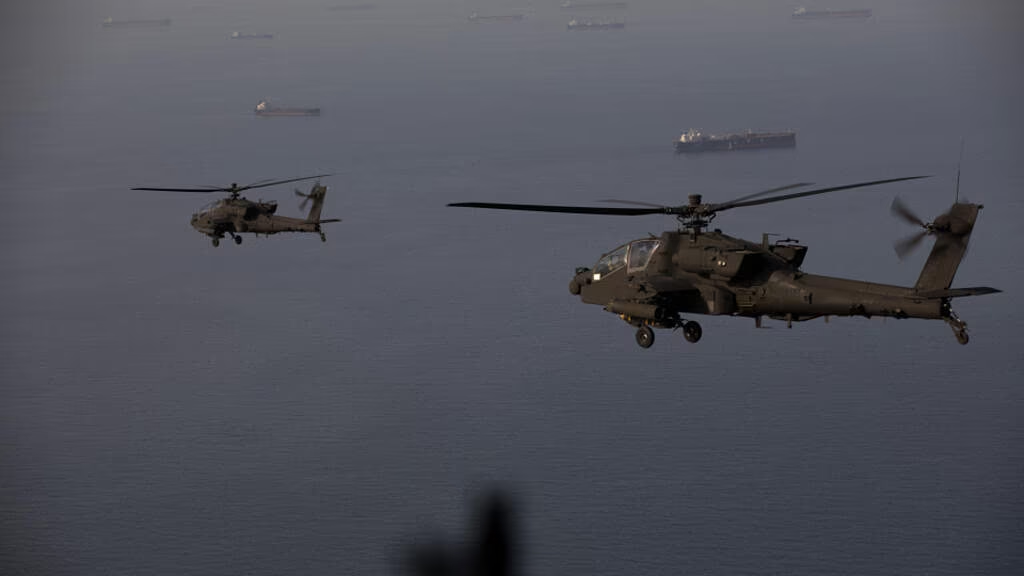
The confrontation between the United States and Iran has entered a new phase of military escalation, after the United States launched strong strikes on Tuesday targeting sites inside Iran, in response to Tehran targeting three commercial shipments while crossing the Strait of Hormuz. This development returns the region to an atmosphere of direct confrontation and raises widespread fears of the collapse of the diplomatic path that began last month.
The American strikes came hours after Washington announced that the Iranian attacks on commercial ships represent a direct threat to the freedom of international navigation and global energy security, stressing that the response came "to protect international interests and ensure the security of maritime passages."
Fragile Agreement on the Brink of Collapse
As part of confidence-building measures, the United States had lifted the ban on Iranian oil sales after reaching a memorandum of understanding with Tehran on June 17, which stipulated a 60-day ceasefire, interspersed with intensive negotiations between the two parties aimed at reaching a comprehensive agreement addressing various outstanding issues, foremost among them the Iranian nuclear program, economic sanctions, and regional security arrangements.
The memorandum of understanding at the time indicated the desire of both sides to contain the military confrontation and open a new window for dialogue, but recent developments have put these understandings to an unprecedented test.
Future of Negotiations in the Balance
Observers believe that the reciprocal strikes between Washington and Tehran put the future of the 60-day negotiation period at stake, as the continuation of negotiations now depends on the ability of both parties to prevent military escalation from getting out of control.
Diplomats also fear that the recent military operations could undermine the fragile trust built over the past weeks, especially if followed by new rounds of reciprocal attacks or if the scope of clashes expands to include other regional parties.
Direct Threat to Navigation and Energy
The escalation comes at a time when the Strait of Hormuz represents one of the most important maritime passages in the world, as a large percentage of global oil and gas exports pass through it. Any disruption in navigation through the strait immediately impacts global energy markets and raises anxiety levels among oil-importing countries and shipping and insurance companies.
Signs of tension have already begun to appear in maritime transport markets, amid expectations of rising insurance and shipping costs if the confrontation between the two parties continues.
Difficult Choices for Both Sides
Despite the military escalation, diplomatic circles still hope to contain the crisis and bring both parties back to the negotiating table, considering that the alternative would be an open confrontation whose outcomes are difficult to predict.
In contrast, the Iranian leadership appears to be facing a complex equation between responding to American strikes to preserve its internal and regional prestige, and avoiding steps that could lead to a complete collapse of the negotiation process and the re-imposition of more economic pressures.
These developments reveal the fragility of any understandings reached between the United States and Iran when security and military files remain without clear solutions. A ceasefire does not gain its value merely from its announcement, but from the existence of monitoring mechanisms and direct communications that prevent miscalculation and contain emergency incidents. What happened in the Strait of Hormuz reflects that any limited friction is capable of transforming the negotiation path into a wide military confrontation. Therefore, the future of understanding will not depend only on political will, but also on the ability of both parties to separate field operations from the negotiation process.
The recent escalation also reconfirms that the Strait of Hormuz remains the most sensitive strategic card in the conflict between Washington and Tehran. Iran realizes that any disruption in this vital passage attracts the attention of the entire world, while the United States views ensuring freedom of navigation as a security and economic commitment that cannot be compromised. Hence, any targeting of commercial ships carries risks that go beyond bilateral relations, directly affecting energy markets and global supply chains, and prompting international powers to closely monitor the crisis.
The fundamental dilemma facing both parties is how to combine military deterrence with continued political dialogue. The United States seeks to send a message that attacks on international navigation will not go unanswered, while Iran tries to avoid appearing to back down under external pressure. Between these two objectives, negotiations become hostage to field developments. If the escalation is not contained quickly, the negotiation period, which was supposed to establish a new agreement, may turn into a final stop before the complete collapse of the diplomatic path.
שתף את דעתך
United States Delivers Strong Blows to Iran After Three Commercial Ships Targeted in Strait of Hormuz