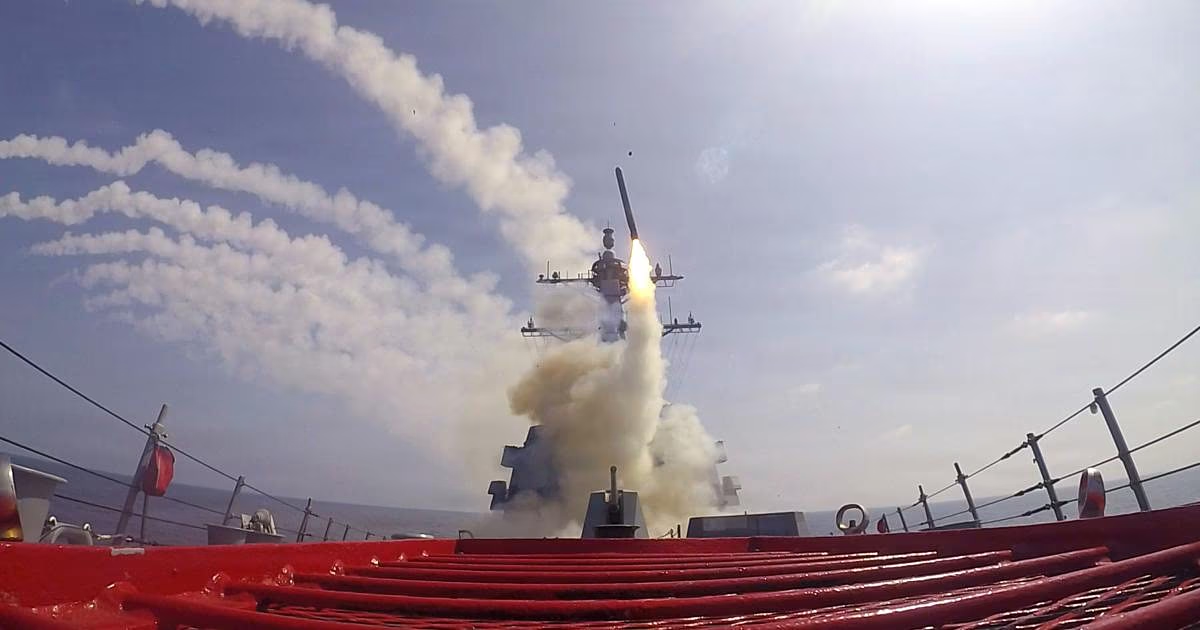







The US Central Command (CENTCOM) announced, early Wednesday, the execution of a large-scale military operation targeting strategic sites within Iranian territory. Military sources clarified that these strikes come as legitimate defense and a direct response to a series of attacks that targeted international navigation in the Strait of Hormuz over the past twenty-four hours.
CENTCOM affirmed in an official statement via the X platform that the objective of these operations is to impose 'exorbitant costs' on the Iranian side as a result of its targeting of civilian-led commercial vessels in a vital international waterway. The Central Command described recent Iranian actions as unprovoked aggression and a clear violation of previously concluded ceasefire agreements.
For its part, a US official revealed to media sources that the target bank included a wide array of Iranian military capabilities, among them advanced air defense systems and coastal surveillance facilities. The raids also hit 'surface-to-air' missile launch sites and anti-ship cruise missile platforms, in addition to drone operating centers and vital port facilities.
In contrast, official Iranian media confirmed loud explosions in various areas in the south of the country, with seven explosions heard in the coastal city of Sirik. Iranian television also reported six other explosions in the vicinity of the strategic Qeshm Island, amidst a state of security and military alert in the region.
On the diplomatic and economic front, Washington took immediate punitive measures, with the US Treasury Department announcing the cancellation of the license that allowed a temporary lifting of oil sanctions on Tehran. The US administration described Iranian behavior in the Strait of Hormuz as 'absolutely unacceptable,' warning of severe consequences that would affect the Iranian economy.
These field developments come after three oil and gas tankers were subjected to simultaneous attacks, the most prominent of which was the targeting of the Qatari LNG tanker 'Al Ruqayyat'. The attacks, carried out by drones, caused a fire in the engine room of the Qatari tanker, which drew widespread condemnation from Doha, which held Tehran fully legally responsible.
Damage was not limited to the Qatari tanker, as navigation reports indicated damage to a giant Saudi crude oil tanker belonging to the 'Widian' company while it was passing off the coast of Oman. The UK Maritime Trade Operations (UKMTO) indicated that the targeted vessels suffered varying degrees of damage, emphasizing the seriousness of the situation in the waterway through which a large portion of global energy supplies pass.
In Doha, Qatari Foreign Ministry spokesman Majed Al-Ansari called on the Iranian side to cease all practices that threaten the safety of international navigation. Al-Ansari stressed that targeting commercial vessels constitutes a grave violation of international laws, calling on the international community to take a firm stance to protect waterways from military escalation.
Observers believe that this escalation coincides with sensitive internal circumstances in Iran, as the country is in its fifth day of mourning for the passing of Supreme Leader Ayatollah Ali Khamenei. It appears that the field tensions have dashed hopes for progress in negotiations that were being mediated by Pakistan and Qatar to reach a final agreement to end the state of war.
For its part, the Iranian Foreign Ministry strongly condemned the US decision to re-impose oil sanctions, considering it a violation of the 'Islamabad Memorandum'. Tehran held the US administration fully responsible for the repercussions of this escalation, noting that US threats hinder any potential negotiation path to achieve sustainable de-escalation.
In Washington, former President Donald Trump hinted at the need to intensify strikes and target Iranian vital facilities more broadly if a permanent agreement ensuring regional security is not reached. These statements reflect a state of political consensus in the United States on the necessity of a firm response against recent Iranian actions in the Arabian Gulf.
Following these events, global energy markets experienced a state of turmoil, with oil prices rising by 1% immediately after news of the US strikes. Experts fear that the continued military escalation in the Strait of Hormuz could lead to a global energy crisis, especially given the ongoing war that first erupted last February.
US Central Command forces have begun launching a series of powerful strikes against Iran to impose exorbitant costs for targeting and attacking commercial vessels.
שתף את דעתך
Widespread Military Escalation: 'Strong' American Strikes Target Iranian Depth in Response to Strait of Hormuz Attacks