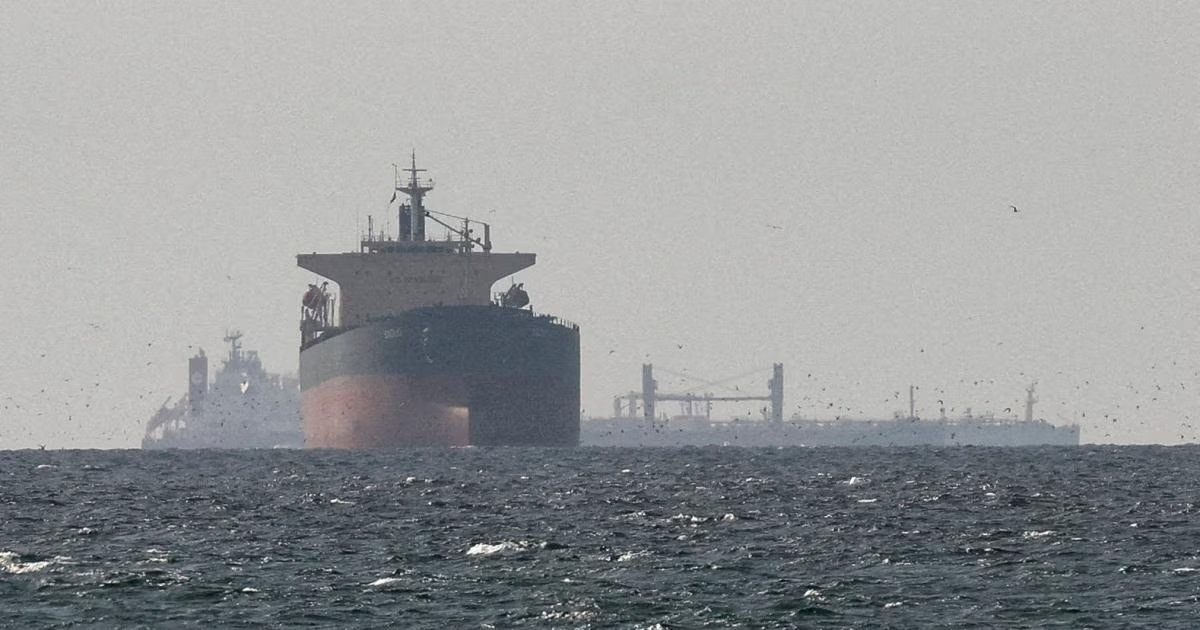







Informed sources in the US capital, Washington, reported that the American administration views with suspicion and unease the recent agreement concluded by Britain and France with the Sultanate of Oman regarding the security of the Strait of Hormuz. These reservations stem from the firm American principle that rejects any regional security arrangements not falling under the leadership umbrella of the United States, especially in vital waterways.
The sources stated that US President Donald Trump had previously directed harsh criticism at Washington's major allies within and outside NATO, due to their refusal to join an international coalition that Washington sought to form. The aim of this coalition was to secure navigation during the peak of regional tensions involving international and regional parties in confronting Iranian moves in the region.
The current disagreement highlights that the European move proposes a separate path for addressing navigation security, which Washington considers a deviation from unified coordination. Observers believe that the hesitation previously shown by allies has now turned into independent initiatives that could weaken the United States' grip on maritime security issues in the Arabian Gulf and the Strait of Hormuz.
Procedurally, the new European agreements provide a framework that regulates the Iranian role in managing navigation within the Strait, which Washington does not officially endorse in its political discourse. Despite the existence of a US-Iranian memorandum of understanding that grants Tehran a role in regulating ship traffic during certain phases, Washington refuses to legitimize this role through other international agreements.
In a related context, President Trump emphasized his country's rejection of imposing any financial fees on ships transiting the Strait in the future, even after the expiration of the deadlines specified in existing understandings. In contrast, London and Paris are focusing on building a technical and military mechanism to ensure smooth passage, which reflects a divergence in priorities between the two sides of the Atlantic regarding this sensitive issue.
British Prime Minister Keir Starmer and French President Emmanuel Macron had affirmed in a joint statement that the Strait of Hormuz represents an indispensable artery for the global economy. The two leaders expressed their full readiness to deploy a multinational military mission to support freedom of navigation, emphasizing the need to maintain regional stability and respect the sovereignty of states bordering the waterway.
Reports concluded that the Sultanate of Oman's agreement to work with the French and British sides to ensure navigation safety in its territorial waters represents a significant strategic step. However, the biggest challenge remains how to balance these efforts with the American desire to dominate security arrangements, which could lead to new political tensions within the Western allied camp.
Washington is uncomfortable with any security agreement in the region that is not under its direct umbrella or leadership.
שתף את דעתך
US Reservations on European-Omani Agreement to Secure Navigation in the Strait of Hormuz