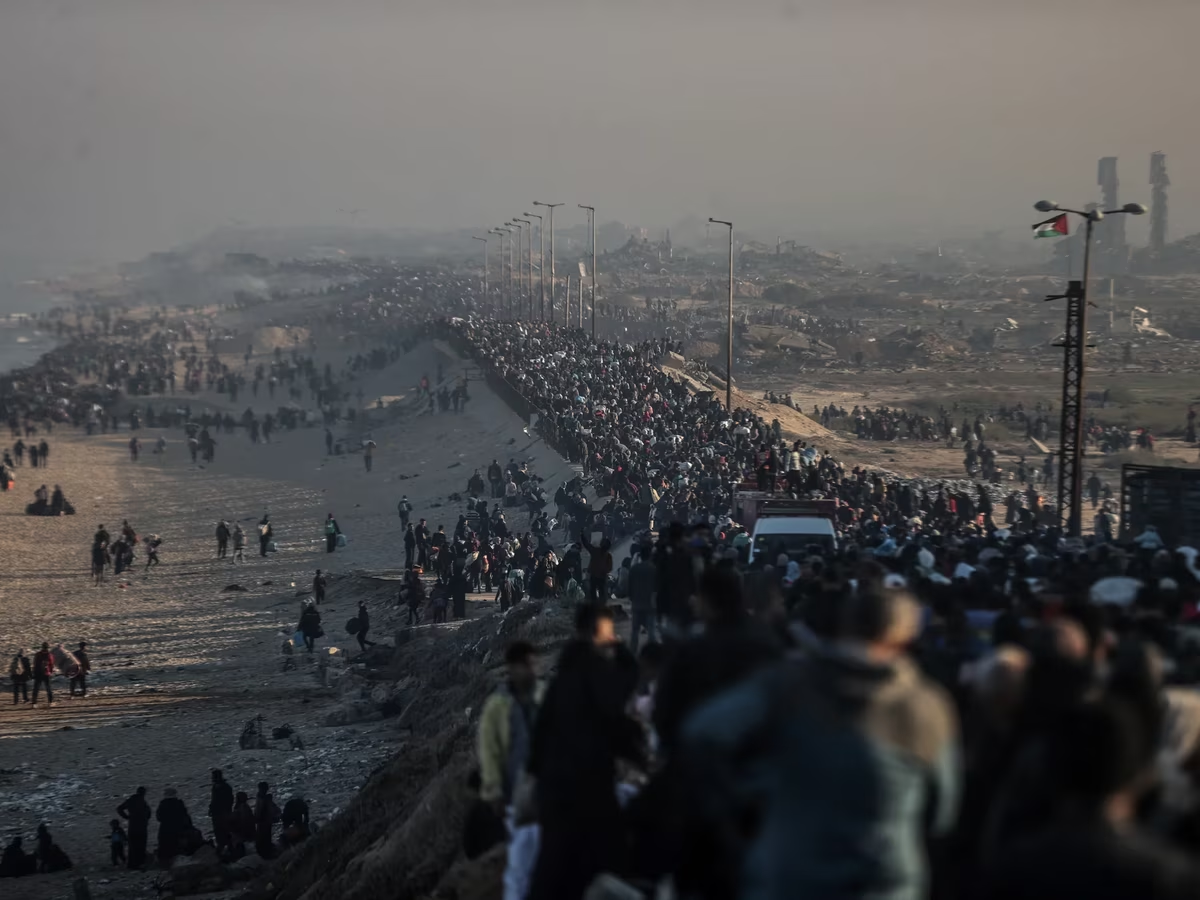







The Islamic Resistance Movement (Hamas) issued an urgent appeal to the Arab League, demanding the necessity of holding an emergency Arab summit aimed at formulating a unified strategy to confront Israeli plans to displace the residents of the Gaza Strip. The movement affirmed that these actions require a stance that goes beyond verbal condemnation to effective diplomatic and political steps that ensure the protection of the Palestinian presence.
In an official statement issued by the movement's spokesperson, Hazem Qassem, the displacement project was described as an existential threat whose danger is not limited to Palestinians alone, but extends to affect the core of Arab national security. Qassem explained that these plans represent a blatant challenge to the will of Arab states, foremost among them the Arab Republic of Egypt, whose borders and security are directly linked to the stability of the Strip.
The spokesperson indicated that the Israeli occupation is practicing a scorched-earth policy by destroying all basic necessities of life within Gaza, in order to forcibly push residents to leave under the weight of impossible living conditions. He stressed that what is required is to compel the occupation to end its aggression and lift the comprehensive siege imposed on the population for many years.
On the Israeli side, Defense Minister Yoav Gallant affirmed the government's continuation in implementing plans aimed at encouraging Palestinians to leave the Strip, reflecting an official insistence on the policy of demographic change. These statements come at a time when international pressure rejecting any forced displacement under any name is increasing.
In an attempt to circumvent international criticism, media sources revealed that instructions were issued to the Israeli security establishment and the Mossad to stop using the term 'voluntary migration'. According to reports, this term has been replaced with the phrase 'freedom of movement plan' to avoid legal prosecution and international accusations of incitement to ethnic cleansing.
Press reports stated that the new Israeli National Security Council head, Shmuel Ben Ezra, led intensive meetings with security agency leaders to discuss mechanisms for implementing these plans. This change in terminology aims to facilitate convincing countries around the world to receive Palestinian migrants under a misleading humanitarian guise.
On the ground, the Gaza Strip continues to suffer from the effects of a devastating aggression that has resulted in the martyrdom of more than 73,000 Palestinians and the injury of approximately 173,000 others since October 2023. Despite the ceasefire agreement coming into effect on October 10, 2025, continuous Israeli violations further complicate the already deteriorating humanitarian situation.
In a related context concerning the administration of the Strip, the National Committee tasked with administering Gaza concluded a series of meetings in Cyprus that lasted for two days. These discussions focused on ways to improve living conditions and alleviate humanitarian suffering for the residents in the post-war phase, with the participation of international experts and consultants.
The committee clarified that it held constructive discussions with the 'Peace Council' teams and the office of the High Representative for Gaza, in addition to the Tony Blair Institute, to explore possible immediate interventions. The discussions included developing comprehensive visions for reconstruction operations and ensuring transparency in the management of financial and logistical resources that will be provided by international donors.
Participants in the Cyprus meetings also reviewed the necessary institutional arrangements to ensure governance and security within the Strip, while emphasizing commitment to a comprehensive plan that ensures the committee assumes its field responsibilities. It is expected that the upcoming executive steps of this committee will be announced soon in coordination with the relevant international parties.
It is worth noting that the 'Peace Council' was established last January as part of an American vision to end the conflict and transfer administrative powers in Gaza to a technocratic committee. However, Israel continues to oppose the entry of this committee into the Strip to carry out its duties, which hinders the start of the internationally agreed-upon transitional phase.
In a significant political development, US President Donald Trump announced mid-January the start of the second phase of the peace plan, which includes a broader withdrawal of the occupation army. This phase includes launching large-scale reconstruction operations, in parallel with discussions about future security arrangements in the region.
Sources reported that the American administration handed the Israeli side a document containing clear demands for the necessity of proceeding with reconstruction projects. The paradox in this document is that it does not stipulate the disarmament of the Hamas movement as a first step to begin construction operations, which represents a shift in the American approach to the crisis.
Despite all these political moves and Israeli plans, the residents of the Gaza Strip affirm their steadfastness in remaining on their land and their categorical rejection of any projects aimed at uprooting them. Popular and national activities emphasize that steadfastness is the only response to attempts to liquidate the Palestinian issue through forced displacement.
The displacement project does not target the Palestinian people alone, but represents a direct threat to the Arab national security system and a blatant challenge to the will of all states.
שתף את דעתך
Hamas Demands Emergency Arab Summit to Thwart Israeli Displacement Plans