






Washington's Message
Washington – Said Arikat - 1/7/2026
The recent war on Iran revealed deep divergences between the United States and Saudi Arabia, after the administration of US President Donald Trump encountered a decisive Saudi refusal to allow the use of the Kingdom's airspace for a US military operation to protect navigation in the Strait of Hormuz. This forced Washington to cancel the operation less than 48 hours after its launch, a development reflecting fundamental shifts in the nature of the strategic relationship between the two countries, according to several American media outlets, most notably what was published by the Wall Street Journal and the New York Times on Wednesday.
According to American officials, the US Central Command launched a military operation in early May, named "Project Freedom," with the aim of escorting commercial vessels and securing their passage in the Strait of Hormuz, after Iran effectively took control of the strait during the war that erupted following the US-Israeli attack on Iran on February 28.
However, Saudi officials unexpectedly informed Washington that the Kingdom would not allow American aircraft to use its airspace to carry out the mission, considering that the American plan could reignite the war and expose Saudi Arabia to new Iranian attacks, according to reports.
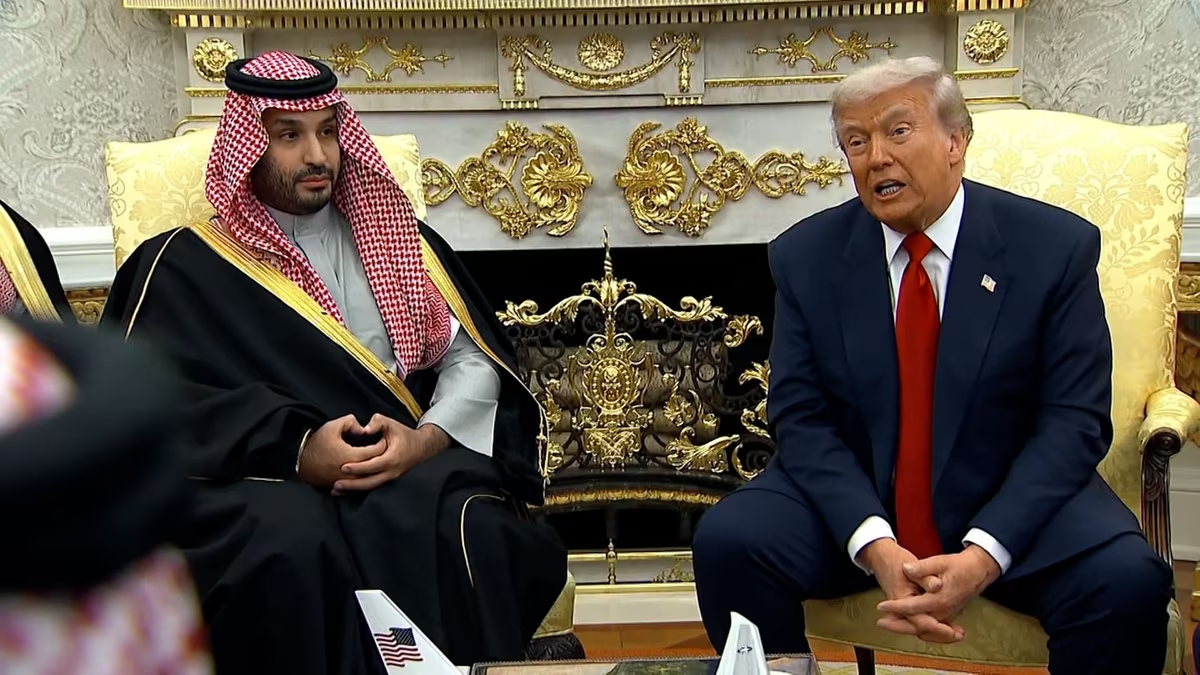
The Saudi stance led to a series of urgent communications between the White House and Crown Prince Mohammed bin Salman, in which President Trump personally participated for three consecutive days, in addition to Vice President JD Vance, Special Envoy Steve Witkoff, Jared Kushner, and National Security Advisor Marco Rubio.
Despite intense American pressure, the Saudi Crown Prince maintained his position, which led the US administration to completely cancel the military operation.
Analysts believe that this development reflects a decline in Saudi confidence in Washington's ability to manage regional crises in a way that protects the security of its Gulf allies, especially after the Kingdom was previously subjected to Iranian attacks targeting Aramco facilities in 2019, when the Trump administration refrained from a military response to Tehran.
Since the outbreak of the recent war, Riyadh has pursued a delicate balancing policy, providing limited political and military support to the United States, but at the same time seeking to prevent the escalation of the confrontation and refusing to be drawn into an open confrontation with Iran.
The Kingdom also intensified its direct contacts with Tehran, benefiting from the rapprochement sponsored by China in 2023. Saudi officials are now directly discussing with the Iranians issues that Riyadh considers more pressing than the nuclear program, such as the security of the Strait of Hormuz, ballistic missiles, and support for armed groups in the region.
American sources indicate that Prince Mohammed bin Salman tried from the beginning of the crisis to persuade Trump to avoid war, before his calculations changed during the fighting phases. However, he later returned to push for a political settlement after it became clear that Iran still retained its basic military capabilities despite American and Israeli strikes.
In contrast, Saudi Arabia continued to diversify its international partnerships away from complete reliance on Washington, strengthening its cooperation with China, and expanding its coordination with Pakistan and other Asian countries, as part of a strategy aimed at reducing the risks arising from any future confrontation in the Gulf.
Despite continued military cooperation between Riyadh and Washington, including peaceful nuclear energy projects and massive arms deals, signs of tension have become more apparent, especially after US Secretary of State Marco Rubio ignored visiting Saudi Arabia during his recent Gulf tour, only visiting Bahrain, Kuwait, and the UAE.
Trump's sarcastic remarks about the Saudi Crown Prince during an investment event in Miami also caused resentment within Saudi circles, after the US President spoke in a manner considered demeaning to the personal relations that both sides had long promoted.
In contrast, the US administration affirms that relations with Riyadh remain strong, and that consultation between the two sides continues regarding the future of Gulf security, in addition to peaceful nuclear energy projects and plans to establish land corridors that reduce reliance on the Strait of Hormuz.
Despite the ceasefire agreement coming into effect, the most complex issues remain unresolved, as the agreement did not address Iran's missile program or Tehran's regional influence, and it granted Iran a role in managing the Strait of Hormuz in coordination with the Sultanate of Oman, which raises widespread concern among Gulf states.
The future of the new nuclear agreement also remains ambiguous, given the previous experience in which Trump withdrew in 2018 from the nuclear agreement concluded in 2015, which led to the acceleration of Iran's nuclear program and increased uranium enrichment levels.
While Riyadh declares its initial support for the US-Iranian understandings as a step towards stability, it deals with them with extreme caution and has not yet made any financial commitments to contribute to the reconstruction of Iran, awaiting clarification on the extent of all parties' commitment to the agreement, and whether it will indeed establish a new security system in the Gulf, or will merely be a temporary truce preceding a new round of conflict.
This crisis reveals that Saudi Arabia no longer views the alliance with Washington as an absolute security guarantee, but rather deals with it based on national interests first. Riyadh, which paid a heavy price in the Aramco attacks in 2019, realizes that engaging in any American military operation could make it the primary target of an Iranian response, while Washington might again hesitate to defend it. Therefore, it seems that the Saudi leadership is seeking to build a deterrence policy based on diversifying international partnerships, direct dialogue with adversaries, and not being fully dependent on the American security umbrella.
The recent war also showed a decline in the United States' ability to impose its agenda even on its closest allies in the Gulf. A few years ago, it would have been difficult to imagine Riyadh rejecting a US military request of this magnitude, but regional transformations, the rise of China, and the return of Saudi-Iranian diplomacy are all factors that have redrawn the balance of power. Gulf security is no longer managed exclusively from Washington, but has become the product of a complex network of regional and international understandings, giving Gulf capitals a wider margin to make independent decisions that sometimes conflict with American wishes.
The most important message generated by this crisis is that the post-war phase may be more complex than the war itself. The ceasefire did not address the roots of the conflict, nor did it resolve the future of Iran's nuclear program, the issue of ballistic missiles, or Tehran's regional influence. With Iran's continued ability to influence navigation through the Strait of Hormuz, Gulf states will remain facing a delicate equation: maintaining their relations with Washington, while avoiding being drawn into confrontations that could directly threaten their economic and security stability.
שתף את דעתך
Covert disagreements between Washington and Riyadh revealed by the Iran war Saudi Crown Prince halted a US military plan and forced the Trump administration to back down