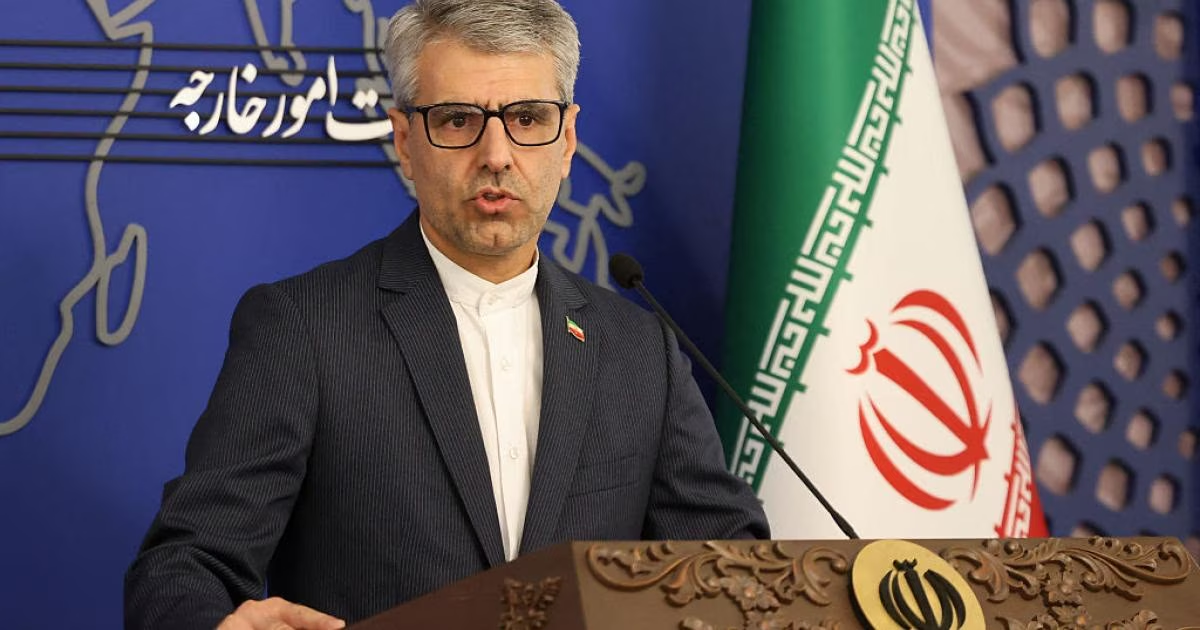







The Iranian Ministry of Foreign Affairs announced today, Monday, its exclusion of any direct talks with the United States of America in the coming days. The ministry's spokesman, Ismail Baqaei, clarified that the Iranian technical delegation that will head to the Qatari capital, Doha, this week aims to follow up on specific technical files, denying any connection between this visit and the arrival of American officials in the region.
Tehran stressed that the current priority lies in implementing the terms of the existing memorandum of understanding, not in starting negotiations for a new final agreement. The Iranian statement indicated that reaching comprehensive understandings requires full commitment to the previously agreed-upon articles, which Iran seeks to ensure before moving to any higher diplomatic levels with the American side.
In contrast, the American administration had painted a different picture, with Washington announcing arrangements for a high-level meeting in Doha tomorrow, Tuesday. Envoys Steve Witkoff and Jared Kushner are scheduled to participate in this meeting to discuss ways to de-escalate, amidst statements by President Trump claiming that the Iranian side requested this meeting.
These diplomatic tug-of-wars come after the conclusion of the first round of indirect negotiations in Switzerland on June 21, which were mediated by Qatar and Pakistan. These discussions focused on the technical details of implementing a 14-article memorandum of understanding, aimed at establishing a roadmap to end the military and economic tension between the two countries.
The Ministries of Foreign Affairs in Qatar and Pakistan had previously revealed that the two parties agreed to form a high-level political committee to oversee the implementation of the understandings. This diplomatic path aims to reach a final and comprehensive agreement within a timeframe of 60 days, provided that what was agreed upon on June 18 is adhered to.
The memorandum of understanding signed between Washington and Tehran includes essential provisions, including a cessation of hostilities and the lifting of the American naval blockade imposed on Iran. The memorandum also includes the reopening of the Strait of Hormuz to international navigation, after its closure led to severe disruptions in global energy markets and a record rise in inflation rates.
In a related context, Tehran issued a strong warning to France, calling on it not to interfere in the security arrangements for the Strait of Hormuz. This stance came in response to a joint French-Omani announcement that touched upon the possibility of carrying out international mine-clearing operations in the strategic waterway, which Iran considered an infringement on its sovereignty.
Iranian Deputy Foreign Minister Kazem Gharibabadi affirmed that the responsibility for securing the strait and clearing mines rests solely with the Iranian state, according to recent understandings. Gharibabadi warned that any attempt by external powers to impose a new reality in the strait would be met with outright rejection, describing French actions as 'provocations' that could further complicate the situation.
French President Emmanuel Macron and Sultan Haitham bin Tariq of Oman had issued a statement from Paris affirming the need to ensure freedom of navigation without restrictions. Both sides expressed their readiness to cooperate with relevant parties to carry out joint operations to clear the strait of mines and enhance intelligence monitoring to ensure the safety of global trade routes.
_The Strait of Hormuz is the cornerstone of the ongoing negotiations to end the conflict, as its closure since the start of military confrontation last February has caused an international energy crisis. International powers seek to ensure that the closure scenario is not repeated, while Tehran insists that its management is a sovereign matter related only to the littoral states of the strait.
In this context, differences emerged between Muscat and Washington regarding future navigation fees, with the United States rejecting the imposition of any costs on ship transit. For its part, the Sultanate of Oman affirmed that the arrangements being discussed with Iran aim to regulate navigation and related services, without including the imposition of traditional transit fees.
France and the United Kingdom are currently leading an international coalition that aspires to play a security role in the region after the end of the state of war, which faces clear Iranian reservations. Observers believe that the struggle for influence in the Strait of Hormuz will remain the biggest obstacle to the full implementation of the de-escalation terms between Tehran and the international community in the coming period.
The situation is sensitive and complex, and we advise France not to complicate matters further through its provocations in the Strait of Hormuz.
שתף את דעתך
Tehran denies negotiating with Washington in Doha and warns Paris against 'provocations' in the Strait of Hormuz