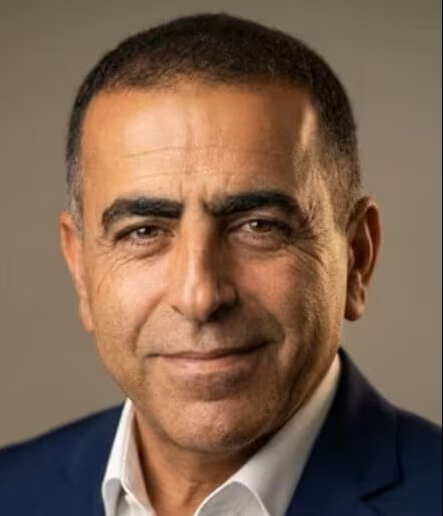







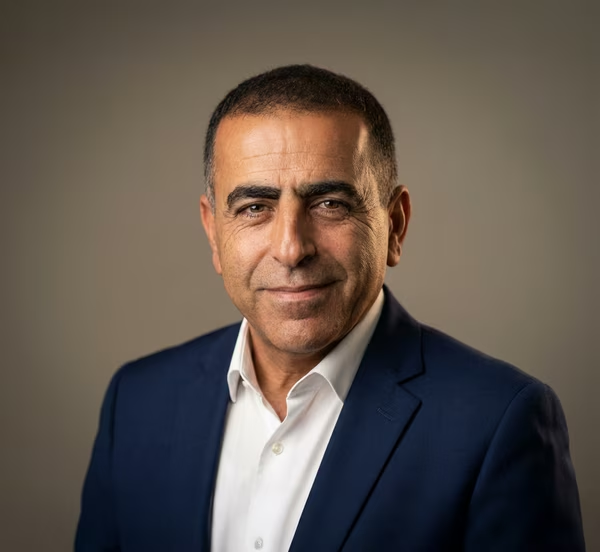
Dr. Ibrahim Nairat
Palestine is no longer discussed today merely as a battlefield or an urgent humanitarian aid issue, but as an open political file potentially subject to reshaping, its features slowly being drawn behind the scenes more than they are publicly announced. While the war in Gaza continues and its repercussions become more complex, a quieter but more profound discussion is taking place in the background: What comes after this moment?
In Washington, European capitals, and influential Arab decision-making centers, approaches are crystallizing that speak not only of ending the crisis but of re-engineering the Palestinian political landscape itself: Who will govern Gaza? How will the relationship between Gaza and the West Bank be reformulated? What is the future of the Palestinian Authority? And what is the nature of the political system that can lead Palestinians in the next phase?
Despite the differing priorities of the United States, Europe, and Gulf states, there is a general convergence on several key issues: ending the war, reconstructing Gaza, restructuring the Palestinian Authority, reunifying the Palestinian political system, and then launching a political process that revives the prospect of a Palestinian state. However, the discussion is not limited to changing governments or personalities; it extends to rethinking the very philosophy of governance.
From a Transitional Authority to a State Project
In a number of political circles and research centers, a vision emerges based on transitioning from a “transitional authority” model to a “state” model. This means moving from daily conflict management to building permanent institutions of a modern state, including a civilian government, an independent judiciary, professional public administration, a regulated economy, and security agencies operating within a unified political and constitutional framework.
In this context, there is repeated talk of a Palestinian government with a civilian and technocratic character that would manage both the West Bank and the Gaza Strip, in parallel with deep reforms in the Authority's institutions, restructuring of security agencies, and renewal of the Palestinian political structure, leading to elections when political and security conditions allow.
The goal here is not limited to improving administrative performance but extends to rebuilding political legitimacy, restoring internal trust, and creating an environment capable of launching a more stable political process.
However, this vision is inseparable from the fundamental problem governing the Palestinian situation, which is the endeavor to build state institutions that perform their functions as if they were a fully sovereign state, while this sovereignty remains incomplete due to the ongoing occupation. This places this model in a middle ground between a “transitional authority” and a “complete state,” where state functions are gradually exercised within existing political and security constraints.
Within this innovative vision, a more specific understanding emerges that the desired Palestinian state institutions should exercise their internal powers towards citizens as if they were a fully sovereign state, in terms of managing public affairs, enforcing law, providing services, and regulating political and economic life, despite the continued presence of the occupation as an external factor limiting sovereign space.
More precisely, the state here is not built as a fully sovereign entity at the level of political reality, but as an institutionally complete system of functions internally, capable of imposing public order and unifying executive authority within society, thereby strengthening the idea of the state from within, even in the absence of full external sovereignty.
This vision is based on a relative separation between the “internal function of the state” and the “issue of ultimate political sovereignty,” focusing on building institutions capable of enforcing law and unifying administrative and security decisions, pending the development of the overall political process.
The goal here is not limited to improving administrative performance but extends to rebuilding political legitimacy, restoring internal trust, and creating an environment capable of launching a more stable political process.
From Multiple Authorities to a Civil State
If past decades were characterized by multiple decision-making centers and overlapping functions between political and security spheres, many of the proposed visions for the next phase tend towards building a civil political scene where the government is the supreme executive authority, and law is the governing framework for the relationship between the state and society.
This approach is based on the idea that the stability of any modern political system requires unity of political and legal authority, such that all institutions, including security agencies, are subject to a single constitutional framework, and the law applies to everyone without exception, within an agreed-upon political legitimacy.
In this context, a vision is proposed that the powers of using force and enforcing law should be confined to official institutions, as this is one of the pillars of building a modern state. The state's monopoly on these powers is not seen merely as a security measure but as a condition for building institutions capable of imposing public order and ensuring equality before the law.
Factional Presence and Institutional Re-alignment
In parallel, a vision emerges within ongoing discussions regarding the reorganization of factions' presence within the Palestinian political system, in a broader context related to strengthening the rule of law and unifying executive authority. The intention here is not to abolish the political role of factions but to redefine it within a clear institutional framework, so that all political actors become subject to the authority of the state and law without exception.
This vision is based on the idea that building a modern state requires unity in executive decision-making, which necessitates subjecting political and security activities to unified legal and regulatory rules, and re-aligning the relationship between factions and governing institutions on an institutional rather than a parallel basis. In this sense, factions are viewed as political forces operating within a state system, not as parallel or alternative entities in the areas of governance and security.
This proposal comes within a vision aimed at reducing duplication of decision-making and multiple centers of power, and enhancing the ability of institutions to enforce law equally on all actors. However, the success of this path remains dependent on the existence of a consensual formula that precisely defines the nature of the relationship between factions and the state, ensuring that law enforcement does not become a tool for political conflict, but rather a unifying framework for reorganizing political life.
Redefining Tools of National Action
If this path progresses, the next phase may witness a gradual shift in the Palestinian center of gravity from military tools to political, diplomatic, and institutional tools, through expanding Palestinian presence in international organizations, strengthening international law instruments, intensifying diplomatic work, and investing in international recognition of the Palestinian state.
In contrast, popular and civil resistance may gain wider space as one of the organized tools of national action, through peaceful mass movements, human rights work, economic boycott, trade union and media activity, and recourse to international justice, within a political and legal framework linked to the state project and its institutions.
In this sense, the shift from military to political action is not understood as a retreat from the national project, but as a repositioning of its tools within a different phase of the conflict.
Does Consensus Precede State Building or Does the State Produce It?
Many believe that any process of rebuilding the Palestinian political system requires broad national consensus beforehand. However, this vision clashes with the reality of the prolonged political division, making it extremely difficult to wait for comprehensive consensus before starting to build institutions.
Another approach suggests that state-building can be a tool for producing consensus, not a result of it.
Comparative experiences indicate that stable institutions, the rule of law, and unified political authority often contribute to gradually reducing divisions, because they impose common rules to which everyone adheres regardless of their political differences.
From this perspective, the most realistic approach may not be to wait for comprehensive consensus, but to gradually establish a rule-of-law state that possesses institutions capable of enforcing law equally on everyone, and subjecting various forces and actors to a single constitutional authority.
Law enforcement here is not understood merely as a security function, but as a process of building trust between citizens and the state, and between society and political institutions. As this authority becomes entrenched, political disagreement transforms from a conflict outside institutions to an organized competition within them.
Vision Gap Between Inside and Outside
However, despite this movement in visions, the perspective adopted by some decision-making circles in the West does not fully align with Palestinian aspirations.
In light of the situation after the Gaza war, it appears that part of Western thinking stems from the idea that the priority in the current phase is to build a stable political system, effective civil institutions, and entrench the rule of law, thereby creating a more stable environment that can later allow for the re-launch of a political process leading to a two-state solution.
This vision is based on the premise that major transformations are not limited to changing the balance of power but can also lead to gradual changes in political consciousness and societal choices, and that periods of intense conflict often open the door to reordering political priorities.
Hence, some Western decision-makers and think tanks are betting that investing in institution-building, supporting civil governance, strengthening the economy, and entrenching the rule of law may, in the long run, contribute to the emergence of a political environment more amenable to negotiated settlements, including the revival of the two-state solution path when appropriate regional and international conditions are met.
However, this bet faces a fundamental challenge: collective consciousness is not shaped solely by political decisions or institutional arrangements, but is also influenced by historical experience, the continuation of the existing reality, and the extent to which people feel that any new political project truly leads to sovereignty and freedom, rather than merely more efficient management of the same reality.
Between State Building and Conflict Management
Ultimately, what is being discussed today is not just about rebuilding infrastructure, but about reformulating the Palestinian political system itself. The question is no longer who will govern Gaza after the war, but what political model Palestinians are intended to move towards: a model of a state with complete institutions, or a model of sustainable conflict management.
Perhaps the greatest challenge lies in the ability to reconcile two parallel paths: building a modern state based on the rule of law and institutions, while simultaneously preserving the essence of the Palestinian cause as a matter of freedom and self-determination.
If Palestinians succeed in building this balance, the post-Gaza phase could turn into an opportunity to re-establish the national project on more stable and clear foundations. However, if the gap between the international vision and Palestinian aspirations widens, the path may remain confined to crisis management instead of reaching a historical settlement that ends the conflict.
שתף את דעתך
Behind the Scenes: What is Being Prepared Politically for Palestine?