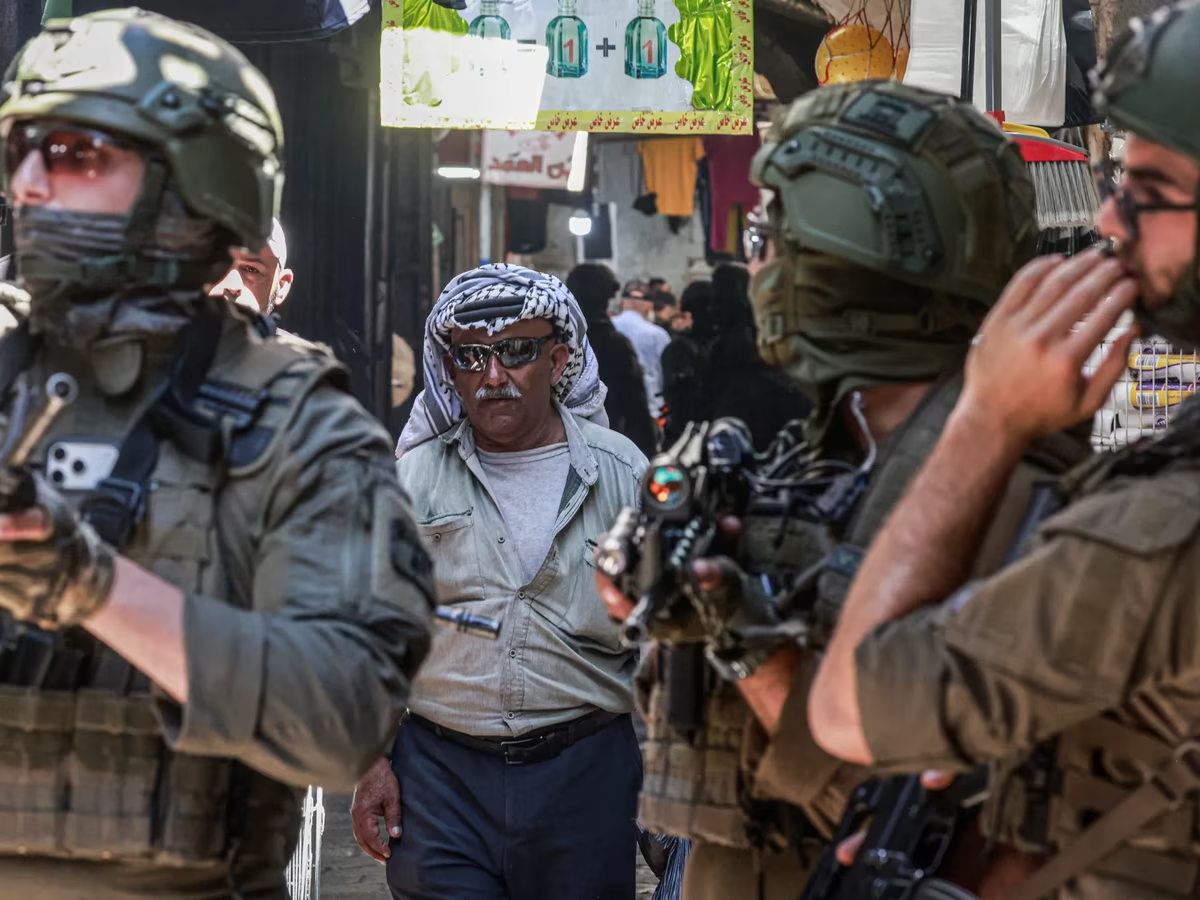







Haaretz writer Gideon Levy believes that the phrase 'there are no innocents in Gaza' was not merely a political slip of the tongue, but rather an ethical key that unleashed the occupation's hand to practice collective punishment, which has extended to include the West Bank. Once the attribute of innocence was stripped from Palestinian society, the occupation no longer needed to prove individual guilt; instead, Palestinian identity itself became an accusation warranting punishment.
The events of October 7th turned life in the West Bank upside down, where no place between Jenin and Hebron resembles what it was before that date. The stark irony lies in the fact that Palestinians in the West Bank were not directly involved in military action at that time, yet they suffered abuse not witnessed by the Palestinian people since the Nakba of 1948.
The occupation authorities treat the Palestinian geography as a single unit for punishment, where the residents of the West Bank bear the brunt of the Gaza events as part of a comprehensive retaliatory policy. Levy describes this situation as a 'life sentence' imposed on millions of Palestinians whose relative calm did not intercede against the oppressive machine that views their existence as a major sin.
Since the start of the war, security and political restrictions in the West Bank have been unleashed, and settlers have exploited the world's and Israeli society's preoccupation with the dead and prisoners to implement their postponed plans. The desire for revenge provided a thick cover for settlers to carry out actions that were previously difficult to pass under international or legal scrutiny.
Occupation forces tightened the closure of Palestinian cities and villages through hundreds of yellow iron gates, turning population centers into besieged enclaves. Nablus, Ramallah, and Hebron did not escape this strangulation, as citizens were forced to take rough and alternative dirt roads, while paved roads remained an exclusive privilege for settlers.
Levy asserts that this suffocating siege is not linked to genuine security necessities, but rather is a tool for daily abuse, which was acknowledged by the legal advisor to the Israeli army when he described the restriction of movement as illegal. However, this legal admission remains without actual value on the ground, as the closure policy continues without any tangible change.
The strangulation did not stop at movement and travel, but extended to strike the livelihoods of Palestinians by preventing tens of thousands of workers from reaching their workplaces within the Green Line. This measure led to an economic and social catastrophe, as Palestinians were trapped in their livelihoods and daily bread just as they were trapped in their cities and villages.
These measures coincided with an escalation in the pace of arbitrary military raids carried out by the army, which were accompanied by the emergence of so-called 'readiness teams' in the settlements. These teams are nothing more than armed militias that grant settlers absolute authority over the lives and passages of Palestinians, turning every settler into a security decision-maker.
Reports indicate the emergence of about 150 new settlement violence hotspots since October, which have managed to control vast areas of land exceeding what official settlement projects achieved for years. This violent settlement expansion is taking place under army protection and with clear political support from the poles of the extreme right-wing government.
Itamar Ben-Gvir's name stands out as a symbol of a new phase of abuse against Palestinian prisoners, where prisons have turned into horrific torture centers lacking the most basic humanitarian requirements. Levy points out that policies of deliberate starvation and humiliation have become an integral part of the punishment structure within detention centers that hold thousands of political prisoners and detainees without trial.
On the level of field killings, the Israeli army made the rules of engagement more flexible, leading to the martyrdom of more than a thousand Palestinians in the West Bank since October, including over 200 children. These victims fell in the context of uncontrolled shooting, although most of them posed no actual threat to Israeli forces or settlers.
In conclusion of his vision, Levy questions the ethical and political utility of continuing this indiscriminate abuse in the absence of widespread armed activity in the West Bank. He places the international and Israeli communities before their responsibilities, asking if it is not time to say 'enough' to this continuous bleeding for nearly three years with no end in sight.
The sin of Palestinians in Israel's eyes is deeper than any action; they are simply Palestinians, and this is enough to impose a life sentence on them.
שתף את דעתך
The Policy of Revenge in the West Bank: Comprehensive Siege and Extrajudicial Killings Since October