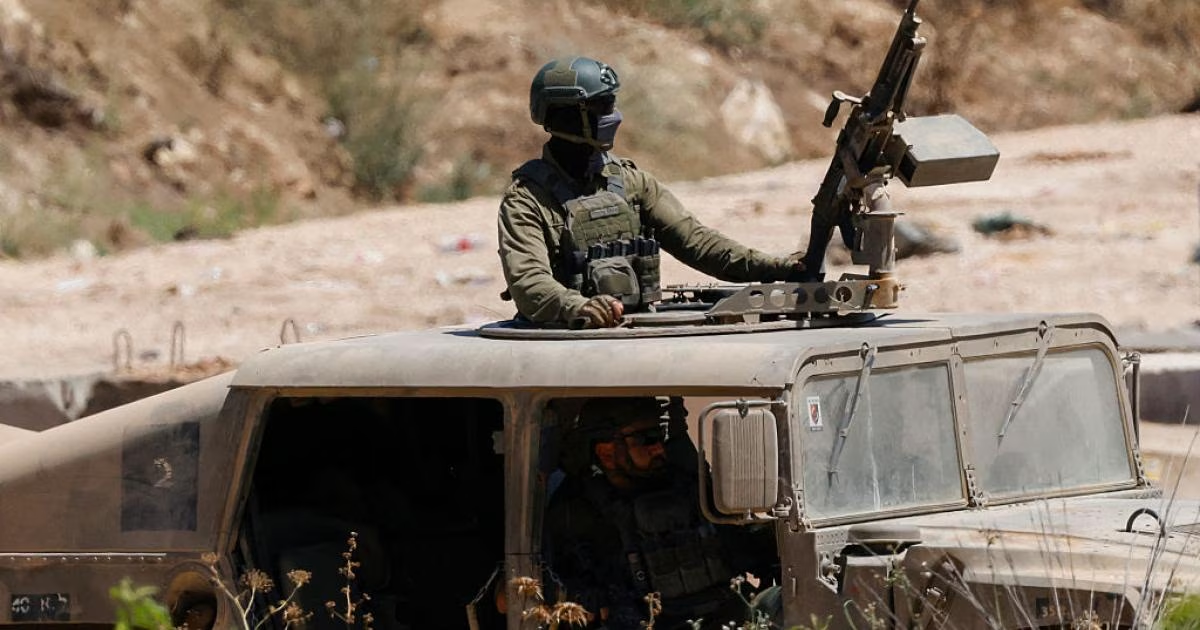







The Israeli government officially announced that there is no time limit for the withdrawal of its forces from South Lebanon, the Gaza Strip, and Syrian territories, emphasizing the continuation of military operations until its security objectives are achieved. These statements came at a sensitive time, coinciding with the start of a new round of talks in Washington, mediated by the United States, aimed at achieving regional de-escalation.
Israeli Defense Minister, Israel Katz, affirmed during a military ceremony that the Israeli army intends to maintain its presence in what he described as 'security zones' for an indefinite period. Katz clarified that this approach aims to protect Israeli settlements from threats posed by armed factions and jihadist elements on those fronts.
Katz stressed Tel Aviv's absolute opposition to any international pressure that might be exerted to push it towards an early withdrawal from South Lebanon, considering that a direct military presence is the only guarantee to prevent future attacks. He pointed out that past experiences have proven Israel's need for direct field control to secure its northern and southern borders.
For his part, Prime Minister Benjamin Netanyahu gave the green light to the army to continue operating with full freedom within Lebanese territories, affirming that forces will remain there as long as security necessity dictates. Netanyahu considered that freedom of military action is the primary tool to ensure that threats do not return to border areas.
In the same context, Israeli government spokesman, David Mencer, clarified that any redeployment of forces in South Lebanon is organically linked to the disarmament of Hezbollah and stripping it of its combat capabilities. Mencer added that Israel will not repeat past mistakes, referring to previous international decisions that failed to clear the area of weapons.
On the international front, French President Emmanuel Macron and Italian Prime Minister Giorgia Meloni revealed a plan to form a multinational 'coalition' to undertake security tasks in Lebanon after the expiration of UNIFIL's mandate. This proposal aims to strengthen Lebanese state sovereignty and support its national army to prevent the South from becoming a base for escalation.
Meloni affirmed during a meeting in the French city of Antibes that coordination between Rome and Paris aims to avoid a dangerous security vacuum in the border region after December 2026. The Italian leadership believes that the presence of an international force with new operating mechanisms could contribute to stabilizing the region more effectively than current formulas.
These European moves come in light of the UN Security Council's decision to end the mission of the United Nations Interim Force in Lebanon (UNIFIL) by the end of next year. This force currently includes about 7,500 soldiers representing 50 countries, but its effectiveness has been subject to continuous criticism by the Israeli side and the United States.
In turn, UN Secretary-General António Guterres warned of the dangers of the absence of a UN military presence in Lebanon, stressing the need to find an alternative formula that ensures continued international oversight. However, Guterres's proposal faces significant challenges in light of the Israeli tendency to impose a new security reality based on direct military force.
Field data indicates that the region is heading towards a phase of political and military complexity, where the Israeli desire for long-term occupation intersects with European efforts to internationalize the security file. The fate of South Lebanon remains pending between the results of Washington's negotiations and ongoing military movements on the ground.
We must remain in the security zone in Lebanon, in Syria, and in Gaza, and not for a limited period, in order to defend our population and our communities.
שתף את דעתך
Israel insists on military presence in Lebanon and Gaza.. and a European proposal for a 'coalition' to replace UNIFIL