






Urgent: Washington's Message
Washington – Said Arikat – 23/6/2026
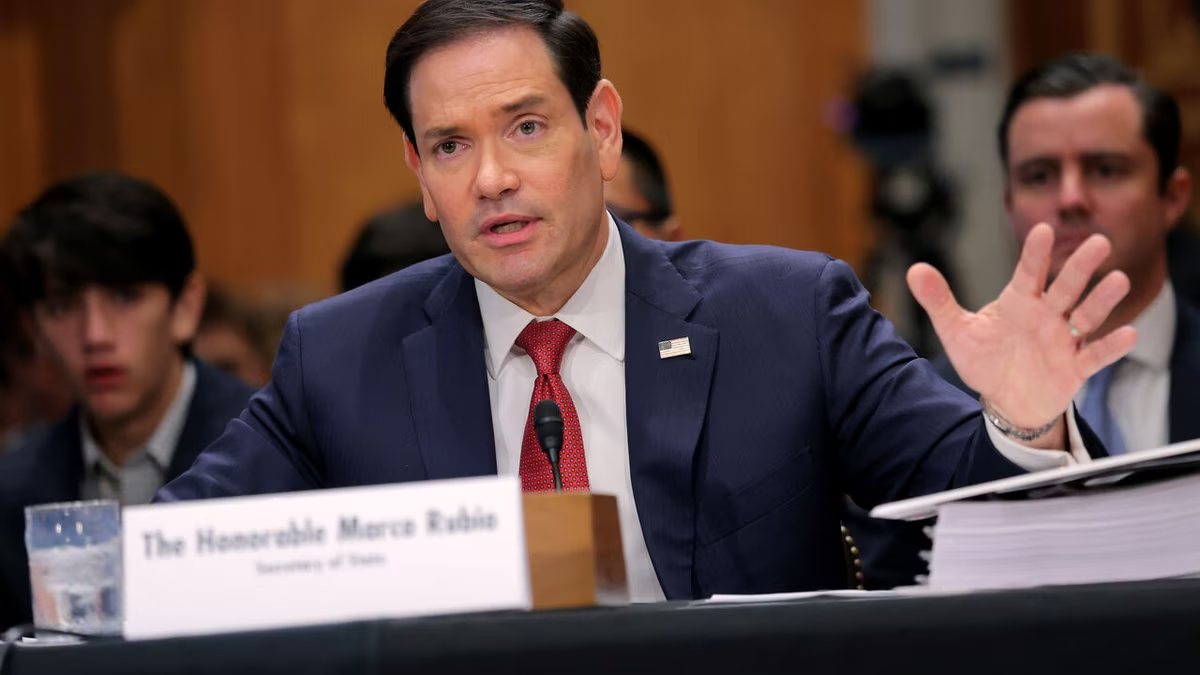
US Secretary of State Marco Rubio affirmed that the future of the negotiating path between Washington and Tehran depends on the extent of Iran's commitment to the pledges it made during the recent talks, especially regarding cooperation with the International Atomic Energy Agency, stressing that the US administration "knows exactly what Iran has agreed to," and that the decision is now in the hands of the Iranian leadership to move forward or face new options that President Donald Trump may decide.
Rubio's statements came during a meeting with journalists in the United Arab Emirates, as part of a Gulf tour aimed at consulting with regional allies on developments in negotiations with Iran and the resulting security and political implications.
Rubio said that the public disagreements issued by Iranian officials regarding the acceptance of international inspections do not change Washington's understanding of what was agreed upon, adding that the implementation of Iranian commitments will open the door for the continuation of the political process, while backtracking will lead to a comprehensive American review of the current path.
The US Secretary affirmed that Washington views its Gulf partners as an essential party in any future security or political arrangements, noting that the purpose of the visit is to listen to their assessments and concerns after the recent meetings held in Switzerland regarding the Iranian file.
Regarding the position of the Gulf states on the proposed framework for understanding with Tehran, Rubio explained that all allies support the principle of peace and de-escalation, but that ultimate success depends on the details and implementation mechanisms. He added that the crisis, which has lasted for nearly five decades, cannot be resolved in a few days, despite what he described as the progress achieved in recent hours.
Rubio indicated that the US administration is aware of the security and economic concerns of the region's countries, stressing that these concerns will be an essential part of any future agreement, given that the Gulf states will be most affected by the outcomes of understandings or their failure.
In response to questions about proposals to establish a fund for the reconstruction of Iran in the event of a comprehensive agreement, Rubio denied the existence of any American plans to finance such a fund, stressing that the United States will not provide government funds for this purpose.
However, he noted that Iran could obtain extensive investment opportunities if it chooses to transform into a "normal state" instead of continuing what he described as supporting armed movements and exporting terrorism. He added that any future investment flows will remain contingent on tangible progress in other security and political files.
Regarding the Lebanon file, Rubio stressed that the ongoing discussions between Lebanese and Israeli officials in Washington are separate from the negotiations with Iran, affirming that Lebanon is a sovereign state and that its future must be decided by the Lebanese through their elected institutions.
He explained that he had contacted Lebanese President Joseph Aoun, and that the United States is working directly with the Lebanese government to address bilateral issues, while acknowledging that Iranian support for Hezbollah will remain part of the US-Iranian dialogue.
Regarding criticisms that the current draft understanding does not clearly include the issue of Iranian missiles or the activities of Tehran's allied groups in the region, Rubio affirmed that these issues will be an essential part of future negotiations.
He said that talk of ending conflicts in the Middle East cannot be achieved as long as groups linked to Iran launch missiles and drones or engage in armed activities, considering that addressing these issues is a necessary condition for the success of any lasting agreement.
The US Secretary also addressed the issue of navigation in the Strait of Hormuz, affirming that freedom of navigation is a principle governed by international law, and that the waterway is an international passage over which no state has the right to impose fees or restrictions on its transit, expressing his belief that the countries of the region agree with this principle.
Rubio's statements reveal that the US administration seeks to market negotiations with Iran as a gradual process that goes beyond the nuclear file towards reshaping entire regional balances. The repeated talk about armed proxies, missiles, and regional influence suggests that Washington does not view the anticipated agreement as merely a technical understanding on enrichment and inspection, but rather a broader framework for readjusting Iranian behavior in the Middle East. However, past experiences indicate that linking all these complex issues to a single agreement may make the chances of success more difficult, given the conflicting regional interests and the entanglement of existing crises.
Rubio's focus on consulting with Gulf allies also reflects a growing American realization that any agreement with Iran will not be sustainable if regional partners feel that their security interests have been ignored. The Gulf states view with concern Iranian missile programs and the network of armed allies spread across several Arab countries, and believe that addressing these issues is no less important than addressing the nuclear program itself. Therefore, it appears that Washington is trying to strike a delicate balance between the requirements of understanding with Tehran and reassuring allies who fear a repeat of past experiences that raised their suspicions.
As for the Lebanese aspect, Rubio's statements reveal an American attempt to separate the path of building the Lebanese state from the path of negotiation with Iran, despite his explicit acknowledgment of Tehran's continued influence through Hezbollah. This approach reflects Washington's desire to strengthen the legitimacy of Lebanese institutions and give the new government a wider margin to act away from regional tug-of-war. However, the success of this approach will remain linked to the ability of the Lebanese state to impose its full authority, a goal that still faces complex political and security challenges amid continued internal divisions and border tensions with Israel.
שתף את דעתך
Rubio from the Gulf: Progress with Iran contingent on international inspection and curbing armed proxies