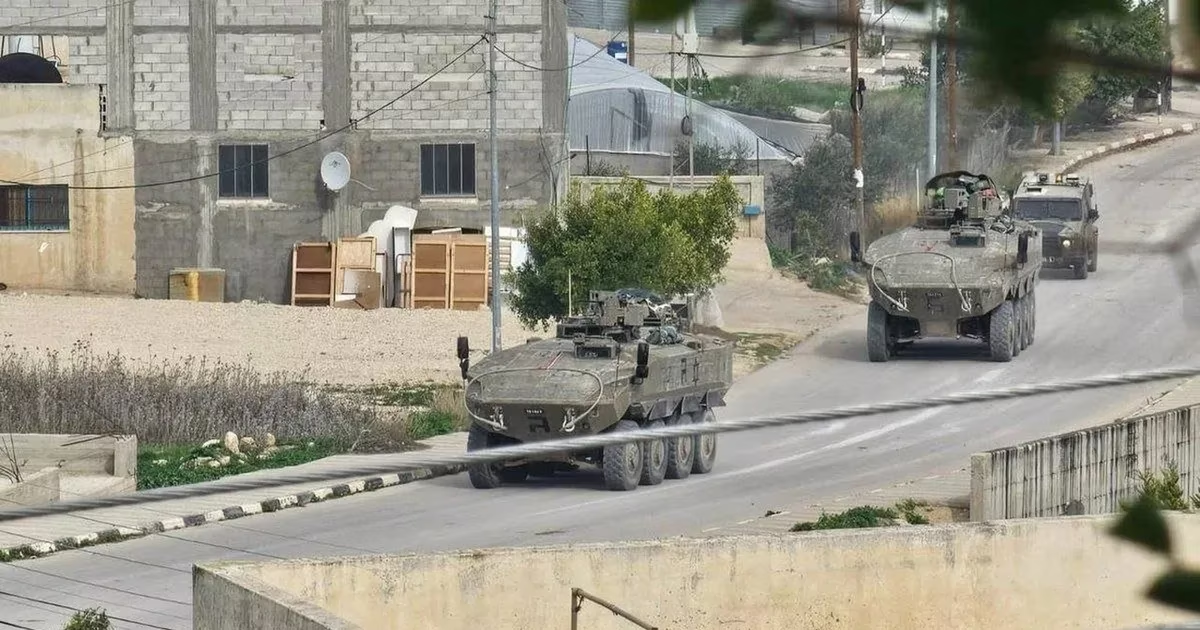







The 1997 Hebron Protocol is one of the most controversial turning points in the history of the Palestinian-Israeli conflict. It was not merely a set of political texts but left deep impacts on Palestinian geography and consciousness. This agreement redrew the boundaries of control within one of the oldest and most symbolic Palestinian cities, at a time when Palestinians hoped for a comprehensive Israeli withdrawal.
The agreement, signed on January 15, 1997, addressed the unique situation of Hebron, which includes the Ibrahimi Mosque (Cave of the Patriarchs) and settlement outposts within its urban fabric. Under this protocol, the city was divided into two distinct areas with differing powers and sovereignty, creating a complex reality that affected the lives of tens of thousands of Palestinian residents who found themselves victims of the new spheres of influence.
The first area, known as 'H1', covered about 80% of the city's area, where administrative and security responsibilities were transferred to the Palestinian Authority. Although this part seemed like a restoration of sovereignty, it remained constrained by the security arrangements imposed by the occupation on the entrances and exits connected to the second area.
The second area, 'H2', remained under full Israeli control. This area includes the Old City, the Ibrahimi Mosque, and the settlements. This division placed thousands of Palestinians under direct military rule, turning their daily lives into a series of confrontations with permanent checkpoints and barriers.
Politically, the agreement was marketed at the time as a step towards peace and a continuation of the Oslo Accords. However, reality proved it to be a 're-engineering' of the occupation. Israel retained strategic and sensitive locations, while granting Palestinians limited administration in densely populated areas, constrained by heavy security obligations.
Since then, Hebron has become a stark example of the idea of 'control without withdrawal,' where the world was led to believe in an Israeli military retreat while dominance was entrenched in the heart of the city. Over the years, the historical heart of Hebron has transformed into a closed space filled with electronic gates and concrete blocks that separate neighbors from each other.
This reality has shifted the conflict from a comprehensive confrontation with the occupation to a fragmented management of daily life, where laws and security responsibilities have become intricately intertwined. The distance between one street and another in Hebron now means moving from a certain level of freedom to strict security restrictions imposed by the occupation forces.
Economically, the city paid a heavy price due to this geographical and security division, as commercial activity in the historical markets was paralyzed. Hundreds of shops closed their doors forcibly or due to a lack of customers, leading to the deterioration of the vital economic artery that the Old City represented for the entire southern West Bank.
The division is no longer just lines drawn on political maps; it has become a daily factor reshaping the social fabric and human relations within the city. Barriers have completely isolated families and made access to essential services or visiting relatives a journey fraught with risks and administrative complexities.
The protocol entrenched an unequal security equation, where the presence of a small number of settlers justified imposing exceptional measures on tens of thousands of Palestinians. This paradox made 'Israeli security' the absolute priority, overriding all human and civil rights of the indigenous population in the city.
With the faltering of political settlement paths in subsequent decades, the Hebron Protocol transformed from a temporary transitional arrangement into a permanent reality that is difficult to overcome. The exceptions made in 1997 are now the rules governing the city today, reflecting a deep crisis in the approach of partial agreements that do not end the occupation.
Observers believe that this agreement embodies the failure of peace bets that are not based on justice and ending the root causes of the conflict. Instead of being a bridge towards independence, the protocol became a tool to legitimize the settlement presence in the heart of major Palestinian cities under the guise of security coordination.
After nearly three decades, the streets of Hebron and its closed markets still bear witness to the complexities of that agreement, which tightened the noose on the homeland and expanded the influence of the occupation. The city, once a symbol of historical diversity, is now an intense model of the identity and sovereignty conflict that was not resolved by papers signed in closed rooms.
The question posed by Hebron's contemporary history remains suspended above its minarets and barriers: Was the 1997 protocol a step towards liberation or an innovative formula for sustaining the occupation? The city's reality today indicates that true peace is not made by dividing spheres of influence, but by completely ending the system of control.
The Hebron Protocol was not merely a partial withdrawal, but a re-engineering of control with new tools through which the occupation retained strategic and religious sites.
שתף את דעתך
The Hebron Protocol of 1997: When Temporary Division Became Permanent Settlement Reality