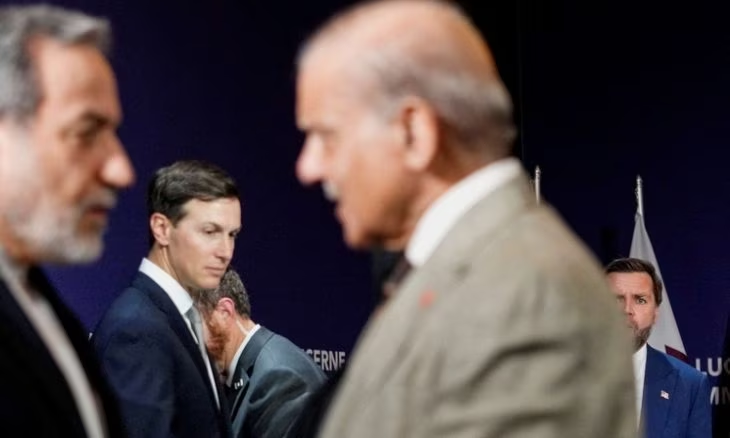







A state of extreme tension prevailed in the corridors of the ongoing talks in the Swiss resort of Bürgenstock between the Iranian and American delegations, following reports that the Iranian delegation had left the meeting venue on Sunday evening. This sudden move came after harsh statements made by US President Donald Trump, in which he threatened to target the Islamic Republic militarily if Lebanese Hezbollah did not stop what he described as 'causing trouble'.
Official media sources in Tehran reported that the delegation left the building where the negotiations were being held after about 80 minutes of discussions described as difficult. The sources explained that the message published by Trump on his social media platform was considered 'offensive' and provocative, which prompted Iranian negotiators to take a protest stance by suspending their presence in the meeting room.
In contrast, there was conflicting news about the reality of a complete withdrawal, as diplomatic sources quoted Qatari and Pakistani mediators as saying that the Iranian delegation was still engaged in the negotiation process. A well-informed diplomat confirmed that the mediators had not been informed of any official intention for a final departure, indicating that what happened might be a temporary suspension of sessions in protest against the escalating rhetoric coming from Washington.
Earlier, the US President had posted a strongly worded warning on his 'Truth Social' platform, demanding that Iran immediately rein in its allies in the region. Trump threatened to launch a military strike more powerful than the attacks carried out by the United States last week, which the Iranian side considered to undermine the foundations of the recently signed 'Islamabad Understanding' between the two parties.
For his part, the Speaker of the Iranian Parliament and chief negotiator, Mohammad Bagher Ghalibaf, responded to these threats by calling on the US administration to be cautious in its statements. Ghalibaf affirmed that the Iranian armed forces are on high alert and ready to respond to any military adventure in an unexpected manner, stressing that Tehran holds the initiative in the field.
Regarding the progress of the talks, Iranian state television clarified that the first session did not address the controversial nuclear file, but focused primarily on the mechanisms for implementing the memorandum of understanding. The discussions also included the volatile situation in Lebanon and the necessity of stopping the war on all fronts as a fundamental condition for moving to advanced stages of the final agreement.
Despite the charged atmosphere, US Vice President J.D. Vance expressed cautious optimism about the possibility of opening a new chapter in bilateral relations. Vance, who is accompanied by a high-level team including Jared Kushner, described the meeting as historic, wondering whether the two sides would succeed in bringing about lasting change in the Middle East or return to past confrontations.
In Doha, Qatari Prime Minister Sheikh Mohammed bin Abdulrahman welcomed the continuation of talks in Switzerland, emphasizing his country's aspiration to build on these steps to reach a comprehensive agreement. Qatar, along with Pakistan, plays a pivotal role in bridging the views between Tehran and Washington to end the war and address decades-old outstanding differences.
These negotiations are based on the 'Islamabad Memorandum of Understanding' which came into effect on June 18 after electronic signing by Presidents Pezeshkian and Trump. The understanding includes 14 clauses aimed at halting military operations, reopening the Strait of Hormuz, and lifting the US naval blockade imposed on Iranian ports.
However, Iranian Foreign Ministry spokesman Ismail Baqaei stressed that the implementation of the first clause related to stopping the war on all fronts, including Lebanon, is the real key to moving forward. Baqaei indicated that without clear guarantees to stop the attacks, it would not be possible to delve into the details of the final agreement sought by international parties.
Regarding the nuclear issue, Iranian President Masoud Pezeshkian affirmed that his country will not relinquish its sovereign right to enrich uranium for peaceful purposes. Pezeshkian expressed Tehran's readiness to provide written guarantees confirming that it does not seek to possess an atomic bomb, provided that this is done under the supervision of the International Atomic Energy Agency and within a framework that preserves Iran's rights.
On the other hand, the Israeli side is monitoring these talks with extreme caution, as Prime Minister Benjamin Netanyahu reiterated his pledges to prevent Iran from acquiring a nuclear weapon under any circumstances. Netanyahu affirmed that the ongoing political developments will not change Israel's strategy aimed at thwarting Iranian nuclear ambitions, which adds a new complexity to the negotiating landscape.
Reports indicate that the first session in Bürgenstock saw an Iranian request for journalists to leave the hall before the official deliberations began, signaling the sensitivity of the issues at hand. The question remains about the ability of mediators to contain the repercussions of Trump's recent statements and restore momentum to the diplomatic path that has begun to falter under the weight of mutual threats.
If the talks continue, they are expected to extend for a period of 60 days, renewable, as stipulated in the initial memorandum of understanding. The international community seeks through these rounds to defuse a widespread regional explosion, especially after the closure of the Strait of Hormuz and the escalation of military operations in Lebanon that now threaten the stability of global energy supplies.
Iran must immediately stop its proxies in Lebanon from causing trouble, and if it does not, we will strike it with greater force than we did last week.
שתף את דעתך
Tension in Switzerland Talks: Iranian Delegation Threatens to Leave After Trump's Threats to Strike Tehran