






The rapprochement between Tehran, Beijing, and Moscow is often viewed as a solid, unified bloc confronting the West. However, a closer examination of the essence of these relationships reveals a complex web of divergent interests. While China views Iran through the lens of economy and energy, Russia sees Tehran as a strategic card to rebalance international powers and prevent American unilateralism in managing Middle Eastern affairs.
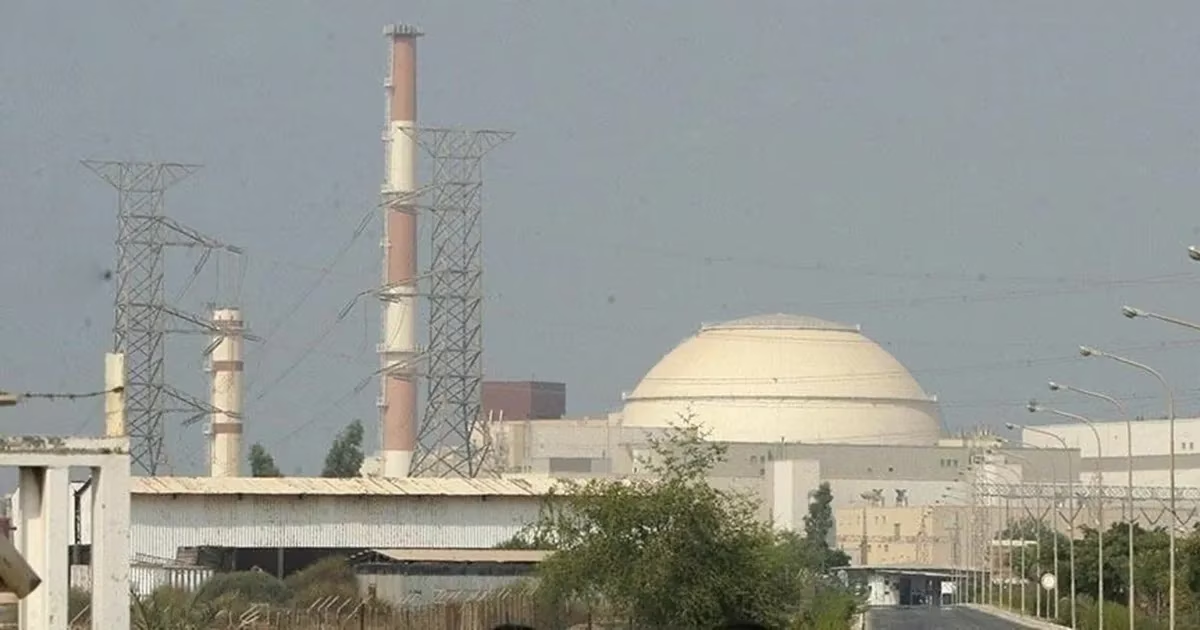
Historically, Iran's nuclear ambitions did not begin as a partnership with the East, but rather with support from the United States and West Germany before the 1979 Islamic Revolution. With the withdrawal of Western companies due to political shifts, Moscow found a golden opportunity to enter the heart of this file by completing the Bushehr reactor and training technical personnel, making it an indispensable partner in the operational structure of the program.
Russia's gains from the Iranian nuclear file extend beyond financial returns; they ensure Moscow a permanent role in the region's most sensitive files. This role was clearly demonstrated in the 2015 agreement, when Russia became a repository for enriched Iranian uranium, making it a technical and political guarantor that prevents Washington from unilaterally shaping regional policies.
Moscow prefers the Iranian file to remain in a long-term 'grey area,' where Tehran possesses an advanced program without reaching an announced nuclear bomb. This situation prevents a nuclear arms race on Russia's southern borders, while at the same time maintaining Iran's constant need for Russian political and technical cover in the face of international pressure.
The war in Ukraine has brought about a fundamental shift in the balance of power between Moscow and Tehran, where the relationship has moved from technical dependence to mutual reliance. This was clearly evident in military cooperation in the field of drones and the exchange of expertise in circumventing Western sanctions, which enhanced Iran's value as an active strategic ally for Russia.
On the other hand, China represents the 'economic lung' that enabled Iran to withstand severe American sanctions. By purchasing oil and signing a 25-year strategic cooperation agreement, Beijing established itself as an indispensable trading partner, benefiting from Iran's geographical location as a link in the Belt and Road Initiative.
The fundamental difference between the two powers is that China ascended from within the global trading system and considers stability essential for its economic growth. Russia, however, still views the world from the perspective of geopolitical conflicts and military balances, which makes their approach to the Iranian file follow different paths despite apparent overlap.
During recent military crises, neither Russia nor China intervened directly, but they provided a political and economic safety net that prevented Iran from being completely isolated. Chinese support in energy markets and Russian diplomatic cover in international institutions formed a bulwark that prevented the collapse of the Iranian state under the weight of external pressures.
The Caspian Sea represents a crucial geopolitical dimension in this tripartite alliance, being a closed sea beyond the reach of American fleets. This northern corridor provided Tehran with a logistical lifeline connecting it to Russia and Central Asia, reducing the effectiveness of military pressures exerted by Washington in southern waterways such as the Gulf and the Strait of Hormuz.
Questions arise about the future of this alliance if Iran fully integrates into the global economy and international trading system. For China, this could mean broader investment opportunities and greater competition, while Russia might lose a significant portion of its political influence based on Tehran's need for mediation and international cover.
Iran's potential integration into the international system could create a conflict of interests with Russia, especially if Iran becomes a competitor in global gas and oil markets. Economic openness could also impose shifts in Iran's internal political structure, which might change the nature of its existing alliances with Eastern powers.
Iran, for its part, plays a delicate balancing act between the Chinese 'Dragon' and the Russian 'Bear' to maximize benefits. It understands that its need for China is primarily economic, while its need for Russia remains linked to national security, the nuclear file, and military power balances in the region.
Talk of a homogeneous 'Eastern axis' overlooks the fact that each party acts according to a purely national agenda that may intersect today and diverge tomorrow. Iran's continued current status serves Russia's strategic interests, while China might prefer a more stable and open Iran to boost trade and energy flows.
In conclusion, the tripartite alliance remains subject to major international transformations and Iran's ability to maneuver between Western pressures and Eastern interests. The question will remain about Beijing and Moscow's willingness to support Tehran if the confrontation with the West reaches a point of no return that threatens their vital interests.
Russia does not want an openly nuclear Iran, but it also does not seem enthusiastic about completely ending the program; the grey area is its preferred playground for influence.
שתף את דעתך
Silent Conflict of Interests: How Do Beijing and Moscow's Visions Intersect on the Iranian File?