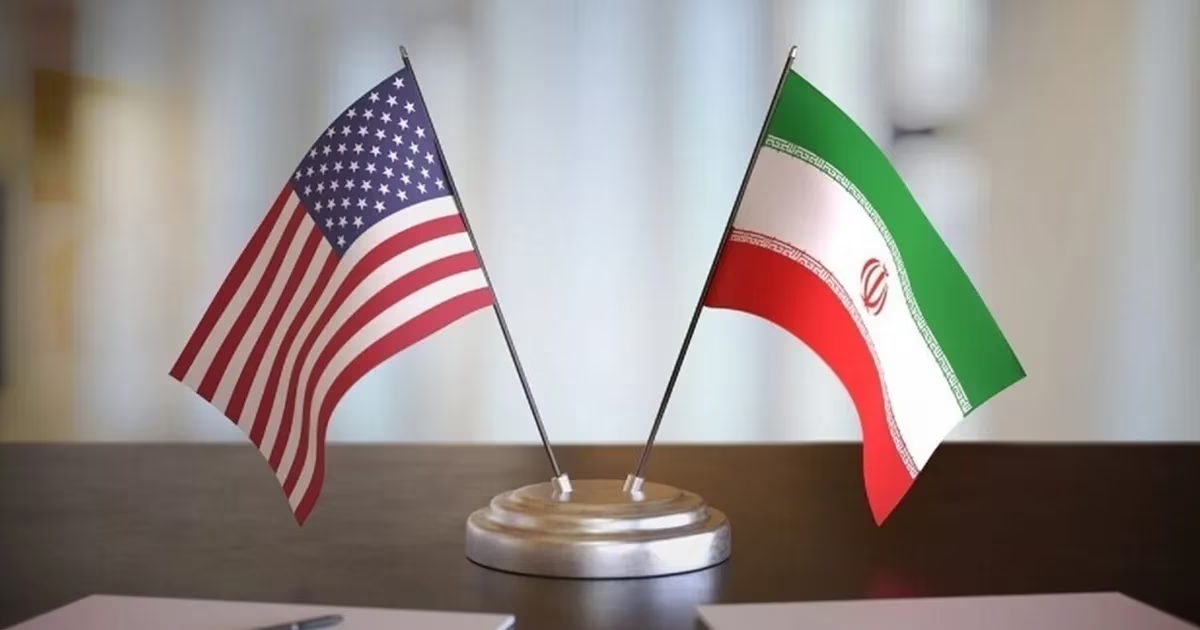







The recently signed Memorandum of Understanding (MoU) between the United States and Iran puts an end to more than 110 days of military confrontations that lacked realistic strategic planning. Field realities have proven the difficulty of resolving a conflict of miscalculations through military force alone, which opened the door for diplomacy and mediators to offer mutual concessions that defuse a comprehensive regional explosion.
The State of Qatar, along with the Sultanate of Oman and Pakistan, played a pivotal role in bridging viewpoints and the deep chasm between Washington and Tehran. This role was evident in the intensive communications conducted by US President Donald Trump with His Highness Sheikh Tamim bin Hamad Al Thani, which reflected high American appreciation for Qatari efforts in achieving this political breakthrough.
During the G7 summit held in France last week, President Trump praised the courage of the Qatari leadership and its role in avoiding the continuation of war with Iran. Trump affirmed in his statements that Qatari mediation was effective and resulted in significant progress, describing the Emir of Qatar as a person who genuinely seeks to achieve peace and stability in the region.
For his part, Iranian President Masoud Pezeshkian, in a phone call with the Emir of Qatar, expressed his appreciation for Qatar's efforts supporting regional security. Pezeshkian thanked Doha for its role that led to the current MoU, especially after the electronic signing that paves the way for the agreement to come into actual effect.
The MoU signed at the Palace of Versailles includes 14 clauses that constitute the first phase of a diplomatic process extending for sixty days. This phase aims to build trust and avoid military escalation, with a focus on ending the blockade and opening the Strait of Hormuz to international navigation and global energy trade.
The agreement includes a clear Iranian commitment not to seek nuclear weapons, with enriched material stockpiles placed under the supervision of the International Atomic Energy Agency. More complex issues are scheduled for discussion in the second phase, after ensuring all parties' commitment to implementing the initial understanding's clauses.
In return, the United States pledges to cooperate with regional partners to develop a comprehensive plan for Iran's reconstruction and economic development. This includes issuing necessary financial licenses and unfreezing Iranian assets, as incentives aimed at ensuring Tehran's continued adherence to the de-escalation clauses.
Despite this progress, serious challenges threaten the sustainability of the agreement, most notably US intelligence assessments indicating an Israeli attempt to thwart the understandings. This threat is clearly evident in the continued military escalation in southern Lebanon, which informed sources consider the biggest test of the will of the parties signatory to the memorandum.
The agreement faced harsh criticism from within the American Republican Party, with some hawks and conservatives describing it as a 'strategic mistake.' Ministers in Benjamin Netanyahu's government also expressed strong opposition to the American-Iranian rapprochement, prompting Trump to respond in angry language reflecting his insistence on moving forward with his new path.
The MoU calls for a permanent ceasefire on all fronts, ensuring respect for Lebanon's sovereignty and stability. It also emphasizes the necessity of securing navigation in the Strait of Hormuz without imposing fees, a vital demand for the Gulf Cooperation Council countries that were affected militarily and economically during the previous period of escalation.
In the next phase, Iran needs to build bridges of trust with its neighbors in the Gulf, especially after the threats to vital infrastructure and energy facilities. The success of Qatari mediation, supported by the Gulf, is an important step towards activating 'supportive diplomacy' aimed at protecting common interests and preventing the region from turning into a war of attrition.
The fundamental question remains about the current US administration's ability to curb Israeli recklessness and prevent the far-right from undermining the agreement. The continuation of the conflict serves personal and electoral agendas for some parties, while the agreement represents a realistic way out that spares the global economy the risks of energy supply disruptions.
The success of this memorandum fundamentally depends on adherence to the specified 60-day timeline to reach a final and comprehensive agreement. Qatari diplomacy remains the guarantor and mediator capable of defusing lingering crises, based on balanced relations with all parties to the conflict in the region.
Without Qatar, we might still be at war with Iran. Emir Tamim is a wonderful person who seeks peace.
שתף את דעתך
Challenges to the Success of the Washington-Tehran Memorandum of Understanding: The Role of Qatari Mediation and Opportunities for Regional Stability