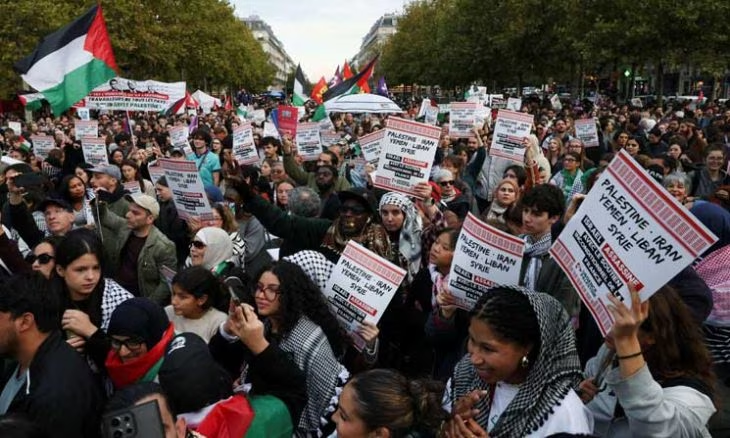







The French university scene is witnessing a state of boiling and escalating tension, in light of the authorities' tightening of measures against student movements condemning the Israeli war of extermination in the Gaza Strip. Field sources reported that activists face an arsenal of penalties, including on-site arrests, exorbitant financial fines, in addition to referrals to disciplinary councils within universities.
These pressures come at a time when the Israeli occupation continues its widespread aggression on Gaza, which has resulted in the martyrdom of about 73,000 Palestinians and the injury of more than 173,000 others. This tragic reality has fueled student anger in France, where protesters are demanding an immediate halt to academic and military cooperation with the Israeli entity.
In a remarkable development, the prestigious Sorbonne University witnessed violent security interventions, where French police arrested 88 activists last May during a demonstration supporting Gaza. These figures reflect the extent of official insistence on restricting freedom of expression within the university campus, under the pretext of maintaining public order and enforcing applicable laws.
Prosecutions were not limited to the security aspect, but extended to include unprecedented financial pressures targeting the pockets of active students. In protests witnessed in Paris last April, authorities imposed fines of 400 euros on more than 70 students, in a move described by human rights activists as an attempt to stifle the movement economically.
Statistics issued by student committees indicate that the total fines imposed in one day exceeded 35,000 euros, which constitutes a significant burden on students. Rania, a member of the Palestine Committee at the Sorbonne, considered that this shift towards financial penalties aims to intimidate students and prevent them from participating in future events.
In a related context, the 'Yadan' bill sparked widespread controversy before its withdrawal, as it aimed to criminalize anti-Zionist positions within universities. Despite the withdrawal of the bill on April 16, its legal and political effects still cast a shadow over the freedom of academic discussion on the Palestinian issue.
Some female students face prosecution on controversial charges, such as the case of student Tiba, who studies at Paris 1 University, who was accused of anti-Semitism merely for her digital stances. Sofia, a member of the Student Unions Federation, confirms that these prosecutions represent a blatant assault on public freedoms and aim to settle scores with opponents of Zionism.
Student movements accuse university administrations of complicity with security services to photograph student IDs and threaten them with arrest if they refuse to provide personal data. These measures, according to activists, are a departure from French university traditions, which have always been a space for political and intellectual struggle against colonialism and injustice.
Students adhere to their basic demands of boycotting institutions and companies involved in supporting the Israeli military machine. Protesters point to strong ties between French universities and arms companies, in addition to partnerships with Israeli academic institutions that directly support the occupation army.
The student movement also demands facilitating the access of Palestinian students from the Gaza Strip to France to complete their education, which has been disrupted by the war. Students believe that the role of universities should be humanitarian and educational, instead of engaging in policies that serve the occupation or justify its ongoing crimes against civilians.
For his part, Ibrahim, a member of the Communist Youth Organization, explained that the security handling of the protests was characterized by a high degree of repression and physical violence. He pointed out that drawing the Palestinian flag or hanging solidarity posters has become a sufficient reason to refer a student for investigation, which reflects the authorities' intolerance of any dissenting voice.
Observers believe that what is happening in France represents a dangerous precedent in the history of university life, where the police are called to break up peaceful sit-ins inside the campus. Field testimonies confirm that security forces used excessive force in dispersing students, and this was interspersed with practices described as having a racist character against the participants.
Despite all these pressures, activists confirm their continued organization of protest events and introductory seminars on the Palestinian issue. Students emphasize that defending human rights and international justice is a moral duty that cannot be compromised, no matter how great the sacrifices or how high the financial fines.
In conclusion, the conflict between the student movement and the French authorities remains open to all possibilities, in light of the students' insistence on breaking the barrier of silence. The Palestinian issue remains the primary driver of these movements, which have revealed a deep gap between declared democratic principles and repressive practices on the ground.
The state has begun to target activists economically through direct financial fines instead of merely traditional arrest procedures.
שתף את דעתך
Between judicial prosecution and financial pressure.. How does France confront the student movement supporting Palestine?