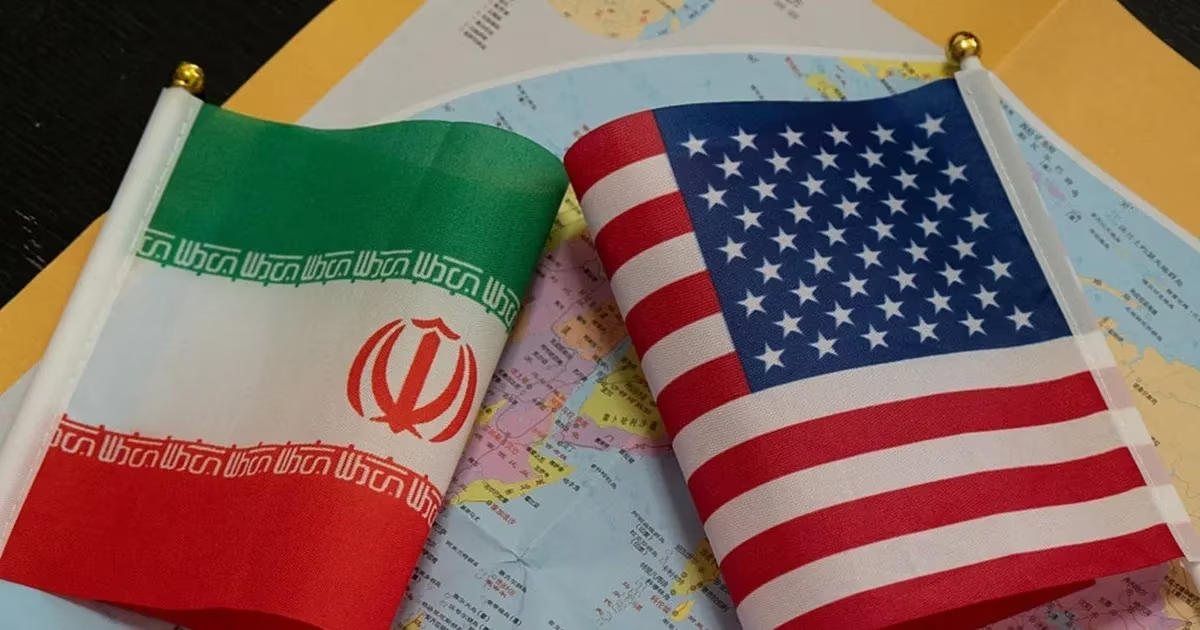







Political circles are awaiting the official final signing in Switzerland of the Iranian-American Memorandum of Understanding, which came as a result of Pakistani mediation supported by an active Qatari role. This procedure was preceded by a mutual electronic signing, amidst media leaks that sparked mixed reactions in the capitals of Tehran and Washington, between supporters who see it as a strategic necessity and opponents who describe it as a concession.
Domestically in the US, criticism from Democratic Party leaders towards the Donald Trump administration escalated, with Senator Chris Murphy describing the framework agreement as an 'American surrender'. Murphy pointed out that involving soldiers in a military confrontation with Iran was a losing bet from the start, emphasizing that Tehran emerged from this confrontation stronger and more resilient.
Criticism was not limited to politicians but extended to think tanks and media, with 'The Atlantic' considering Iran the true victor in this conflict. Analysts explained that the United States failed to achieve the fundamental goals it announced at the beginning of the escalation, which granted Iran a more influential regional and international standing after its steadfastness against military pressures.
In Israel, a state of deep shock prevailed in both government and opposition circles, with Avigdor Lieberman describing the memorandum as a great catastrophe. Benjamin Netanyahu found himself in an embarrassing defensive position, especially with the agreement's text stipulating a cessation of hostilities on all fronts, foremost among them the Lebanese front, which represents a priority in the memorandum.
The structure of the final agreement, drafted by Tehran in 14 clauses, is completely devoid of any reference to the Iranian missile program or its regional alliance network. The Iranian negotiator succeeded in isolating these files from the discussion table, focusing on linking the nuclear file to a cessation of war and an immediate lifting of the economic and naval blockade.
The effects of the agreement began to appear practically even before the official signing, as Iran resumed exporting oil and petrochemicals without objection from American fleets. In return, Tehran pledged the gradual opening of the Strait of Hormuz within thirty days, with a view to collecting navigation and environmental service fees from passing ships in coordination with the Sultanate of Oman.
Regarding the nuclear file, the agreement included a negotiation period extending for sixty days, with advanced centrifuges and nuclear facilities remaining under Iranian sovereignty. Washington appears to have backed down from its demands to dismantle the program, contenting itself with understandings regarding reducing high enrichment levels within Iranian territory or converting them into nuclear fuel through international intermediaries.
Recent intelligence reports indicate that Iran now possesses a 'strategic weapon' in its proven ability to control international waterways. Security sources confirmed that Tehran rapidly rebuilt its military industrial base faster than expected, giving it a permanent ability to threaten navigation in the event of a collapse of political understandings.
Despite this progress, there remain existing risks that could jeopardize the agreement, most notably the possibility of Israel violating the ceasefire in Lebanon to undermine Trump's efforts. In this context, Tehran insists on the necessity of a complete Israeli withdrawal from southern Lebanon, holding the American administration responsible for curbing any future Israeli military action.
In conclusion, the current scene shows the superiority of the Iranian negotiator who managed to transform military steadfastness into tangible political and economic gains. While Trump seeks to market the agreement as a historic achievement, observers believe that Tehran succeeded in establishing new rules of engagement that guarantee its national interests and end decades of imposed isolation.
Iran grew stronger day by day, and the military mission against it was impossible.
שתף את דעתך
A Reading of the Balance of Power: How Tehran Imposed Its Conditions in the Memorandum of Understanding with Washington?