






Washington - Said Arikat - 19/6/2026
News Analysis
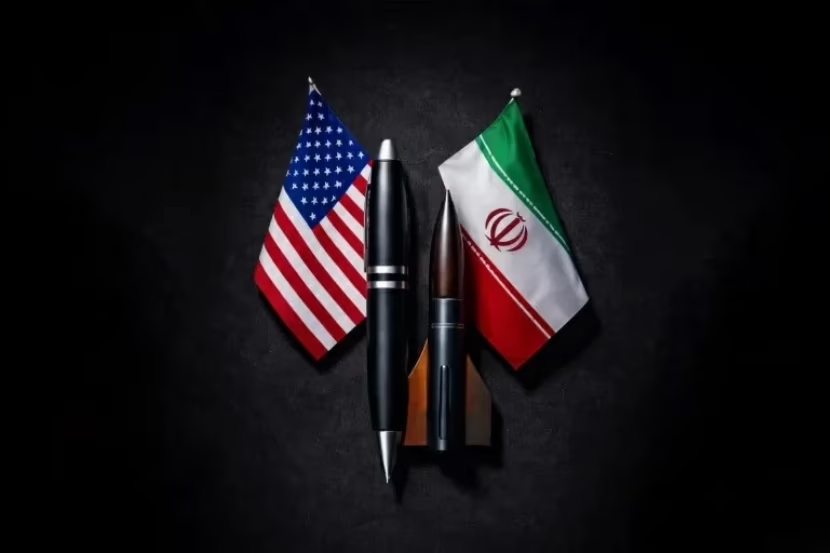
In a scene with striking political and historical implications, US President Donald Trump, on Wednesday, signed a memorandum of understanding with Iran at the Palace of Versailles in France to end hostilities between the two countries. For many observers, this step seemed an implicit acknowledgment of the failure of the US-Israeli war to achieve its stated goals or to bring about the strategic transformations that Washington and Tel Aviv sought at the beginning of the confrontation.
The signing took place at the Palace of Versailles, which more than a century ago witnessed the signing of the peace treaty that ended World War I, in a symbolic choice reflecting the parties' desire to give the agreement a historical character. Footage showed Trump signing the document in the presence of French President Emmanuel Macron and US Secretary of State Marco Rubio. After the signing, the US President announced that oil prices were falling and financial markets were making gains, considering this evidence of his policy's success.
However, the official celebration of the agreement did not obscure the growing wave of criticism from experts and observers who believed that the war ended with results contradicting the objectives raised at its outset. The US administration had presented the confrontation as a means to reshape the Middle East, reduce Iran's regional influence, and force it to make fundamental concessions. However, the new agreement indicates Washington's return to the negotiating table without clearly achieving those goals.
According to available data, representatives from the United States and Iran had electronically signed the memorandum of understanding before the official signing ceremony, initiating a new sixty-day negotiation phase, which is supposed to discuss the future of Iran's nuclear program, regional security issues, and bilateral relations between the two countries.
Critics of the war point out that its actual results were far from the expectations that accompanied its beginning. Iran did not experience political or military collapse, nor did military operations succeed in dismantling its regional alliance network or undermining its ability to influence regional issues. On the contrary, Tehran managed to withstand months of fighting before returning to negotiations while still a key player in the Middle East equations.
In contrast, the war left widespread economic repercussions. Global energy markets witnessed severe disruptions, and transportation, insurance, and shipping costs increased. International supply chains were also affected, and economic growth forecasts in several major economies declined. Despite the US administration's talk of market improvement after the agreement, the effects of the crisis are still evident in the global economy.
As for the human cost, it is one of the most controversial aspects of the war. Estimates indicate thousands of dead and wounded in Iran, in addition to widespread damage to civilian infrastructure, including schools, water networks, and service facilities. The repercussions of the war also extended to other countries in the region, especially Lebanon, where Israeli military operations led to thousands of casualties and the displacement of large numbers of people.
One of the most prominent political outcomes of the war, as observers see it, is a decline in the Israeli role during the final stage of negotiations. The Israeli government, which strongly pushed for confrontation with Iran, ultimately found itself facing an agreement in which it was not a major party in its drafting, while the goal of weakening Iran or eliminating the influence of its regional allies was not achieved.
Despite the importance of the memorandum of understanding, the most sensitive issue remains unresolved: Iran's nuclear file. The document sets a general framework for future negotiations, but it does not include crucial details regarding the future of enrichment, monitoring mechanisms, or mutual guarantees. For this reason, experts believe that the path towards a comprehensive settlement is still long and complex.
Some analysts argue that the main paradox is that the war ended by bringing the parties back to the diplomatic track that existed before its outbreak. After months of military confrontation, mutual escalation, and enormous human and economic losses, Washington and Tehran returned to negotiate the same issues that were on the table before the war, which raises fundamental questions about the utility of a conflict that could have been avoided through a political path from the outset.
Failure of the Regime Change Project
The most significant implications of the agreement lie in the collapse of the goal that was raised from the early days of the war: changing the Iranian regime. US President Donald Trump spoke more than once about the possibility of bringing about radical political change in Tehran, adopting a vision long promoted by Israeli Prime Minister Benjamin Netanyahu. However, this goal clashed with the realities of history, geography, and politics, as many of Trump's senior advisors and national security experts warned that overthrowing the Iranian regime by force could lead to widespread regional chaos and the collapse of state institutions. After months of war and destruction, the entire project ended in direct negotiations with the very regime that was supposed to be overthrown, making the war evidence of the failure of the theory of regime change by military force.
Netanyahu Convinced Washington of a War Without Horizon
The results of the war reveal the extent of Netanyahu's influence in pushing the US administration towards a military option that did not enjoy consensus within the American establishment. The Israeli argument was based on the premise that military strikes would lead to the collapse of the Iranian regime or an internal uprising that would overthrow it, a premise not based on factual evidence as much as it relied on political bets and ideological wishes. Numerous reports indicated reservations within American security and military circles regarding this approach, but Trump ultimately adopted the Israeli vision. Today, after reaching an agreement with Tehran, that theory appears closer to a political illusion than a well-thought-out strategy, while the region and the world bear an enormous human and economic cost as a result of this failed gamble.
Return to Diplomacy After an Unnecessary War
The great irony is that Washington ultimately returned to the point that many diplomats and experts advocated before the outbreak of the war. Instead of overthrowing the Iranian regime or forcing its surrender, the US administration found itself negotiating with the Iranian leadership on the same issues that were on the table before the confrontation. This reinforces the impression that the war was not a strategic necessity as much as it was a response to a vision adopted by Netanyahu and convinced Trump of, despite the reservations expressed by a number of his senior advisors. From this perspective, the agreement may be seen as a belated acknowledgment that diplomacy was the most rational option from the beginning, and that the war only delayed the settlement and increased its human, economic, and political cost for all parties.
שתף את דעתך
Washington and Tehran Agreement Reveals Failure of US-Israeli War to Change Regional Balances