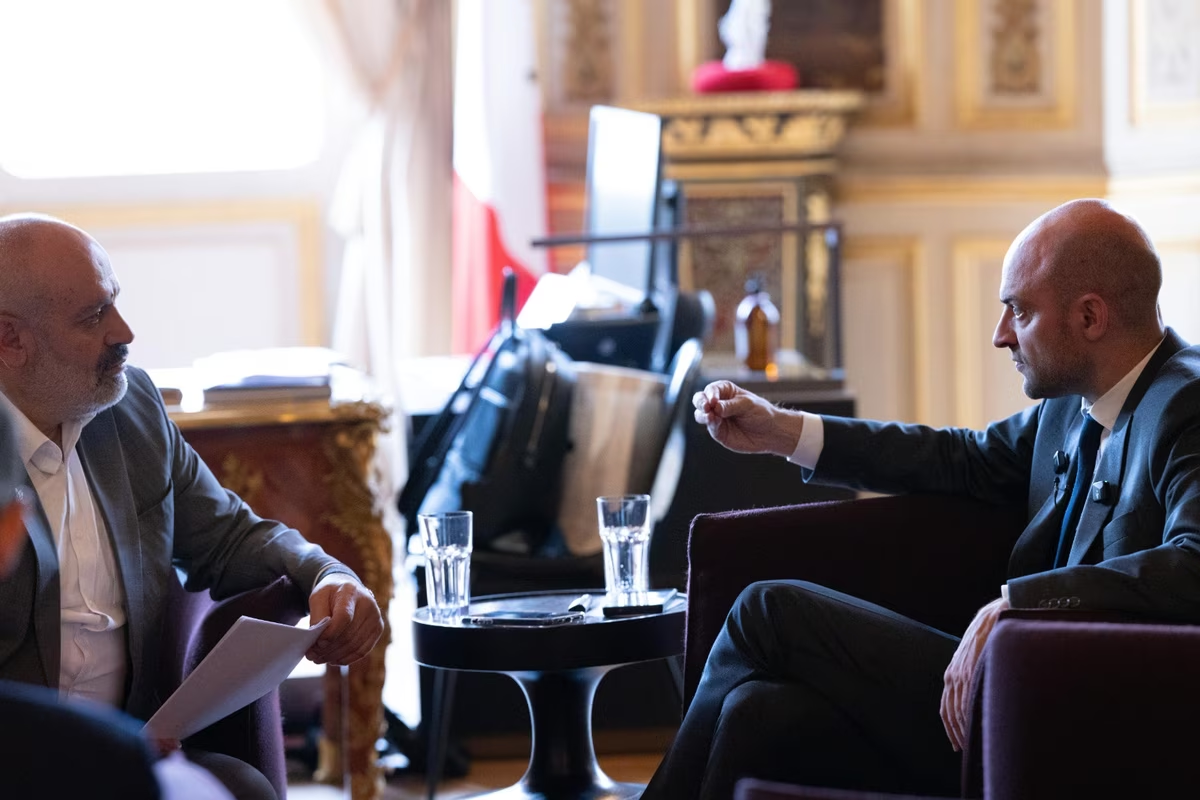







The New York Declaration enshrines the right of the Palestinian people to their independent state. Peace and security can only be built on recognition, and the only solution to this conflict is a two-state solution. Peace is not born from diplomatic summits or governmental agreements, but grows in the hearts and souls of peoples. We are following with concern the statements and actions of Ben Gvir and Smotrich... and that is why we froze them with sanctions. Israel's security can only be built on the two-state solution, and on recognition and respect. The implementation of the "E1" settlement project will not only constitute a major violation of international law and international humanitarian law, but will also necessitate a very strong response from European countries. We explicitly warned companies; those participating in the "E1" settlement project tenders will expose themselves to international sanctions. France condemns in the strongest terms the restrictions imposed by Israel in Jerusalem on churches and mosques and the prevention of access for Palestinians, Christians and Muslims, to holy sites. We were shocked by the way French and European citizens participating in the "Fleet of Resilience" were treated, and I referred this file to the French Public Prosecutor, who opened a special investigation. We have repeatedly expressed to the Israeli authorities, at all levels, our deep concern regarding human rights violations within Israeli prisons and detention centers. There is no alternative to UNRWA, and Israel's targeting of UN buildings and the demolition of its headquarters in Jerusalem is condemned, and these actions are illegal and a violation of international law. There is an unprecedented explosion in settler violence and settlement... We asked the European Commission to restrict imports from settlements so that they do not benefit from European trade agreements with Israel. We do not merely issue statements of condemnation and denunciation; France recognized the State of Palestine, which encouraged ten other countries to follow suit. We will leave it to the French judiciary, with complete independence, to rule on the cases of soldiers holding both French and Israeli nationalities who fought in Gaza. The international community is not only required to provide humanitarian assistance, but also to create incentives and exert pressure to make the right decisions to achieve the two-state solution. Paris - Interviewed by Mohammed Abu Khdeir Jean-Noël Barrot, French Minister for Foreign Affairs and Minister for Europe and Foreign Affairs, broke the stereotypical image of the reserved European diplomat, to declare for the first time in a clear voice that "France recognized the State of Palestine in 2025, and encouraged ten other countries to follow suit." He said: "We are following what is happening in Gaza and the West Bank with concern, and we do not merely issue statements of condemnation and denunciation." In what was considered the boldest moment in the interview, the Minister revealed details of the actual sanctions imposed on Itamar Ben Gvir and Bezalel Smotrich, saying: "These are the ones who are destroying the two-state solution, and that is why we froze them with sanctions." French Foreign Minister Jean-Noël Barrot spoke in a special and exclusive interview with (Al-Quds) in his office in Paris about France's "shock" at the treatment of French and European solidarity activists in the "Fleet of Resilience" and Palestinian prisoners, and revealed the opening of a judicial investigation into the "Fleet of Resilience" file, confirming that reports of abuses in Israeli prisons prompted the French Public Prosecutor to open a special investigation. Minister Barrot also spoke about the "unprecedented explosion in settler violence and settlement," and revealed an official European demand "to restrict imports from settlements so that they do not benefit from trade agreements with Israel," describing the situation in the Palestinian territories as "horrific." In an angry response to those who accuse Paris of merely condemning, the Minister said: "I do not know any country in the world that has done more for the Palestinian cause than France has in the past two years." This special meeting, which comes at a time when the occupied Palestinian territories are subjected to one of the most violent and severe Israeli attacks, with cruelty and complexity in the political and field landscape in Gaza, the West Bank, and occupied Jerusalem, amid an unprecedented Israeli escalation on the ground, may be an announcement of the birth of a bolder European stance towards Israel, or merely diplomatic statements that will melt away when dealing with what the region is exposed to. The full text of the interview is as follows: Q: Thank you for this opportunity. First, I would like to start with the situation in Palestine, and perhaps you are following what is happening in the West Bank and Gaza, after the martyrdom of more than 72,000 Palestinians and the destruction of more than 80% of Gaza. What is your opinion? How can we stop this massacre and genocide in Gaza? Despite the announcement of a ceasefire, the killing of Palestinians in Gaza has not stopped. Netanyahu announced that he would expand the areas controlled by Israel and occupy 70% of the besieged strip. What is your position? And how do you view the situation in the West Bank? A war in another style, what is the reason for this silence? After the Israeli army used to kill 100 citizens daily, today it kills 7 to 10 citizens daily, destroys entire residential blocks in Gaza, demolishes dozens of homes in the West Bank, what is your position? Don't you think that should stop? A: Since the beginning of the war in Gaza, after October 7, France has stood by the Palestinian people. It hosted the first international humanitarian conference in Paris in November 2023, which raised one billion dollars to support the Palestinian people. France was one of the first countries to send military ships to treat wounded children, men, and women from Gaza. Then, last year, or 18 months ago, France, along with Saudi Arabia, launched a major international initiative to revive the two-state solution and reaffirm the Palestinians' right to self-determination. This initiative led to a declaration adopted by the United Nations on September 12 of last year, paving the way for a peace plan. It is a peace plan that has achieved some results, meaning that the war in Gaza has stopped, although the ceasefire is constantly violated. The last hostages were released, and we saw a slight but insufficient increase in the delivery of humanitarian aid to Gaza. The implementation of this peace plan, which includes the disarmament of Hamas, as well as the issue of Palestinian leadership in Gaza, and the prospect of a Palestinian state, is still faltering. That is why we hosted hundreds of leaders from Israeli and Palestinian civil society in Paris, who were invited to implement the peace plan and the two-state solution. This is very important, and I had to say that before mentioning what we are doing in Paris, because the peace plan has become stalled. We are witnessing an unprecedented acceleration of illegal settlement in the West Bank, and a sharp escalation of violence, which has led us to take a series of European and national sanctions against entities, individuals, and government officials responsible for this. We believe that this clearly constitutes a violation of international law and human rights, and also contradicts Israel's own interest and security. That is why we are trying today to build this bridge in Paris. Q: You are talking about an initiative, but who is your partner in Israel for making peace in the region? Netanyahu is not interested. He destroyed the two-state solution and wants to make Israel bigger. He spoke about this at the United Nations and raised a map of Greater Israel. A: That is why it was very important to rally 142 countries around the New York Declaration, which revives the two-state solution and reaffirms the right of the Palestinian people to establish their state. This large and overwhelming majority of countries that adopted this declaration sent a very strong signal to the United States and to the Israeli government, that there is no other path to peace and security. In fact, the peace plan supported by the United Nations refers to this New York Declaration. A diplomatic initiative of this kind may seem somewhat abstract and far from the suffering of people on the ground. But the situation would probably have become much more difficult if we had not affirmed these very important principles. And you say that the two-state solution is dead, and we say it is alive. The best proof of this is this gathering today of Israeli and Palestinian activists who work daily to prepare for peace and create the conditions for it. Peace does not come only through diplomatic conferences or agreements between governments, but it can also grow in the souls and hearts of people. Q: Are you engaging in dialogue with the Israeli side, or with the Israeli government, about the two-state solution? Do you have a partner? A: We are engaging in dialogue, but we have very strong disagreements with the policy being pursued, and that is why we have imposed sanctions. Q: There is no one in the current Israeli government who sees a two-state solution, but Smotrich and Ben Gvir, who are central ministers working to destroy this solution you are talking about? A: And that is why we imposed sanctions on them. On both of them. Q: Do you see anyone in this government or in the Israeli opposition who includes the two-state solution in their political program for the upcoming elections? Even if Netanyahu disappears and this government falls and a new government comes, we do not see anyone in the opposition talking about the two-state solution. They all talk about how to destroy, and how to make Israel bigger. A: That is why it is very important that today in Paris we have Israeli figures and leaders who believe that Israel's security can only be built on the two-state solution, and on recognition and respect. This is our vision. This is the vision that led France to recognize the State of Israel in 1949, and which led France to recognize the State of Palestine in 2025. Peace and security can only be built on recognition, and the only solution to this conflict is a solution based on two states living side by side in peace and security. Q: What about Jerusalem? Israel continues to Judaize the city and demolish homes in the neighborhoods of Silwan, Sheikh Jarrah, and Al-Bustan. Does France recognize East Jerusalem as the capital of Palestine? And when will you start protecting Muslims and Christians in the city? In what country do you need permission to go to a church or mosque to pray? The occupation closes the Church of the Holy Sepulchre and Al-Aqsa Mosque whenever it wants. When will you act to push Israel to respect the status quo for Jerusalem and the holy sites for 100 years? When will the French or Europeans intervene to stop these practices? A: You have heard France condemn in the strongest terms this type of restriction imposed by the Israeli authorities on access to religious sites. We, in particular, and because of its connection to our history, pay special attention to the fate of Christian communities and Christian holy sites in Jerusalem and beyond. Our Consulate General in Jerusalem does its utmost to support communities targeted by extremist violence. Q: How do you view the demolition of homes in Jerusalem and the West Bank? The occupation municipality in Jerusalem announced that more than 20,000 homes in Jerusalem are unlicensed, and it is pushing for their demolition, while in return, they are building thousands of settlement units, and every week they have a plan for more settlement with the aim of Judaizing the city, the latest of which is the "E1" project, which will divide the West Bank into two parts and isolate occupied East Jerusalem. A: We have imposed sanctions, and we have made it absolutely clear to the Israeli authorities that the acceleration of settlement in the West Bank, as well as in East Jerusalem, is unacceptable. In particular, we warned that the "E1" project, which includes 3,400 units that could accommodate up to 15,000 people, and divides the West Bank into two parts and separates the West Bank from Jerusalem, will not only constitute a major violation of international law and international humanitarian law, but will also necessitate a very strong response from European countries. We also explicitly warned companies that if they participate in such tenders, they will expose themselves to international sanctions. Q: You said that Hamas released Israeli hostages from Gaza. What about our hostages? We have 10,000 prisoners held hostage. And perhaps you are following reports from Human Rights Watch, and B'Tselem, one of the most prominent Israeli human rights organizations, and what is happening to them. They were raped... and prisoners are being raped, they are treated very badly. How are you following this matter? There are thousands of them without any charge, without any guilt. They did nothing. Every day we have 300 or 200 or 150 new prisoners arrested by the Israeli occupation army. Arrest has become a kind of daily habit for the occupation army? And ministers like Ben Gvir, he is the one who orders and follows up on that. A minister in the government! How do you view that? A: Indeed, as you said, we were shocked by the way French and European citizens were treated under the influence of Mr. Itamar Ben Gvir when the "Fleet of Resilience" protest was arrested a few weeks ago and its activists were detained. We summoned our ambassador for clarification. And based on these clarifications, we took sanctions against Itamar Ben Gvir. Then, based on the detailed report issued by our Consulate General in Turkey, where the participants who had been arrested arrived, I referred the matter to the French Public Prosecutor, who opened an investigation; given the extent of the violations committed. We have, on several occasions, expressed to the Israeli authorities at all levels, our deep concern regarding human rights violations, including within prisons. Q: UNRWA. As you know, Israelis, since 1949, have been attacking UNRWA and attacking the United Nations. A few months ago, they attacked and destroyed UNRWA schools in the Gaza Strip, and in Jerusalem they demolished its headquarters. They are, in a way, destroying the right of return for Palestinians, and trying to cut off its funding, what is your position on targeting this UN agency. Will you fund UNRWA? How do you view the demolition of its main office in Jerusalem? Do you think UNRWA is still important in this situation? A: France has supported UNRWA for a long time, and also during the past three years. Our total commitment to Gaza and Palestine has reached 100 million euros annually. We contribute directly to UNRWA's funding, as well as to supporting the Palestinian Authority. We have also helped facilitate the reform of the UN agency, through a report prepared by my predecessor, Catherine Colonna, the former French Foreign Minister, which also proved that there is no alternative to UNRWA. We have proven that there is no alternative to it. And whenever UN buildings are targeted, we condemn these actions, because they are, once again, illegal. Q: "Condemnation and concern," we hear the same thing... Most countries condemn, denounce, and deplore, and Israel continues to kill, destroy, and displace Palestinians in Jerusalem, the West Bank, and the Gaza Strip, and imposes a new fait accompli on the ground and on Palestinians. When can serious action be taken and Israel be held accountable for the crimes it commits, and when will Security Council and United Nations resolutions related to the Palestinian issue be implemented? A: No, you cannot say that, sir. I mentioned my great support for Palestine. And I mentioned major rounds of sanctions. And I mentioned the recognition of Palestine, and that France's recognition of Palestine prompted ten other countries to recognize it. Don't tell me that I only condemn. Otherwise, direct this question to another European, not to me. Q: My point of view is that this applies to the whole world. We hear the United Nations repeating "we express our concern," and 157 countries condemn in the United Nations, and the International Criminal Court accurately describes the situation, and we do not see any real movement to stop what is happening in the West Bank and the Strip. A: Well, ask them. Ask me what the purpose of today is. Today, for the first time in a very long time, Israelis and Palestinians are meeting, together, with ministers from 15 countries. Perhaps you think this is unhelpful, but I think it is very important, and many of us here think it is important; because it is the only way forward to build a common future and build a bridge. I do not spend my time condemning. When you ask me if I condemn certain things, I condemn them. We are working. And we have worked very intensively over the past two years. In fact, I will say it more clearly: I do not know any country in the world that has done more for the Palestinian cause than France has in the past two years. We may differ. This is my opinion. If you know other countries, please do. Q: We are looking at the situation. I live in Jerusalem. That's why I said they don't care about condemnations. And we don't see any effect on the ground of decisions and movements to stop the war and stop the demolition of homes, the confiscation of lands, the destruction of infrastructure, the cutting down of trees, the displacement of citizens, and the building of settlements and outposts. A: Yes, that doesn't change anything. Q: They are building more and more settlements. That's why the second question comes. How do you view the killing of Palestinians by settlers, the demolition of homes, the theft of sheep, the theft of land, and the expulsion of people from their homes? The theft of their money and farms under the cover of the Israeli army and with its protection? According to the United Nations, settlers destroyed 28 small villages between Jerusalem and the West Bank in just two or three months. How do you view the crime of the settlers? A: We see a sharp escalation of violence. And we see the unprecedented acceleration of settlement. And we see that as a major issue, of course, for the primary victims who are the Palestinians, but also for Israel, because this creates conditions for instability and insecurity, and more broadly for the region. That is why, in addition to the sanctions we have already taken, we have asked the European Commission to restrict imports coming from settlements, which should not benefit from the trade relations that link European countries with Israel. And I very much hope, and I am conducting these discussions today with European commissioners - two of whom are in Paris for this civil society conference - that we can move quickly, because this situation, as you say, is horrific. Q: When will we see these settlers, and the government, the army, and the ministers on the blacklist? When will we sanction the soldiers who hold both French and Israeli nationalities who fought in Gaza? They have two nationalities, and they go for fun to kill in Gaza and then return. When will you sanction them? When will we see a blacklist or the names of these people? A: We expressed our anger after the publication of some particularly shocking videos by Israeli soldiers. The issue of the criminal responsibility of Israeli soldiers falls within the jurisdiction of the Israeli judiciary, which we call upon to fully investigate the alleged facts. As for our citizens, several complaints have been filed before the French judiciary. We will leave it to the French judiciary to rule on these cases with complete independence. Q: In light of the developments in the region, how do you see the future? Do you think peace will come from within Israel? Do you see a horizon on the Israeli side? Perhaps there are those who dare to declare the necessity of ending the occupation? Or should the solution come from outside? A: First and foremost, from within, and from the people who are in Paris today. These do not represent the majority today in Israel and Palestine, but they are true leaders who call for an end to settlement, an end to the occupation of Gaza, as well as the disarmament of militias, and Hamas, they want the two peoples to live in peace and security. But it is clear that the international community must help. And not only work to alleviate the suffering of the Palestinian people through humanitarian assistance, but also by creating incentives and exerting pressure to make the right decisions, so that the peace plan enters its second phase, Israel withdraws from Gaza, Hamas is disarmed, and the Israeli government puts an end to violence and illegal settlement activity. And then, to put everyone on the only path to peace and security, which is the two-state solution.
שתף את דעתך
French Foreign Minister Jean-Noël Barrot in a special interview with "Al-Quds"... New York Declaration champions the two-state solution and the "E1" project calls for a strong and immediate European response