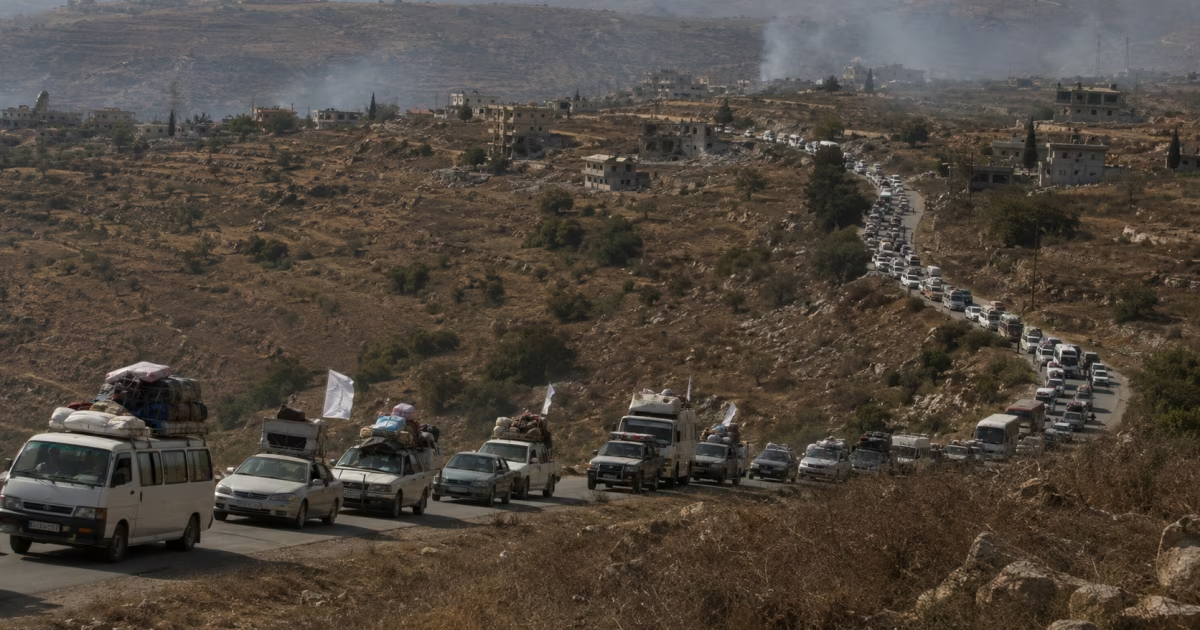







Every year on August 11th, Lebanese memory recalls the tragedy of the Marjayoun convoy massacre, which occurred during the 2006 summer aggression, when Israeli occupation aircraft targeted thousands of civilians fleeing the inferno of shelling. The convoy, comprising about a thousand vehicles, had set off based on prior coordination and security guarantees provided by the international emergency forces 'UNIFIL', but the occupation reneged on its promises as usual.
The tragedy began when occupation tanks seized the joint security force barracks in Marjayoun a few days before the end of the war, prompting Lebanese forces to decide to withdraw. Hundreds of displaced families from Marjayoun and Arqoub villages joined the military convoy, seeking a safe passage towards the Western Bekaa, away from the raging front lines.
Field reports indicate that the convoy was delayed in setting off due to roads being damaged by previous raids, which necessitated the intervention of 'UNIFIL' bulldozers to clear the paths. The arduous journey began under the surveillance of Israeli reconnaissance aircraft that never left the skies, despite international assurances that the agreed-upon route was immune from military targeting.
Upon the convoy's arrival at the outskirts of Jub Jannin town in the Western Bekaa around 10 PM, warplanes suddenly attacked the displaced civilians with a series of concentrated missiles. The raids targeted the front, middle, and rear of the convoy simultaneously, leading to a state of extreme panic among thousands of civilians who were riding buses and civilian cars flying white flags.
This treacherous aggression resulted in the martyrdom of seven people, including a paramedic, and the injury of dozens with varying degrees of severity, with estimates ranging between 36 and 65 wounded. The road, which was supposed to be a passage to safety, turned into a scene of death and destruction, with many vehicles burned and the belongings of the displaced scattered across the area.
In an attempt to evade legal and moral responsibility, the occupation army quickly presented conflicting narratives about the reasons for the targeting. Hebrew sources at the time claimed that forces suspected the transport of weapons for Hezbollah inside the trucks, and also alleged that 'UNIFIL' had not obtained final permission for the movement of such a large number of vehicles.
'UNIFIL' forces firmly responded to these claims, with its commander at the time, General Alain Pellegrini, confirming that the Israeli side had explicitly given the green light for the operation. International sources clarified that the coordination included specifying the route and timing of the movement, making the Israeli targeting a deliberate violation of field understandings and the rules of international humanitarian law.
For its part, 'Human Rights Watch' refuted the Israeli narrative in a detailed report, describing the occupation's justifications as unbelievable and contradicting tangible facts. The organization stressed that the convoy was clearly visible to aircraft, and its size and the civilian nature of the vehicles within it warranted refraining from shelling under the laws of war.
This massacre is part of a broader context of the 2006 aggression, which lasted 34 days and left massive destruction in Lebanese infrastructure, including bridges, power stations, and airports. The economic cost of that war amounted to about seven billion dollars, under the scorched-earth policy adopted by the occupation to pressure the popular base of the resistance.
Historical sources confirm that the 'True Promise' operation carried out by Hezbollah in July 2006 aimed to liberate prisoners, but the Israeli response exceeded all military limits, directly targeting civilians. The Marjayoun massacre is a stark example of the policy of targeting displaced persons that was repeated in other locations such as Marwahin and Qana during the same war.
Living memory of this massacre still demands justice and truth, as survivors and the families of the martyrs insist on prosecuting those responsible for issuing the bombing orders. The issue is not just a historical event, but part of a long record of violations for which the occupation has not been held internationally accountable to this day.
Subsequent investigations proved that the convoy did not contain any military targets, and that all those on board were civilians and security personnel with light weapons, which were disarmed before departure. This reality places the international community before its responsibilities to protect civilians in armed conflicts, especially in light of the repetition of the same criminal patterns.
In conclusion, the Marjayoun convoy massacre remains a testament to the treachery of the occupation, which does not respect international conventions or the guarantees it provides through intermediaries. The stories of the survivors who witnessed the night of terror in the Western Bekaa continue to narrate chapters of Lebanese steadfastness in the face of a war machine that did not differentiate between a child, a paramedic, and a soldier.
Documenting these crimes aims to prevent the obliteration of the Palestinian and Lebanese narrative in the face of Israeli propaganda that always tries to distort facts. Massacres do not expire, and the right of victims to justice remains as long as collective memory preserves the details of that bloody night in August 2006.
Knowing that a large civilian convoy was heading north, and observing the white flags, should have been enough for the Israeli army not to carry out this raid.
שתף את דעתך
Marjayoun Convoy Massacre 2006: When the Occupation Betrayed Displaced Civilians Under UNIFIL's White Flags