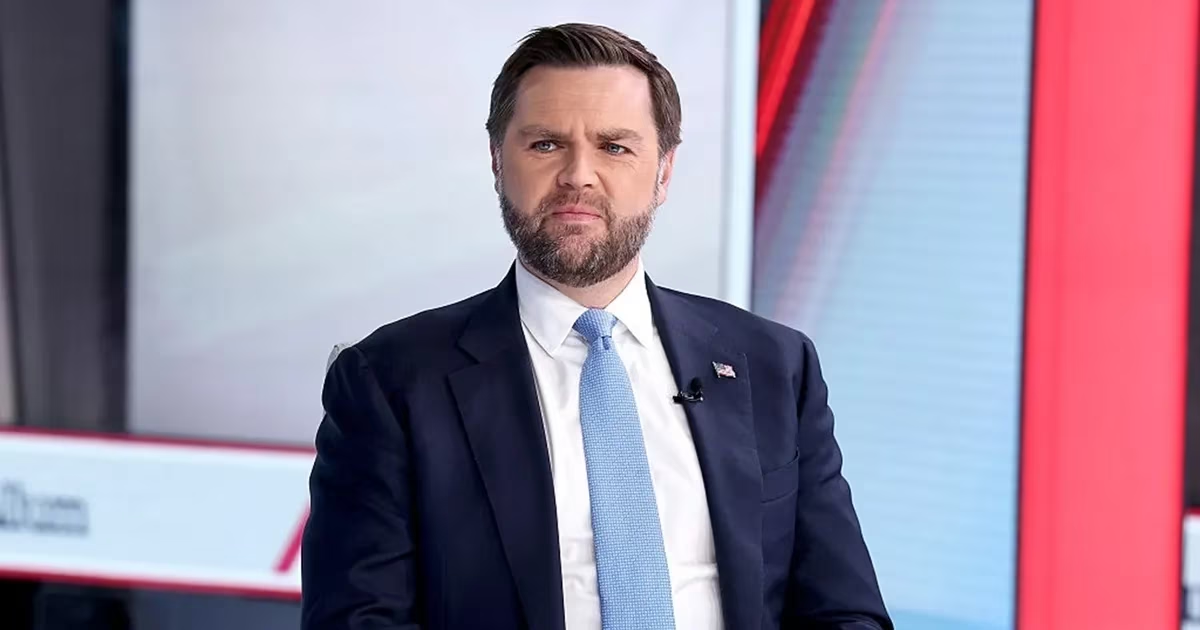







US Vice President JD Vance made important statements, revealing that the recently signed memorandum of understanding between the United States and Iran is merely a 'general framework' for basic principles. Vance clarified that this document is not the final version of the agreement, but rather a prelude to in-depth technical negotiations that will take place at later stages to complete outstanding details.
In a press interview with American media, Vance described the memorandum as very brief, not exceeding one and a half pages, outlining the general lines for the exchange of commitments between the two parties. He indicated that the main goal of this move is to build common ground that ensures the achievement of Washington's and Tehran's interests alike in thorny issues.
The Vice President touched upon the content of 'Paragraph One' of the memorandum, emphasizing that it obliges the Iranian side to the principles of peace and stability in the Middle East region. This commitment, according to the American vision, includes stopping financial and logistical support for groups classified by the United States as terrorist organizations operating in the region.
Vance stressed that the essence of the understanding is based on the necessity of ending what he described as 'destabilizing activities' attributed to Tehran, in exchange for mutual benefits guaranteed by the American administration. He considered that maintaining regional security is the primary driver of these understandings that the Trump administration seeks to establish as a new political reality.
In an economic surprise, Vance revealed the possibility of Iran obtaining massive reconstruction funding, potentially reaching $300 billion, with contributions from some Gulf countries. He clarified that this financial support is conditional on Tehran's full commitment to the terms of the agreement and tangible progress in the ongoing negotiation process between the two capitals.
Regarding the skeptical Israeli position, Vance expressed confidence that Tel Aviv will ultimately accept the agreement despite current differences in viewpoints. He acknowledged the existence of disagreements with Benjamin Netanyahu's government over ways to end regional conflicts, but stressed that common interests will ultimately prevail.
The Vice President affirmed that the US administration sees this proposed agreement as an effective means to enhance Israel's long-term security, not the opposite. He expected the Israeli government to support the diplomatic path as implementation stages progress and tangible results emerge on the ground regarding direct threats.
For his part, Israeli Prime Minister Benjamin Netanyahu commented on these developments by indicating that his country and President Donald Trump do not always agree. This statement reflects the extent of the gap in assessing the situation regarding the nuclear file and Iranian influence, despite the close alliance between the two parties.
On the technical front, Vance explained that the agreement will reopen the door for the return of International Atomic Energy Agency inspectors to Iranian facilities. Washington considers international oversight to be the primary guarantee for ensuring the peaceful nature of the nuclear program and adherence to enrichment restrictions.
The memorandum also includes clear provisions for dealing with Iran's current stockpile of highly enriched uranium, which previous reports estimated to be around 12 tons. The mechanism for disposing of or reducing this stockpile will be through trilateral coordination involving the IAEA, Tehran, and Washington to ensure transparency.
Regarding the timeline, Vance announced that next Friday will see a crucial meeting to officially sign the agreement, followed by the immediate commencement of technical negotiations. These negotiations will focus on setting precise timelines for the gradual implementation of the provisions to ensure testing the intentions of all concerned parties.
These developments come in the context of a comparison with the 2015 agreement, as the current agreement seeks to impose stricter restrictions on international navigation. Sources indicate that the Trump 2026 agreement includes immediately opening the Strait of Hormuz to global trade without any restrictions or military threats.
The current understandings also include an immediate cessation of military operations on all fronts, including the Lebanese arena, with a 60-day truce. This truce aims to provide a suitable environment for negotiating more complex issues, such as ballistic missiles and the timeframes for suspending enrichment.
In a confidence-building step, the United States is expected to release approximately $25 billion of frozen Iranian assets as part of the comprehensive deal. The Trump administration claims that this path is the only way to prevent Iran from acquiring a nuclear weapon and protect the region from scenarios of comprehensive escalation.
The memorandum is a general document that outlines an agreement based on the exchange of commitments and benefits between Washington and Tehran to enhance stability.
שתף את דעתך
Vance reveals features of the 'framework agreement' with Iran: Gulf funding and return of international inspectors