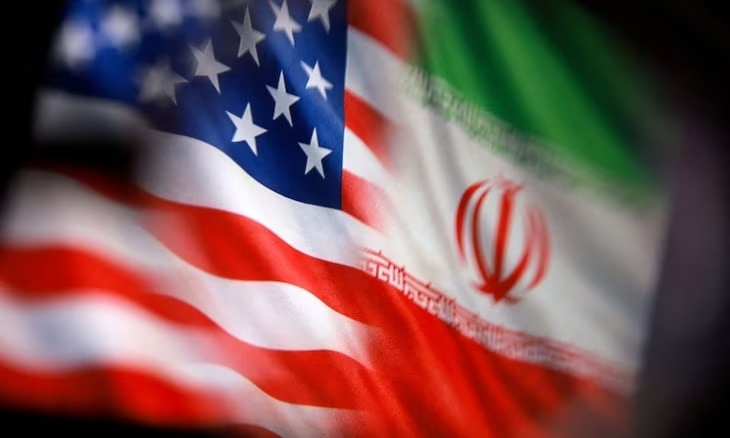







International political circles are awaiting the official signing of the Memorandum of Understanding between Iran and the United States on June 19, an agreement aimed at ending four months of military escalation that has affected the entire Middle East region. Iranian Foreign Minister Abbas Araqchi confirmed that the full details will not be officially announced until after the signing ceremony, noting that this agreement paves the way for a new phase of supplementary negotiations.
Leaked information indicates that the agreement consists of 14 basic articles, prioritizing the immediate and permanent cessation of all hostilities on all fronts, including the Lebanese arena. This article aims to ensure regional stability, allowing both parties to engage in complex technical and political negotiations on long-standing issues.
Regarding the economic aspect, the draft included provisions for lifting the naval blockade imposed by Washington on Iranian ports since mid-April, in addition to the withdrawal of American forces from areas surrounding Iran. The memorandum also notes the suspension of sanctions imposed on oil and petrochemical exports, providing a vital lifeline for the Iranian economy.
The issue of frozen funds is one of Tehran's most prominent gains in this agreement, as media sources revealed a move to release approximately $24 billion during the final negotiation period, which will extend for sixty days. Iran is expected to receive half of this amount as a gesture of goodwill before the actual start of the scheduled negotiation rounds on the nuclear program.
Regarding the Strait of Hormuz, there was a divergence in statements between Washington and Tehran; while US President Donald Trump announced that the strait would be open without fees, Iranian sources confirmed that reopening would occur within a month according to special sovereign arrangements. The sources clarified that Tehran added a clause guaranteeing its right to impose maritime service fees in cooperation with the Sultanate of Oman.
The Iranian Foreign Minister stressed that his country has made a decisive decision that the management of the strategic waterway will not return to its former state, considering it a strategic deterrent. Araqchi pointed out that imposing transit fees might conflict with international law, but service fees are a sovereign right that will be exercised to ensure the security and safety of navigation under Iranian supervision.
Following the signing, intensive negotiations are scheduled to begin for 60 days, focusing primarily on Iran's nuclear program and uranium enrichment levels. These sessions will discuss the fate of Iran's stockpile of highly enriched uranium and the international mechanisms that ensure the nuclear program does not shift towards military purposes in the future.
In press statements, the US President hinted that negotiations might lead to a suspension of uranium enrichment in Iran for a period ranging from 15 to 20 years. Trump affirmed that the primary goal is to ensure that Iran's enrichment capabilities do not exceed internationally permissible peaceful levels, which represents the core of Western concern regarding Tehran's nuclear activities.
For his part, Iranian Deputy Foreign Minister Kazem Gharibabadi clarified that the negotiations will not be limited to the nuclear aspect but will also include post-war reconstruction and economic development files. Through these discussions, Tehran seeks to establish an international mechanism that ensures all parties adhere to the terms of the agreement and prevents Washington from reneging on it in the future, as happened in previous experiences.
Despite the comprehensiveness of the agreement, sensitive issues remain outside the scope of the initial understanding, most notably Iran's ballistic missile program. Media reports indicated that Tehran succeeded in excluding the missile file and its support for its allies in the region from the agenda of the current negotiations, which may raise widespread reservations among other regional parties.
Observers believe that the exclusion of the 'Axis of Resistance' and the missile program from the memorandum represents a diplomatic victory for Iran, which insists that these files are related to national security and are not open to negotiation. In contrast, the current US administration focuses on neutralizing the nuclear threat as a top priority to ensure that the region does not slide into an uncontrolled nuclear arms race.
Sources indicate that the coming days will witness intensive diplomatic movements to finalize the drafting of the technical provisions before the June 19 deadline. Both parties aim, through this secrecy surrounding the details, to avoid internal political pressures and opposition that may emerge from hardline factions in both countries.
The success of this memorandum in transforming into a permanent agreement largely depends on the extent of Washington's commitment to actually and tangibly lifting financial and banking restrictions on Tehran. Iran links any progress in the nuclear file to its ability to access its frozen funds abroad and restore its natural share in the global oil market without obstacles.
In conclusion, this anticipated agreement represents a fundamental turning point in the course of Iranian-American relations, and if successful, it could lead to the formulation of a new security system in the region. However, challenges remain regarding how to reconcile Israeli security demands with the terms of the agreement, which seem to have granted Tehran wide leeway in its defensive and regional files.
The management of the Strait of Hormuz will not return to what it was, and the passage will remain a deterrent tool in the hands of the Islamic Republic.
שתף את דעתך
Details of the Iranian-American Memorandum of Understanding: A Roadmap to End the War and Lift Sanctions