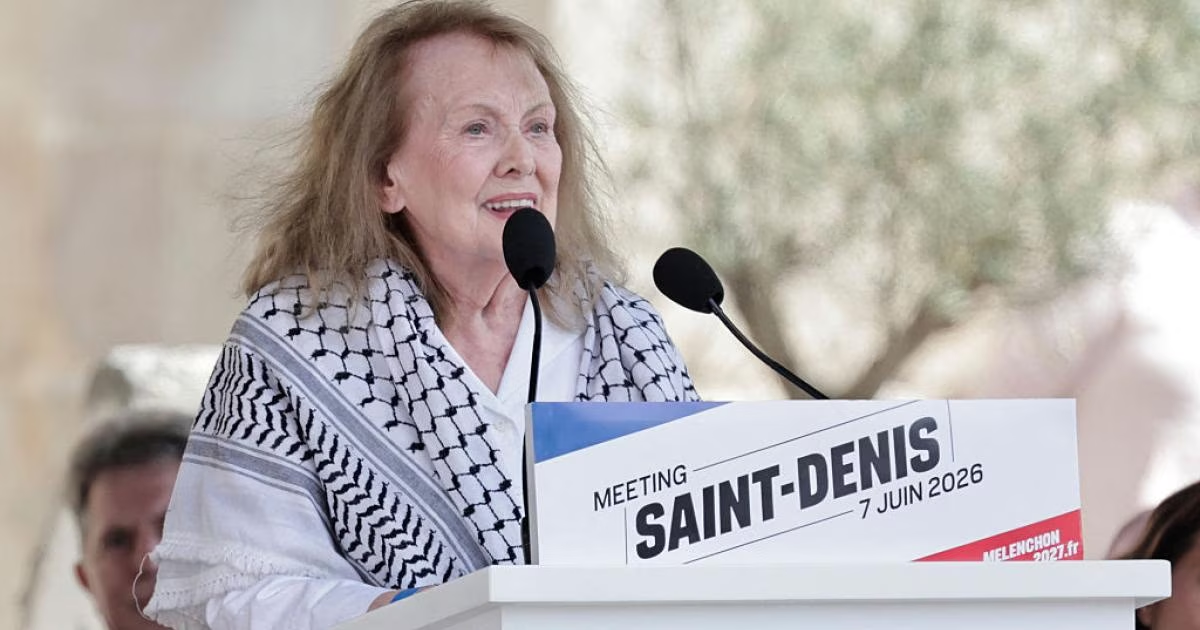







Annie Ernaux, the first French woman to be awarded the Nobel Prize in Literature, was not merely a novelist recounting her childhood memories in Normandy; she transformed into a global cultural icon linking literature with steadfast political commitment. Ernaux recently appeared at an electoral rally for Jean-Luc Mélenchon, candidate for the 'La France Insoumise' movement, wearing a Palestinian keffiyeh, a clear visual message affirming her full alignment with Palestinian rights in the face of occupation.
This appearance with the keffiyeh was not a fleeting moment, but an extension of a long struggle Ernaux has waged against Israeli apartheid policies. Over the past decade, the French novelist has intensified her involvement in issues related to the Middle East, considering that the silence of intellectuals in the face of crimes committed in Gaza constitutes an unacceptable complicity.
Ernaux's political awareness stems from her upbringing in a small town in Normandy, where she experienced stories of war, occupation, and bombing that resonated in her family home. This background made her realize early on the meaning of oppression and injustice, which was later reflected in her anti-Israel stance, placing her at the forefront of Western intellectuals condemning the occupation's crimes in the Gaza Strip.
In 2018, Ernaux was among the most prominent signatories of a statement against the 'French-Israeli Cultural Season,' accusing Tel Aviv of using art to whitewash its image and crimes. She then believed that there was a moral duty for people of conscience to reject any form of cultural normalization with a state that practices systematic oppression against an unarmed people.
Her efforts did not stop there; in 2019, she led a widespread call to boycott the 'Eurovision' contest hosted by Tel Aviv, urging the French delegation to withdraw. She considered that participation in such events grants symbolic cover for the occupation to continue its settlement and aggressive policies in Jerusalem and the occupied territories.
With the escalation of Israeli aggression in 2021, Ernaux joined nearly 1,500 cultural figures in demanding the immediate dismantling of the Israeli 'apartheid' system. The message she signed emphasized the necessity of ending attacks against Palestinians and ending the occupation that disregards all international laws and conventions.
In early 2024, Ernaux continued her pressure by calling for a boycott of German cultural institutions that restricted freedom of expression in solidarity with Palestine. The French writer protested against the gagging policies practiced by some European countries against anyone who criticizes the genocide in the Gaza Strip.
In November 2024, Ernaux also topped a list of over six thousand international writers and publishers who called for a boycott of complicit Israeli cultural institutions. The signatories affirmed their commitment not to cooperate with publishing houses and festivals that justify the occupation or contribute to whitewashing the ongoing genocide.
Her support was not limited to statements but extended to defending international human rights figures, as she announced her support for UN Special Rapporteur Francesca Albanese in February 2025. Ernaux stood against French and German pressures that demanded Albanese's dismissal due to her bold reports describing what is happening in Gaza as genocide.
In a related context, Ernaux fiercely defended political prisoners, including the Lebanese activist Georges Abdallah, whom she described as a victim of the French state's judiciary. She considered that his continued imprisonment for many years brought shame to France, which later culminated in his release in July 2025 after widespread human rights pressure.
Literarily, Ernaux began her career in 1974 with the novel 'Cleaned Out,' and since then, she has been delving into the memory of class, body, and social transformations. Her works, such as the novels 'A Man's Place' and 'Shame,' are considered precise dissections of French society and its contradictions, which made her deservedly win the Nobel Prize, as certified by the Swedish Academy.
The Swedish Academy described Ernaux's writings as possessing 'courage and incisive acuity' in uncovering the collective constraints of personal memory, which explains her ability to connect the private and the public. She does not write only about herself, but about the 'forgotten' and marginalized classes who find in her words a voice that expresses their pains and aspirations.
French President Emmanuel Macron described her as 'the voice of the freedom of women and the forgotten of the century,' despite the radical difference in her political positions from his government's orientations. This paradox reflects the power of Ernaux's influence, who managed to command literary respect even from her political opponents in the French and international arenas.
Annie Ernaux remains a model of the organic intellectual who is inseparable from the issues of her time, seeing the Nobel Prize as a 'great responsibility' to continue bearing witness to justice. Through her Palestinian keffiyeh and her free pen, she affirms that true literature is that which sides with humanity in the face of instruments of oppression and destruction.
I dedicate the Nobel Prize to all who suffer, to all who struggle, and to those who are not recognized.
שתף את דעתך
Annie Ernaux.. Nobel Laureate in Literature in the Trenches of Defending Palestine, with the Keffiyeh as a Witness