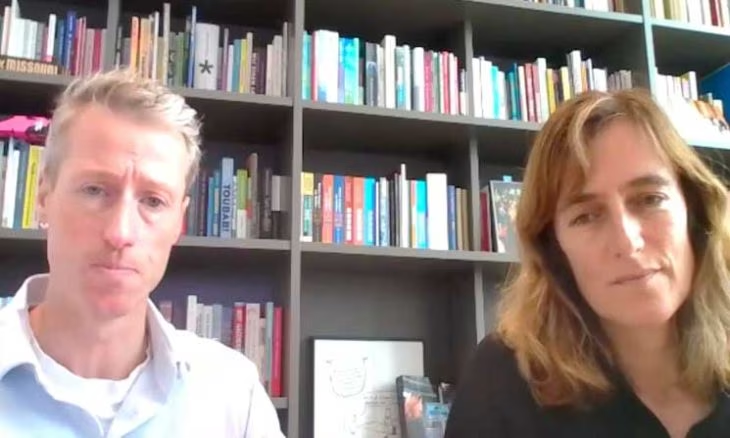







Dutch journalists Maud Effting and Willem Feenstra, working for 'De Volkskrant' newspaper, won the 'Distinguished Journalism Award' within the prestigious European Press Prizes. This recognition came in appreciation of their in-depth investigative report titled 'What the Wounds Tell,' which exposed grave violations committed by the Israeli occupation army against children in the Gaza Strip during the ongoing genocide war.
The journalists called on the international community and human rights organizations to pay greater attention to the data and testimonies they collected during the investigation. They affirmed that the work revealed recurring patterns of fatal injuries among children, necessitating legal prosecution and international pressure to stop these crimes, which are documented by medical personnel returning from the field.
Journalist Maud Effting explained that the idea for the investigation stemmed from the practical impossibility for international journalists to enter the Gaza Strip due to strict Israeli restrictions. This media blockade prompted the team to search for alternative sources who had experienced the events, and international doctors became the 'last witnesses' who were able to see the atrocities firsthand and convey them to the world.
The investigation's methodology focused on a pivotal question posed to doctors who worked in the Strip's hospitals: the number of children under the age of fifteen they had seen with single, direct gunshot wounds to the head or chest. This type of injury leaves no doubt that it resulted from deliberate sniping operations and not merely random shrapnel or collateral fire.
Effting pointed out that the multiple testimonies collected confirmed that the nature of the wounds and entry points left by bullets in the children's bodies clearly indicated precisely directed gunfire. She stressed that these scientific and medical findings deserve in-depth study by global public opinion as they are conclusive evidence of targeting the most vulnerable civilians.
For his part, journalist Willem Feenstra stated that doctors returning from Gaza did not consider their mission over with the end of their medical shifts; rather, they felt a moral responsibility to convey the truth. He explained that many of these doctors became eyewitnesses documenting extraordinary events and war crimes that require precise documentation to ensure that perpetrators do not escape punishment.
The investigation team did not limit itself to the oral accounts of doctors but subjected every testimony to a rigorous verification process that included reviewing supporting medical documents. The journalists asked sources to provide them with photographs, videos, laboratory test results, X-rays, in addition to clinical records and daily notes they had made during their work.
To ensure the highest standards of professional accuracy, the team enlisted independent forensic medical experts from the Netherlands and Belgium to analyze images and medical data. Specialists in military affairs were also consulted to understand the implications of projectiles and recurring patterns of injuries, which confirmed the hypothesis of direct targeting of children in fatal areas of the body.
Feenstra affirmed that the team was aware of the sensitivity of the issue and the political pressures that might result from its publication, especially given the global polarization regarding the war on Gaza. Nevertheless, the Dutch newspaper committed to supporting the journalists and protecting their independence, emphasizing the role of investigative journalism in uncovering facts, no matter how painful or controversial.
The newspaper and publishers faced criticism and pressure from pro-occupation parties, but the editorial board firmly stood behind the investigation due to the strength of the evidence presented. Feenstra considered that the existence of a courageous media institution is the fundamental pillar that allows journalists to tackle complex issues affecting human rights in conflict zones.
This investigation's importance comes at a time when statistics indicate the martyrdom and injury of tens of thousands of Palestinians, with massive destruction affecting health and civilian infrastructure. International medical testimonies emerge as a tool to break the information blockade imposed by the occupation by preventing foreign journalistic teams from accessing the heart of the events.
The journalists considered that the European award is not just a personal tribute but an acknowledgment of the importance of the Palestinian cause and the necessity of keeping violations in the spotlight. They affirmed that the difficult conditions in Gaza increase the responsibility of the press to search for reliable sources and scientifically verifiable testimonies to counter narratives of misinformation.
Feenstra concluded his statements by emphasizing that journalism remains the primary tool for holding those in power accountable and exposing crimes against humanity in democratic societies. He noted that the world is witnessing major crises that require in-depth professional coverage that goes beyond breaking news to reach the roots of facts and systematic violations.
The investigation 'What the Wounds Tell' represents a model of journalistic work that integrates science and field testimony to expose the practices of the occupation. This work remains a historical and legal document added to the record of evidence condemning the ongoing genocide in the Gaza Strip, placing the international community before its moral and legal responsibilities.
The pivotal question was to determine the number of children under 15 years old who sustained single gunshot wounds to the head or chest, injuries that clearly indicate directed fire.
שתף את דעתך
Dutch investigation wins European award after documenting occupation's sniping of Gaza children